
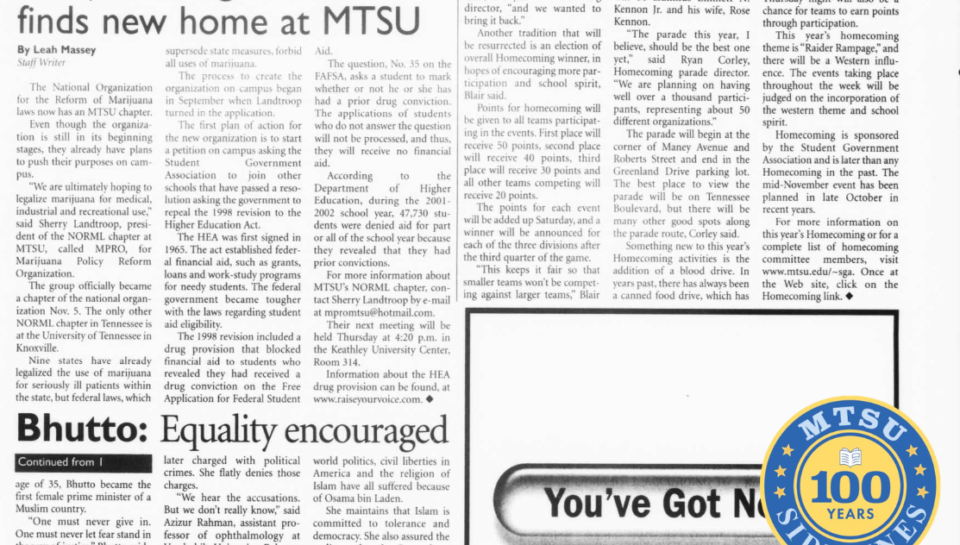
You’re reading a story from Sidelines 100, a project showcasing a century of student storytelling at Middle Tennessee State University. Sidelines 100 plans to highlight 100 stories from the newspaper archives this fall and spring.
This story originally ran in the Nov. 11, 2002, edition of Sidelines. Subscribe to our newsletter to stay on top of all things Sidelines 100.
The story has been updated for current basic AP style, but the wording in the story has not changed. Any ideas, perspectives or opinions do not necessarily reflect those of Sidelines.
The National Organization for the Reform of Marijuana laws now has an MTSU chapter.
Even though the organization is still in its beginning stages, they already have plans to push their purposes on campus.
“We are ultimately hoping to legalize marijuana for medical, industrial and recreational use,” said Sherry Landtroop, president of the NORML chapter at MTSU, called MPRO, for Marijuana Policy Reform Organization.
The group officially became a chapter of the national organization Nov. 5. The only other NORML chapter in Tennessee is at the University of Tennessee in Knoxville.
Nine states have already legalized the use of marijuana for seriously ill patients within the state, but federal laws, which supersede state measures, forbid all uses of marijuana.
The process to create the organization on campus began in September when Landtroop turned in the application.
The first plan of action for the new organization is to start a petition on campus asking the Student Government Association to join other schools that have passed a resolution asking the government to repeal the 1998 revision to the Higher Education Act.
The HEA was first signed in 1965. The act established federal financial aid, such as grants, loans and work-study programs for needy students. The federal government became tougher with the laws regarding student aid eligibility.
The 1998 revision included a drug provision that blocked financial aid to students who revealed they had received a drug conviction on the Free Application for Federal Student Aid.
The question, No. 35 on the FAFSA, asks a student to mark whether or not he or she has had a prior drug conviction. The applications of students who do not answer the question will not be processed, and thus, they will receive no financial aid.
According to the Department of Higher Education, during 2001 – 2002 school year, 47,730 students were denied aid for part of or all the school year because they revealed that they had prior convictions.
For more information about MTSU’s NORML chapter, contact Sherry Landtroop by e-mail at [email protected].
Their next meeting will be held Thursday at 4:20 p.m. in the Keathley University Center, Room 314.
Information about the HEA drug provision can be found at www.raiseyourvoice.com.
To contact the Sidelines 100 editor, email sidelines100@mtsusidelines.com.
For more news, visit www.mtsusidelines.com, and follow us on Facebook at MTSU Sidelines and on X and Instagram at @mtsusidelines. Also, sign up for our weekly newsletter here.
The Student News Site of Middle Tennessee State University
Your email address will not be published.