Nearly five years after the Alabama Legislature approved a medical cannabis program in the state, the weeks-long process of producing and testing products for patients has begun, setting up an early May availability for patients.
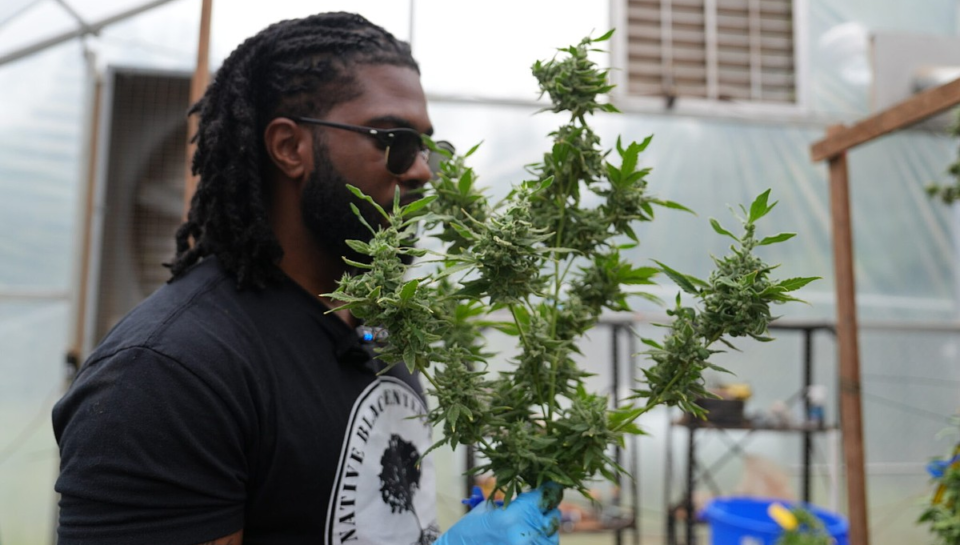
Antoine Mordican, CEO of Native Black Cultivation, said in a phone interview Tuesday that he sent the first biomass, or cannabis flour, to Homestead Health, a processor, on April 10. Mordican grows and harvests medical marijuana on his farm in Bessemer.
“Alabama doesn’t allow anything smokable, so no flower, no vape. If you have to add heat to it, the state of Alabama don’t allow it,” Mordican said.
Once the state’s medical cannabis program is fully operational with all its dispensaries open, Mordican said he will distribute biomass to all processors who are granted licenses by the Alabama Medical Cannabis Commission. The processors take the biomass and extract the THC oil, then produce the approved products with the oil.
Products are restricted to tablets, tinctures, patches, oils and gummies (only peach flavor), with raw plant material and smokable forms remaining prohibited.
Tyler Robinson, owner and CEO of Homestead Health, previously Jasper Development Group Inc., said in a phone interview Tuesday that the product production and testing process takes about two to three weeks before products are delivered to dispensaries.
“Once it comes back as a pass, we will start making it into a final product formulation,” Robinson said. “Once it’s in the final product formulation, we’ll send it back to testing.”
It takes that long, he said, because the product is tested several times during the process.
“It might take a little longer than what people might expect, but you want to make sure that you’re going to market with a quality product that passes all the necessary requirements,” he said.
Robinson said he is aiming to have products delivered to dispensaries by May 4, but a more likely goal is May 11.
“From the conversations we’ve had, we still believe early May. But we don’t know the timelines for how long once it goes from a cultivator to a processor, how much time that’s gonna take,” said John McMillan, executive director of the commission, in a phone interview Tuesday. “We don’t control that.”
Vince Schilleci, owner of dispensary Callie’s Apothecary, which plans to open a location in Montgomery, said in a phone interview that Callie’s will open in mid-May.
“We’re happy that we can put the patients first at this point. We’re almost there,” he said.
Justin Aday, general counsel for the commission, said in a March interview that biomass is tested before it is delivered to the processor, multiple times at the processor, and one final time before it is delivered to a dispensary.
“From the seed to the sale is tracked in our seed-to-sell tracking system,” Aday said in March. “If you have a product that you purchased off of the shelf at a dispensary, we can tell you where that product came from and all the stops related to it along the way.”
Litigation has held up access to medical cannabis. Some firms sued the commission for not being awarded a license, citing a discriminatory process. Another case involved five parents who sued the commission over delays in access to cannabis. The lawsuit was dismissed in August.
Robinson said that the litigation has hurt patients more than anybody, even though cultivators and processors like him have been working since they were awarded licenses.
“When litigation arises, the payroll and the bills don’t stop coming,” he said. “Ultimately, it’s the patients that have hurt the worst in all of this. It’s just unfortunate because we’re doing all we can on our end.”
Robinson encouraged patients to educate themselves on what conditions qualify for cannabis treatment and how to get it.
Physicians will not prescribe medical cannabis. Instead, they will recommend a product they believe will work for a patient with a qualifying condition — including cancer, depression, Parkinson’s Disease, post-traumatic stress disorder, sickle-cell anemia, chronic pain and terminal diseases. Each qualifying patient will have to register with the commission to get a recommendation from a physician and to receive a cannabis product from a dispensary.
As of Tuesday, there were 43 physicians certified to recommend medical cannabis to patients in Alabama, according to the Alabama Board of Medical Examiners.
“What this means for Alabama is patients will be getting the much-needed medicine they need. We’ve had the program now for five years, there’s been a crazy delay and we’re just now getting to this point. We’ve been caught up in litigation, lawsuits, things like that,” Mordican said. “But now that we have everything we need, we can start to service the people of Alabama.”
Read more at AlabamaReflector.com.
Copyright © 2026, Chattanooga Times Free Press, Inc.
All rights reserved.
This document may not be reprinted without the express written permission of Chattanooga Times Free Press, Inc.
Material from the Associated Press is Copyright © 2026, Associated Press and may not be published, broadcast, rewritten, or redistributed. Associated Press text, photo, graphic, audio and/or video material shall not be published, broadcast, rewritten for broadcast or publication or redistributed directly or indirectly in any medium. Neither these AP materials nor any portion thereof may be stored in a computer except for personal and noncommercial use. The AP will not be held liable for any delays, inaccuracies, errors or omissions therefrom or in the transmission or delivery of all or any part thereof or for any damages arising from any of the foregoing. All rights reserved.