
NATIONAL NEWS
Apr 24, 2026, 1:05 PM
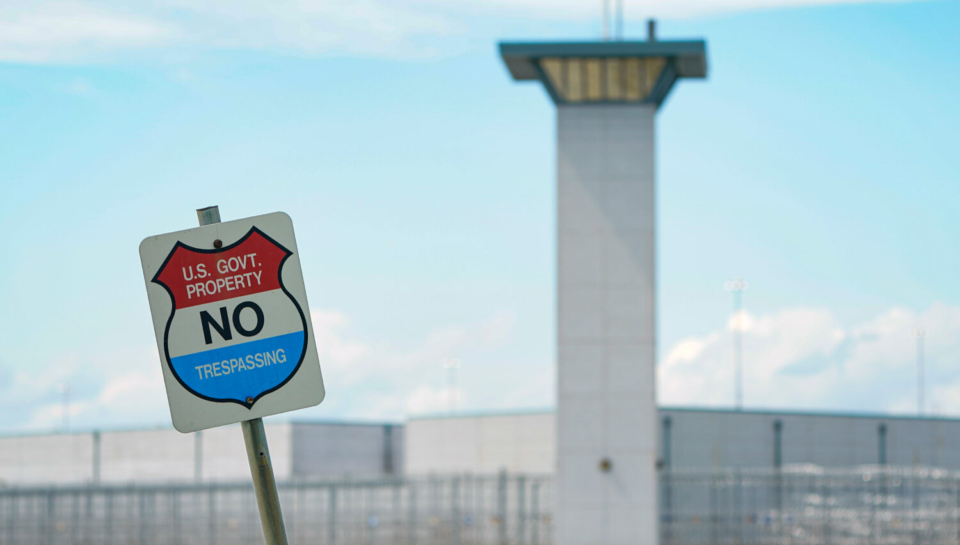
FILE – A no trespassing sign is displayed outside the federal prison complex in Terre Haute, Ind., Friday, Aug. 28, 2020. (AP Photo/Michael Conroy, File)
Credit: ASSOCIATED PRESS
(AP Photo/Michael Conroy, File)
BY
The Trump administration’s historic move to reclassify state-licensed medical marijuana as a less-dangerous drug was cheered by some advocates but for others, it fell far short for the thousands still incarcerated on federal cannabis-related convictions.
The executive order, which acting Attorney General Todd Blanche signed Thursday, does not address current penalties for possessing and selling marijuana or those jailed with yearslong sentences.
“While this is a victory, the fight is far from over,” said Jason Ortiz, director of strategic initiatives for the Last Prisoner Project, a nonprofit focused on cannabis criminal justice reform.
Proponents of legalizing marijuana as well as overhauling prison sentencing say this order, which does not completely decriminalize the drug, benefits only cannabis researchers, growers and others in Big Weed. Meanwhile, thousands — many of whom are people of color — are stuck serving harsh sentences for marijuana-related offenses. Or they have served their time but having a conviction on their record has made life difficult.
Now, advocates are calling on Congress and state lawmakers to take concrete steps to ensure those with marijuana-related convictions receive fair treatment or be forgiven altogether.
Blanche’s order reclassifies state-licensed medical marijuana as a less-dangerous drug. The major policy shift, which both Presidents Barack Obama and Joe Biden had considered, means cannabis won’t be grouped with drugs like heroin.
But it does not legalize marijuana for medical or recreational use. It shifts licensed medical marijuana from Schedule I — reserved for drugs without medical use and with high potential for abuse — to the less strictly regulated Schedule III. This will likely give licensed medical marijuana operators and cannabis researchers a major tax break and less stringent barriers to doing normal business.
Virtually no one imprisoned at the federal level is there solely for marijuana possession. But many are there for large-scale possession, trafficking offenses or both.
Hector Ruben McGurk, 66, has been serving life without the possibility of parole since 2007 for transporting thousands of pounds of marijuana and money laundering. He is currently imprisoned in Beaumont, Texas, over 800 miles (1,290 kilometers) from his son’s El Paso home. His incarceration has been hard on his son, said McGurk’s daughter-in-law, Ferna Anguiano. And the distance makes visits logistically difficult.
So it’s tempting to see this order as a glimmer of hope, given that the family believes McGurk’s punishment far outweighs his crimes. But Anguiano has no idea how to navigate lobbying for his release.
“His release date is death,” Anguiano said. “I mean, we see all this stuff on the news — bigger cases, fatal cases — and people are going in and out of prison and coming out to their families.”
They try to keep in touch through phone calls and a prison texting service. They’re concerned about McGurk’s health and his diabetes management. It would be a dream come true for him to come home.
“He deserves a second chance,” Anguiano said. “Yes, it was a poor decision he did in his lifetime. He was younger. But he is not a bad person. I think it’s fair to say he has served enough time for it.”
It’s not clear whether punishments would be different had marijuana always been scheduled differently, drug policy experts say.
“In addition to schedule-specific penalties, there are marijuana-specific penalties that have nothing to do with the schedule,” said Cat Packer, director of drug markets and legal regulation at the nonprofit Drug Policy Alliance. “Even if marijuana were to be moved to Schedule V, those criminal penalties would still exist and there are mandatory minimums for simple possession.”
Destigmatizing marijuana has long been an issue for both political parties. Obama commuted the sentences of about 1,900 federal prisoners, almost all of whom were incarcerated for nonviolent drug crimes. Biden pardoned 6,500 people convicted of use and simple possession of marijuana on federal lands and in the District of Columbia. President Donald Trump’s administration has taken far fewer drug clemency actions and does not have an overarching policy directing such actions.
“What many people on the right and the left would like is to move marijuana from this ‘just as bad as heroin’ category and to just sort of de-schedule it entirely,” said Marta Nelson, director of sentencing reform at the Vera Institute of Justice. “Regulate it like you do alcohol or tobacco.”
Studies show Black Americans are roughly 3.7 to 4 times more likely to be arrested for marijuana possession than white Americans, despite usage rates being roughly the same across racial groups. Federal-level marijuana cases are pretty small today, but those serving sentences for federal drug offenses are overwhelmingly Hispanic and Black, according to Justice Department and Bureau of Justice Statistics data.
The racial disparity with drug convictions is reminiscent of 2010 legislation Obama signed reducing the gap between mandatory sentences for crack cocaine versus powder cocaine. In 2018, Trump made it apply retroactively.
Because business owners with state medical marijuana licenses are predominantly white, the tax relief created by the rescheduling will also likely give a leg-up to mostly white businesses, Packer said. A lot of equity programs won’t apply.
“This is going to, in my mind, widen the gap, the financial disparities, the business disparities that currently exist between Black and brown, Latino and white owners in the cannabis industry because licenses were not distributed equitably,” Packer said.
In theory, Trump could issue a blanket pardon like he did for Jan. 6 rioters. But Nelson thinks that is highly doubtful.
“Having marijuana convictions on the record for things like mass immigration enforcement is helpful to the administration,” Nelson said.
An impactful next step would be for Congress to outline very comprehensive legislation addressing existing marijuana-related convictions, expungements and industry regulations, she added.
The Last Prisoner Project and other organizations are planning to renew a dialogue with federal lawmakers, including the Congressional Cannabis Caucus, which includes Democratic Rep. Ilhan Omar and Republican Rep. David Joyce. They will also continue to lobby for Trump to conduct a large-scale act of commutation and clemency.
Advocates are also hoping Trump’s order will prompt every state to rethink their marijuana classification and penalties.
“It is imperative that every state review their situation, as a lot of their controlled substances at the state level are tied to the federal government,” Ortiz said. “We’re gonna see other states that are going to need a little help from the public to remind them what the right thing to do is.”
Associated Press
RAMALLAH, West Bank (AP) — The post-Oct. 7 order in the Middle East — such as it is — is barely pieced together by conditional ceasefires and mutual threats. Iran has suffered severe blows, yet not enough to shake its posture at the negotiating table. Its allies Hezbollah in Lebanon and Hamas in Gaza are […]
53 minutes ago
Associated Press
PHILADELPHIA (AP) — Every day, visitors from around the world make their way to the steps of the Philadelphia Museum of Art — not necessarily for the galleries inside, but for a statue of a fictional boxer from South Philadelphia. The bronze figure of Rocky Balboa — arms raised in victory, clad in boxing trunks […]
5 hours ago
Associated Press
NEW YORK (AP) — Stanley Richards knows how bleak life can be at Rikers Island, New York City’s notorious jail complex. As a young man, he spent two years locked up there for robbery. Now, he runs the place as the city’s new Department of Correction commissioner. In January, Mayor Zohran Mamdani tapped Richards to […]
5 hours ago
Associated Press
WASHINGTON (AP) — The U.S. military said it launched another strike Friday on a boat accused of ferrying drugs in the eastern Pacific Ocean, killing two people. The Trump administration’s campaign of blowing up alleged drug-trafficking vessels in Latin American waters has persisted since early September and killed at least 183 people in total. Other […]
6 hours ago
Associated Press
JACKSON, Miss. (AP) — Mississippi Gov. Tate Reeves on Friday announced he will call a special session for judicial redistricting once the U.S. Supreme Court rules on a Voting Rights Act case that has broad implications for minority representation throughout the country. During oral arguments last fall, the Supreme Court appeared poised to strike down […]
9 hours ago
Associated Press
NEW ORLEANS (AP) — Louisiana police say a podcast helped them solve the decades-old killing of a 16-year-old girl and announced Friday that four men now face criminal charges in connection with her rape and murder. In 1982, teenager Roxanne Sharp was killed in the woods of St. Tammany Parish, about 30 miles (48 kilometers) […]
9 hours ago
Three independent organizations that evaluate home service contractors each reached the same conclusion: Home Comfort Alliance is among the most reliable in its market.
Discover Aegis Living’s respite care, offering flexible short stays tailored for seniors and their families. Explore the benefits now.
Chrystal Ortega’s tireless dedication recently earned her the WSECU Community Champions Award and a $1,000 grant to further the mission.
When Shawn Tibbitts opened Tibbitts FernHill, he was just trying to survive. The small Tacoma restaurant has since earned culinary awards and praise.
Wilcox Family Farms is continuing its cherished holiday tradition of giving back by donating nearly one million eggs to food banks across the South Sound region this season.
Matthew Ballantyne has transformed that early awareness into action, embodying the organization’s mission: “No Kid Sleeps On The Floor In Our Town.”