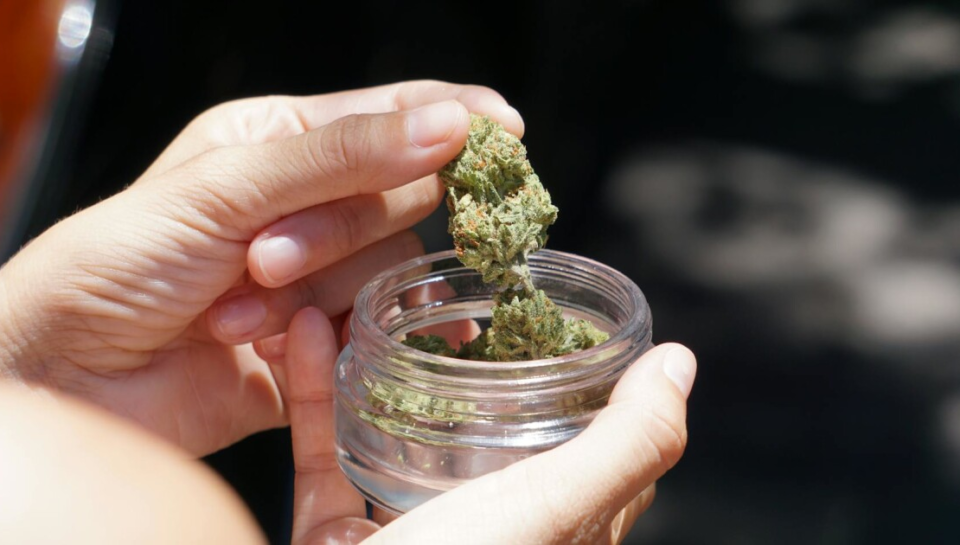
Indiana has some of the most stringent laws on cannabis in the country, but despite that, use among adults has consistently increased over the past decade.
That is according to a new report from the Richard M. Fairbanks Foundation, which partnered with the think tank, the RAND Corporation for the analysis. It examines Indiana’s current landscape and potential policy considerations related to cannabis.
Even though marijuana use is largely illegal in Indiana, Hoosiers likely spend anywhere between $1.2 and $2.6 billion annually on cannabis products, according to the report.
That is mostly due to the fact that all of Indiana’s neighbors have approved some kind of legal cannabis use. Illinois, Michigan and Ohio now allow recreational cannabis sales. Kentucky allows for medical use and sale.
The report estimates that 44% of Hoosiers live within a 50-mile drive of a licensed dispensary and almost all Hoosiers live within a 100-mile drive of a licensed dispensary.
“So that’s one of the kind of big takeaways, is there’s a lot of access here in Indiana, even though we have very restrictive policies,” said Emi Whitesell, vice president of impact and evaluation for the Richard M. Fairbanks Foundation.
Indiana has prevented the sale, production or redistribution of cannabis products as other states have moved to legalize use. A loophole allows certain intoxicating hemp products that include the delta-9 THC to be sold in the state as long as it has 0.3% or less of the psychoactive component.
The most recent attempt to close that loophole and restrict hemp products failed in the Indiana General Assembly.
Whitesell said the report is not intended to give a definitive answer on what kind of policies around cannabis use that Indiana lawmakers should approve, but instead is meant to explain what is Indiana’s landscape around cannabis use and the policy factors shaping it.
Researchers looked into cannabis policy in and around Indiana for around 18 months, which included talking to regulators, lawyers, people in the industry, retailers and advocates, according to researchers on the study.
Another one of the report’s significant findings was that in 2024, there were over 13,000 arrests involving cannabis, with 90% of those being for possession and more than 75% of those arrests involved other non-cannabis charges. That number has remained steady for the past five.
The arrest rates for Black residents were approximately four times higher than the arrest rate for White residents, the report found.
The report estimates that Indiana’s criminal justice system spends between $10 to $20 million per year on these arrests. Whitesell said even if the state legalized cannabis use, not all of those costs would go away.
“It turns out that the cost to set up and regulate a cannabis system could actually outweigh any criminal justice savings that we have as a state,” Whitesell said.
The report estimates that if Indiana were to legalize recreational cannabis sales, it could generate $180 million in annual tax revenue within five years. That amounts to about 1% of Indiana’s $18 billion general fund.
Beau Kilmer, one of the researchers of the report, since Michigan has some of the lowest prices and close to 900 stores selling cannabis products, the policy Indiana ultimately chooses would need to take into account neighboring states.
“They’ve got to be really thoughtful about the number of licenses they’re going to give out, how much production they’re going to allow, because those decisions can really matter in terms of kind of how this plays out, in terms of kind of public health,” Kilmer said.
Some state lawmakers have already stated their support for further legalization of cannabis in recent years.
Gov. Mike Braun told reporters this week that he is willing to do “what makes sense,” noting that all of Indiana’s neighbors have some form of legalization.
Braun said, “I think just like anything, you got to take what’s evolved over time. You stick your head in the sand, you generally are going to make the wrong decision.”
The federal government has also made recent moves to relax marijuana rules when it comes to medical marijuana.
Contact Government Reporter Caroline Beck at cbeck@wfyi.org