
House Passes Farm Bill Including Hemp Provisions, But Without Delaying THC Product Ban Scheduled For This Year
GOP-Led Congressional Committee Votes To Block Marijuana Rescheduling, Defying Trump
Trump Administration May Stop Pursuing Prosecutions Of Marijuana Users For Possessing Guns, Attorney General Says
Senate Committee Takes Up Veterans-Focused Psychedelics Bill, With VA Officials Expressing Concerns
Congressional Committee Wants Feds To Go After Cannabis Product Manufacturers Making Unlawful Health Claims
There’s ‘Strong Public Demand’ For Bigger Marijuana Reform Than Trump’s Rescheduling Move, Federally Funded Study Shows
Chinese Researchers Reveal Ancient Use Of Cannabis As ‘Indispensable’ Crop That Was ‘Deeply Integrated’ Into Daily Life
Teen Marijuana Use Is Lower Now Than Before Legalization, Government Study From Minnesota Officials Shows
Medical Marijuana Helps People Stop Using Opioids, Sleeping Aids And Other Prescription Drugs, Study Shows
Vaporizing Marijuana Reduces Harmful Inhaled Byproducts By 99% Compared To Joint Smoking, New Study Shows
Politicians And Major Brands Celebrate Cannabis Culture On 4/20
Woody Harrelson And Bill Maher Complain That Marijuana Taxes Are Too High While Smoking Joints At The Dispensary They Own Together
WNBA Offers To End Marijuana Testing For Women’s Basketball Players As Part Of Reported Deal With Union
DEA Promotes Anti-Marijuana PSA Contest Inviting Students To Warn Peers About THC Dangers On 4/20
Largest Entertainment Arena In US Partners With Cannabis Businesses To Sell THC Drinks At Concerts And Live Events
Target Expands Involvement In Hemp THC Drinks Market With 72 New Licenses In Minnesota
Marijuana Sales Are Rising And Alcohol Is On The Decline As Consumer Preferences Evolve, Government Data In Canada Shows
Feds Deny Snoop Dogg Request To Trademark ‘Smoke Weed Everyday’ Because Marijuana Is Illegal And Song Lyric Is Too Popular
Marijuana Kiosks For Seniors Are Coming To Independent Living Communities Across Arizona
Montana Retailers Have Sold More Than $1 Billion Worth Of Recreational Marijuana Since Legalization Took Effect
GOP lawmakers still trying to block cannabis rescheduling despite Trump (Newsletter: April 30, 2026)
Hemp amendments stall in Congress, for now (Newsletter: April 29, 2026)
Cannabis businesses can apply for federal protections with DEA this week (Newsletter: April 28, 2026)
Trump pushes Congress for hemp & CBD reforms (Newsletter: April 27, 2026)
Trump talks benefits of medical cannabis after rescheduling announcement (Newsletter: April 24, 2026)
Published
on
By
The U.S. House of Representatives has passed large-scale agriculture legislation that contains provisions aimed at reducing regulatory burdens for producers of industrial hemp. The bill does not, however, include any language to delay or alter the federal recriminalization of hemp THC products that’s scheduled to take effect later this year.
The House voted 224-200 to pass the Farm Bill, formally known as H.R.7567, the Farm, Food, and National Security Act of 2026, on Tuesday.
Bipartisan lawmakers had filed amendments to the bill to regulate hemp THC products and delay the ban, but the sponsors withdrew the proposals for unknown reasons. A separate amendment to speed up recriminalization of the products was also filed, but the House Rules Committee did not allow it to advance to floor consideration.
Hemp derivatives with less than 0.3 percent delta-9 THC on a dry-weight basis were federally legalized under the 2018 Farm Bill that President Donald Trump signed during his first term in office. But late last year, Trump signed new legislation containing provisions that will redefine hemp to make it so only products with 0.4 milligrams of total THC per container will remain legal after November 12.
While the hemp THC regulation and ban delay amendments didn’t make it into the current Farm Bill, it does include several sections that concern cannabis grown by farmers for industrial purposes such as fiber and grain.
For example, the legislation would amend existing statute related to the development of industrial hemp production regulatory plans by states and tribes—including surrounding polices for testing, sampling, background checks and record-keeping.
Here’s a summary of the hemp language in the 2026 Farm Bill from House Agriculture Committee staff:
“Sec. 10005. Hemp production.
Section 10005 amends subtitle G of the Agricultural Marketing Act of 1946.
Subsection (a) amends section 297B to require State and Tribal plans to include a procedure under which a hemp producer shall be required to designate the type of production of the hemp producer; allow State and Tribal plans to include a procedure for the use of visual inspections, performance-based sampling methodologies, certified seed, or a similar procedure when developing sampling plans for industrial hemp; allow State and Tribal plans to include a procedure for eliminating the 10-year period of ineligibility following the date of conviction for producers of industrial hemp with a felony related to a controlled substance; require documentation during inspections that demonstrates a clear intent to produce industrial hemp for producers under a State or Tribal plan that includes procedures for reducing or eliminating sampling or testing requirements for industrial hemp; allow testing if a producer of industrial hemp fails to provide required documentation; require the State or Tribe to report a producer of industrial to the Attorney General and applicable law enforcement officers if that producer violated the State or Tribal plan by producing a crop that is inconsistent with the designation of industrial hemp; and ban any person who knowingly produced a crop that is inconsistent with the designation of industrial hemp from obtaining a hemp license for 5 years.
Subsection (b) amends section 297C to require a Department of Agriculture plan to include a procedure under which a hemp producer shall be required to designate the type of production of the hemp producer; allow a Department of Agriculture plan to include a procedure for the use of visual inspections, performance-based sampling methodologies, certified seed, or a similar procedure when developing sampling plans for industrial hemp; allow a Department of Agriculture plan to include a procedure for eliminating the 10-year period of ineligibility following the date of conviction for producers of industrial hemp with a felony related to a controlled substance; require documentation during inspections that demonstrates a clear intent to produce industrial hemp for producers under a Department of Agriculture plan that includes procedures for reducing or eliminating sampling or testing requirements for industrial hemp; allow testing if a producer of industrial hemp fails to provide required documentation; and requires the Secretary to collect information related to the designation of the type of production of hemp producers and the laboratory certificate of analysis for hemp disposed of.
Subsection (c) amends section 297D to require the Secretary of Agriculture to establish a process by which the Department of Agriculture can issue certificates of accreditation to laboratories for the purposes of testing hemp.”
A committee report says the bill “recognizes the continued Congressional support for the industrial hemp industry, and maintains the bifurcation of industrial hemp from hemp-derived cannabinoid final form products that was put into statute through the Agriculture, Rural Development, Food and Drug Administration, and Related Agencies Appropriations Act, 2026.”
“It is the intention of the Committee that the Department work with States and Tribes to implement language included in this bill in such a way that allows States to best support those producers of industrial hemp products while maintaining State authority in making regulatory decisions that best reflect the needs of their constituents. Additionally, the Committee believes that the Department should prioritize their work in coordinating with the DEA to reduce the bottlenecks that occur due to a lack of appropriately accredited labs, as this issue has been an ongoing challenge for the producers of hemp that could impact the sector moving forward if not addressed.
The statutory framework for hemp laid out in this bill recognizes multiple primary agricultural outputs of the hemp plant, including fiber and grain, each of which involves the on-farm separation of the primary product from the cannabinoid- containing floral material of the plant. Terpenes follow this same production model. Terpenes are non-intoxicating aromatic compounds that originate in the flowering tops of the plant and are separated from cannabinoid-containing vegetative material during primary agricultural processing, in the same manner as grain is separated through threshing and fiber is separated through cutting and retting. Therefore, the Committee recognizes the production of the whole plant, or any lawful part thereof, for the extraction, production, or manufacture of any non-cannabinoid essential oil, aromatic compound, terpene, or other non-cannabinoid volatile organic compound derived from such plant as the production of industrial hemp, such that any cannabinoid components of such plant satisfactorily meet all other components of the definition of ‘hemp’ as defined by Pub. L. 119-37.”
The Senate is expected to consider its own version of the Farm Bill in the coming weeks and months, and hemp industry advocates hope lawmakers in that chamber will take action to avert the scheduled ban on THC products.
Meanwhile, White House officials recently provided feedback on pending legislation to create a regulatory framework for hemp.
Last week, Vince Haley, director of the White House Domestic Policy Council and James Braid, assistant to the president for legislative affairs, sent hemp policy suggestions to Rep. Andy Barr (R-KY), who has been helping to lead efforts to enact regulations for the plant as an alternative to prohibition.
“We appreciate your work to advance the policy of” an executive order Trump signed in December that included provisions seeking to protect Americans’ access to CBD products, the staffers wrote in a letter to the congressman.
“We are transmitting for your consideration draft legislative text and comments to address the statutory definition of final hemp-derived cannabinoid products in order to allow Americans to benefit from access to appropriate full-spectrum CBD products while preserving the Congress’s intent to restrict the sale of products that pose serious health risks,” the White House officials said, according to a social media post containing a screenshot of the letter. “We are available for discussion and further technical assistance.”
The attachment with the administration’s proposed legislative text has not been publicly released, and the White House and Barr’s office did not respond to Marijuana Moment’s request for further details.
It’s not clear from the letter’s text whether the White House was proactively sending legislative proposals to the lawmaker or if they were replying to something his office submitted—though two cannabis industry sources suggested to Marijuana Moment that Barr first sent language to the administration, which then provided technical feedback.
Trump last week pushed congressional lawmakers to take action to amend the currently scheduled hemp ban, which he suggested threatens to federally recriminalize full-spectrum CBD products.
“I am calling on Congress to update the Law to ensure that Americans can continue to access the full-spectrum CBD products they have come to rely on, and that help them, while preserving Congress’s intent to restrict the sale of products that pose Health risks,” the president said in a Truth Social post on Thursday, the same day his administration announced it is moving forward to reschedule marijuana.
“We must get this done RIGHT and FAST, especially for those who saw that CBD helps them,” he said. “Plus, I am told it will also help our GREAT FARMERS, who we love, and will always be there for.”
Rep. Jim Baird (R-IN) had filed a hemp ban delay amendment before the House Agriculture Committee when it took up the Farm Bill last month, but that panel’s chairman determined that the proposal was not germane to the legislation.
A number of other bipartisan hemp reform bills are pending in Congress.
This month, for example, Sens. Rand Paul (R-KY), Amy Klobuchar (D-MN) and Joni Ernst (R-IA) filed the Hemp Safety Enforcement Act, which would effectively let states opt out of the federal recriminalization of hemp THC products that is set to be enacted later this year.
Ernst later withdrew her name as a cosponsor of the legislation, however. Her office did not reply to Marijuana Moment’s request for clarification on the move.
—
Marijuana Moment is tracking hundreds of cannabis, psychedelics and drug policy bills in state legislatures and Congress this year. Patreon supporters pledging at least $25/month get access to our interactive maps, charts and hearing calendar so they don’t miss any developments.
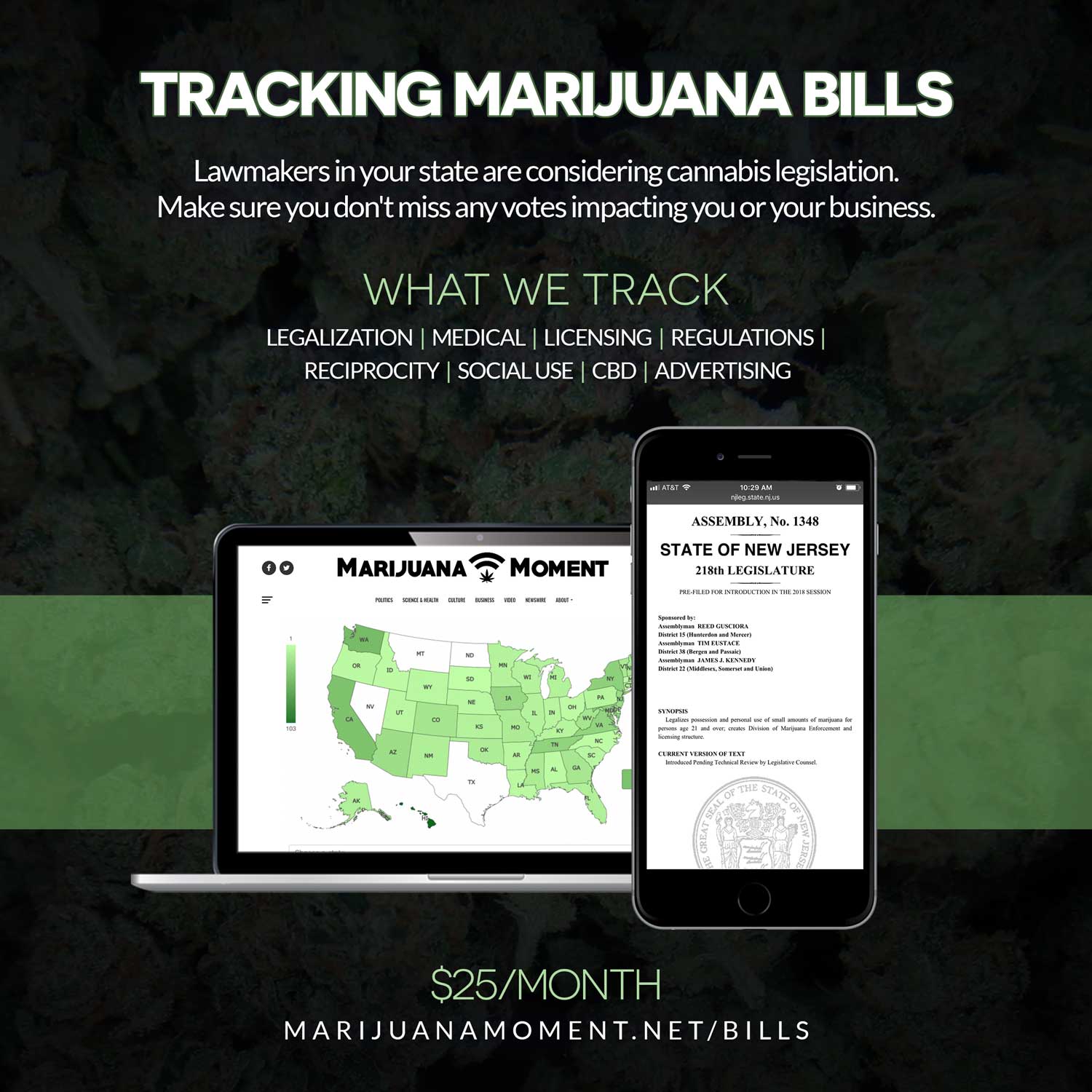
Learn more about our marijuana bill tracker and become a supporter on Patreon to get access.
—
A U.S. Department of Agriculture report published this month shows that farmers in the U.S. grew three-quarters of a billion dollars worth of hemp crops in 2025—a 64 percent increase from the prior year.
Meanwhile, the Trump administration this month launched a new initiative to cover up to $500 worth of hemp-derived products each year for eligible Medicare patients. The program being implemented by the Centers for Medicare & Medicaid Services (CMS) focuses largely on CBD but also allows a certain amount of THC in products.
Anti-marijuana organizations filed a lawsuit suit against the Medicare hemp coverage policy, and lawyers for Health and Human Services Sec. Robert F. Kennedy Jr. and CMS Director Mehmet Oz recently filed a brief asking that the case be dismissed.
Meanwhile, the White House Office of Management and Budget has been holding a series of meetings about a Food and Drug Administration (FDA) CBD products enforcement policy.
FDA also issued guidance making clear that it does not intend to interfere with implementation of the Medicare hemp-derived products coverage plan.
CMS separately finalized a rule that will allow coverage of some hemp products as specialized, non-primarily health-related benefits through Medicare Advantage plans.
As hemp products have become more popular with consumers, some large brands are attempting to get in on action.
Major retailer Target, for example, is expanding its participation in the hemp-derived THC beverage market. Last year, the company began a pilot program involving sales of cannabis drinks at 10 select stores in Minnesota. That apparently went well, and now the company has obtained licenses from Minnesota regulators to sell lower-potency hemp edible products—including THC drinks—at all 72 of its stores in the state.
Tom Angell is the editor of Marijuana Moment. A 25-year veteran in the cannabis and drug law reform movement, he covers the policy, politics, science and culture of marijuana, psychedelics and other substances. He previously reported for Forbes, Marijuana.com and MassRoots, and was given the Hunter S. Thompson Media Award by NORML and has been named Journalist of the Year by Americans for Safe Access. As an activist, Tom founded the nonprofit Marijuana Majority and handled media relations, campaigns and lobbying for Law Enforcement Against Prohibition and Students for Sensible Drug Policy.
Add Marijuana Moment as a preferred source on Google.
All the cannabis news you need, all in one place. Copyright © 2017-2026 Marijuana Moment LLC ® and Tom Angell