
Springfield Daily Citizen
Springfield, MO News
To read this story, please sign in with your email address and password.
You’ve reached your limit of free stories this month. Love our reporting? Subscribers enjoy unlimited access to stories, listening on-the-go, personalized feeds, insider exclusive perks, and easy delivery to all devices.
Skip the limits: Redeem a full year of access for just $1 a week!
*New subscribers only. Other conditions apply.
CLAIM OFFER
Don’t have an account yet? Register here.
by Rebecca Rivas and Julia Garrison, Missouri Independent
When Missouri voters legalized recreational marijuana in 2022, the constitutional amendment they approved carried forward a limit meant to prevent any single company from controlling too much of the market.
But one key phrase from the state’s medical marijuana law was gone.
The constitution’s medical marijuana provision barred the state from issuing more than five dispensary licenses to any entity under “substantially common control, ownership, or management.” The recreational marijuana amendment instead says an entity may not own more than 10% of total dispensary licenses, dropping the language covering common control and management.
That change received little public attention during the campaign. But records obtained by The Independent show it helped create an opening for Good Day Farm, the Little Rock-based marijuana company that was the leading donor to the legalization campaign, to build a much larger footprint in Missouri than the state’s license cap might appear to allow.
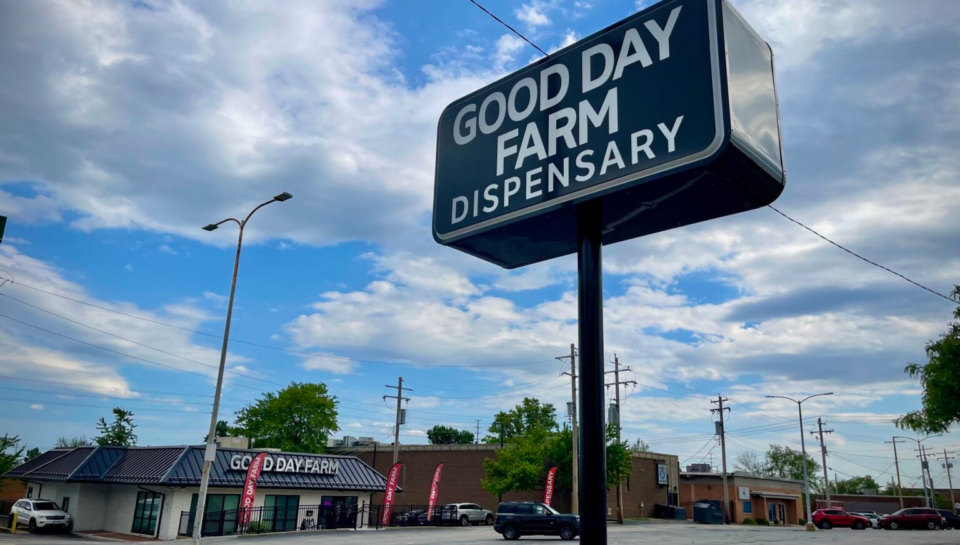
Good Day Farm and affiliated entities are now tied through ownership records, management structures and acquisition agreements to more than 60 of Missouri’s 224 dispensary licenses — more than a quarter of the market. The next-largest marijuana operator in Missouri own 16 dispensaries, according to ownership records obtained through a public records request.
A class-action lawsuit this week led by two Missouri marijuana manufacturing companies now alleges that Good Day Farm and its affiliates used that structure to form an “illegal cartel,” coordinating pricing, product supply and retail operations across dispensaries that do not all operate under the Good Day Farm name.
The petition, filed by Local Cannabis and VIBE, names nearly 50 LLCs and a handful of individuals, alleging they violated the state constitution’s cap on the number of licenses one group can own or manage. It also argues Good Day Farm and its affiliates violated Missouri antitrust laws through price-fixing, supplier-allocation agreements and coordinated conduct meant to consolidate control of the state’s retail marijuana market.
“Ultimately, the GDF Cartel has — through a combination of price-fixing, product- and supplier-allocation agreements, and coordinated exclusionary conduct — unlawfully seized control of the Missouri retail dispensary market that serves as the sole channel through which Plaintiffs can legally reach consumers,” states the lawsuit, which was filed in Jackson County Circuit Court.
Good Day Farm did not respond to a request for comment from The Independent.
The lawsuit marks a new phase in a debate that has followed Missouri’s marijuana industry since before voters approved recreational sales. Critics of the 2022 amendment warned during the campaign that the proposal could entrench existing marijuana operators and limit competition, while supporters argued it would safely legalize adult-use cannabis and expand access.
Good Day Farm’s role in that campaign was significant.
The company was the top donor to the successful 2022 legalization effort. Its attorneys also served on the advisory team that drafted the constitutional amendment.
The resulting amendment preserved a 10% cap on ownership of dispensary licenses. But unlike Missouri’s medical marijuana provision, it did not include limits on “substantial common control” or “management.”
Local Cannabis and VIBE argue in their lawsuit that the broader medical marijuana language still applies to recreational licenses and that Good Day Farm’s structure violates the constitutional cap.
“The arrangements of the GDF Cartel providing for substantially common control, ownership, or management of licensed dispensaries in excess of the Ten-Percent Licensing Cap violate [the Missouri Constitution] and are unlawful, unenforceable, and void,” the lawsuit states.
The two companies, represented by the law firms Feuerstein Kulick LLP and Bryan Cave Leighton Paisner LLP, are seeking monetary damages and asking for a permanent injunction against the alleged arrangements. They also filed a motion for a preliminary injunction, seeking “urgent relief” from the fixed prices that “cause enormous and long-lasting harm to the public.”
“Defendants, led by a group of Arkansas investors who otherwise have no connections to Missouri, are engaged in a widespread scheme to defraud Missouri consumers,” the motion states, “and use illegal means to drive independent operators owned and operated by Missourians out of business.”
Good Day Farm first began operating in Missouri in 2020, according to its earliest LLC registration with the Secretary of State.
After the 2022 constitutional amendment passed, company employees registered two additional LLCs — one in November 2022 and another in February 2024 — that went on to acquire 20 dispensaries, two manufacturing facilities and two cultivation sites, according to state records.
The lawsuit cites a 2025 letter to investors touting Good Day Farm’s “two vertical businesses” — Good Day Farm and Codes dispensaries — along with new acquisitions expected to boost profits. The letter suggests further consolidation “may lead other retailers in the state to consider selling as fear sets in with our soon-to-be even more dominant position.”
According to the lawsuit, those acquisitions include licenses tied to Fresh Karma, 3Fifteen Primo and Greenlight.
The lawsuit describes the alleged network as encompassing 21 Good Day Farm dispensaries, 20 Codes dispensaries, 10 Greenlight dispensaries, six Fresh Karma dispensaries and four 3Fifteen Primo dispensaries.
The group had to acquire most of the licenses from existing facilities because the state has not issued any new comprehensive licenses since the medical marijuana program began, other than through settlements in license application disputes.
The Independent contacted multiple Fresh Karma and 3Fifteen Primo locations, where employees said the stores are now owned by Good Day Farm.
The lawsuit anticipates defendants will contend the operation is lawful, the verticals do not constitute “substantially common control, ownership or management” within the constitution and the coordinated wholesale procurement does not violate state antitrust laws. Local Cannabis and VIBE argue those defenses fail.
The $150 million agreement
A central piece of the Missouri lawsuit is a previously undisclosed $150 million acquisition offer involving Bon Vert Ventures LLC, described in the agreement as a “recently formed manager-managed Missouri limited liability company created primarily to pool investments.”
The memorandum was a solicitation to potential investors to participate in the acquisition of 10 dispensary licenses: five owned by COMO Health LLC, the company behind 3Fifteen Primo, and five held by True Level Investments LLC, which operates several Fresh Karma locations.
But the structure of the agreement, the lawsuit argues, raises deeper questions about who would actually control those licenses.
While outside investors would formally own Bon Vert, the agreement grants sweeping authority to its manager, who would make “all decisions,” including pricing and product selection across the dispensaries.
“The Manager and/or its affiliates also operate multiple other dispensaries, cultivation facilities and processing facilities in the Missouri marijuana industry,” the agreement states.
The document further links Bon Vert’s management to Good Day Farm. William Mullen, general counsel for Good Day Farm, is identified as counsel for the manager, with the agreement listing his Good Day Farm email address and the company’s Arkansas mailing address.

The arrangement also required Bon Vert’s dispensaries to enter into supply agreements with other entities in what the lawsuit describes as the “GDF Cartel” — and vice versa — effectively binding the acquired licenses into an existing network of coordinated operations.
The lawsuit alleges the agreement shows Good Day Farm was aware the expansion could invite scrutiny under Missouri’s 10% dispensary license cap.
One provision warns that the manager and its affiliates could face “additional scrutiny” because of the number of marijuana businesses under their control, noting such scrutiny could “create disruption to the business.”
It goes further, acknowledging that “assurances cannot be made” that the Missouri Division of Cannabis Regulation would not challenge the concentration of licenses.
Jason Corrado, an owner of COMO Health, said his group sold their five licenses to Bon Vert about a year ago.
“I would love to comment,” he said, “but I don’t have anything substantive to add to the conversation at this time, due to pending litigation.”
The Independent was not able to reach a representative for True Level or Bon Vert prior to publication.
A spokesperson for the division declined to comment on the lawsuit, citing the ongoing litigation.
Public records reviewed by The Independent raise additional questions.
In response to a records request, the state said there are no ownership changes on file involving Good Day Farm or its affiliates for the licenses tied to COMO Health and True Level.
But a separate review of property records tied to COMO Health dispensary locations shows ownership addresses and organizers connected to Good Day Farm, suggesting a more complex relationship than marijuana compliance filings alone reflect.
“The GDF Cartel is suppressing competition in the wholesale cannabis market and enriching itself with illegal profits through an unconstitutional and clandestine business conspiracy,” said Bob Hoffman, the attorney leading the class-action case. “Missouri’s cultivators and manufacturers have been suffering under this scheme for too long.”
Wholesale pressure
The lawsuit also details how the group’s alleged market power reshaped wholesale pricing across Missouri.
Before the expansion of affiliated entities like Codes, dispensaries typically purchased products from cultivators and manufacturers at about 50% of the suggested retail price, the petition states.
That changed as Good Day Farm’s network grew, according to the lawsuit.
The company began centralizing purchasing across both Good Day Farm and Codes dispensaries, allowing it to negotiate on behalf of dozens of storefronts simultaneously. With that leverage, the lawsuit alleges, Good Day Farm pushed suppliers — including Local Cannabis and VIBE — to accept deeper discounts.
The goal, according to the lawsuit, was to drive procurement margins beyond 50%.
By consolidating purchasing across 21 Good Day Farm locations and 20 Codes dispensaries, the petition argues, the group “illegally supercharged” its bargaining power far beyond what any single operator could achieve under state law.

The lawsuit cites a May 8, 2024, email from Patrick Lee, then Good Day Farm’s director of procurement, as a turning point.
“Mr. Lee’s email made clear that Good Day Farm and Codes sought to acquire Local Cannabis’ products at a 60% discount to their suggested retail prices,” the petition states.
The order, it states, came with a strict condition: “FILL or KILL,” meaning suppliers had to accept the terms in full or lose the business entirely.
Internal investor materials cited in the lawsuit suggest the strategy was working.
In a first-quarter 2025 presentation, Good Day Farm told investors it was able to achieve a 60% procurement margin with “48 of 50” third-party vendors, attributing that leverage to “the size of our retail platform.”
And the company signaled those margins could climb even higher.
As it moved to incorporate additional dispensaries tied to Greenlight, 3Fifteen Primo and Fresh Karma, executives projected margins “upwards of 70%,” according to the presentation.
The pressure appears to have continued throughout 2025. On March 10, Good Day Farm sent VIBE Cannabis an order form demanding a 65% discount on products, the lawsuit alleges.
Local Cannabis and VIBE allege that Good Day Farm organizes coordinated quarterly “purchasing” meetings—referred to as “kiss the ring” meetings — where unaffiliated wholesalers can attempt to “sell” their products. Good Day Farm “uses these quarterly meetings to set the pricing and product selection” for all its affiliates.
Because Missouri law requires cultivators and manufacturers to sell through licensed dispensaries, the petition argues, companies like Local Cannabis and VIBE have limited options.
“Because the GDF Cartel controls a disproportionately large volume of retail sales across the state,” the lawsuit states, “plaintiffs and the class have little choice but to acquiesce … or be cut off from a significant portion of the key dispensary distribution channels.”
Hoffman said many license holders know something is wrong but do not realize the scope of the alleged market manipulation.
Ownership records
The Independent requested documents related to ownership of 15 separate entities that have ownership connections to Good Day Farm. The documents support claims made within the lawsuit that numerous entities own the 41 Good Day Farm or Codes dispensary licenses, and the people managing communications with state regulators are often Good Day Farm employees.
While a majority of the ownership documents The Independent requested were deemed “proprietary,” some files — including branding agreements, letters to the companies and “common control affidavits” — provided a closer look into how these entities operate in affiliation to Good Day Farm.
They also show how the compliance process for alerting the Division of Cannabis Regulation about ownership changes may have shifted since the recreational marijuana amendment was passed.
One 2022 document obtained by The Independent lists numerous owners, along with the subsidiaries of MO-MMD LLC, all with ties to Good Day Farm. Two of the three subsidiaries include the same Little Rock mailing address as Good Day Farm. The third includes Alex Gray — chief strategy officer and president of sales for Good Day Farm — as a manager on state business registration documents.
Gray is named in the lawsuit and did not respond to The Independent’s request for comment by press time.
The state of Missouri required MO-MMD LLC to submit a common control affidavit in 2022 related to medical regulations, attesting that members and owners don’t make policy or operating decisions for any other Missouri medical marijuana facility licensee than the ones named in the document.
The only common control affidavits The Independent received were dated before the 2022 amendment went into effect. It’s unclear if the group, and licensees in general, are still required to submit additional documents like these under the recreational marijuana program, raising questions about transparency in ownership.
Jim Smith — who was chief general legal counsel and director of mergers and acquisitions for Good Day Farm between 2020 and 2022 — was affiliated with five separate dispensary licenses as an owner, principal officer and manager of these facilities, according to a personal disclosure form submitted to the state. Yet it details that Smith would not have any economic or voting interest in any of these facilities.
Many of these documents list Ryan Herget — a co-founder of Good Day Farm — as a manager who does not receive compensation.
Missouri Vertical Investments LLC registered with the secretary of state on November 10, 2022, two days after the election. It went on to acquired 17 licenses that became CODES dispensaries. Gray is listed as the manager in registration documents.
In some transfer application documents for Codes dispensaries, Gray and other investors and employees of Good Day Farm are listed as board members for Missouri Vertical.
Former Missouri Supreme Court Judge Mike Wolff, who opposed the recreational cannabis amendment, wrote in a 2022 op-ed that the proposal risked creating an “insiders’ cartel” because the constitutional language was shaped by those who already held marijuana licenses.
After reviewing the anti-trust lawsuit this week, Wolff said the allegations reflect the concerns he raised at the time.
“This was from the very start an insider’s game,” Wolff said. “The insiders are the people who already had licenses. The insiders not only got the licenses, but now they’re trying to control the market in a way that keeps prices in place and drives out competition.”
Correction: This story was updated at 8:30 a.m. to correct the cap on dispensary licenses under the 2018 medical marijuana amendment.

Missouri Independent is part of States Newsroom, a network of news bureaus supported by grants and a coalition of donors as a 501c(3) public charity. Missouri Independent maintains editorial independence. Contact Editor Jason Hancock for questions: info@missouriindependent.com. More by Missouri Independent
The mission of the Springfield Daily Citizen is to inform our community and be a catalyst for good. Our vision is to reinvent local news in Metro Springfield by telling the stories of our community, bringing issues to light, encouraging discourse and inspiring citizens to vote and take action.
Content may not be reproduced in any manner without the express written consent of the Springfield Daily Citizen or the partner organization that produced the content.
Learn more about us »


Springfield Daily Citizen
901 S National Ave
Springfield, MO
65897
417-837-3666
info@sgfcitizen.org
This site is protected by reCAPTCHA.