Texas Judge Allows Smokable Hemp And Other Products To Be Sold, Blocking State Ban From Being Enforced
DEA Clarifies That The Synthetic Cannabis Compound HHC Is Federally Banned, And Doesn’t Count As Legal Hemp
California Officials Make It Easier For Marijuana Businesses To Access Federal Benefits Under Trump’s Rescheduling Move
Maryland Psychedelics Task Force Is Extended Through 2027 With Governor’s Signature
Pennsylvania Governor’s Campaign Calls Out Reelection Opponent For Opposing Marijuana Legalization
There’s ‘Strong Public Demand’ For Bigger Marijuana Reform Than Trump’s Rescheduling Move, Federally Funded Study Shows
Chinese Researchers Reveal Ancient Use Of Cannabis As ‘Indispensable’ Crop That Was ‘Deeply Integrated’ Into Daily Life
Teen Marijuana Use Is Lower Now Than Before Legalization, Government Study From Minnesota Officials Shows
Medical Marijuana Helps People Stop Using Opioids, Sleeping Aids And Other Prescription Drugs, Study Shows
Vaporizing Marijuana Reduces Harmful Inhaled Byproducts By 99% Compared To Joint Smoking, New Study Shows
Politicians And Major Brands Celebrate Cannabis Culture On 4/20
Woody Harrelson And Bill Maher Complain That Marijuana Taxes Are Too High While Smoking Joints At The Dispensary They Own Together
WNBA Offers To End Marijuana Testing For Women’s Basketball Players As Part Of Reported Deal With Union
DEA Promotes Anti-Marijuana PSA Contest Inviting Students To Warn Peers About THC Dangers On 4/20
Largest Entertainment Arena In US Partners With Cannabis Businesses To Sell THC Drinks At Concerts And Live Events
Target Expands Involvement In Hemp THC Drinks Market With 72 New Licenses In Minnesota
Marijuana Sales Are Rising And Alcohol Is On The Decline As Consumer Preferences Evolve, Government Data In Canada Shows
Feds Deny Snoop Dogg Request To Trademark ‘Smoke Weed Everyday’ Because Marijuana Is Illegal And Song Lyric Is Too Popular
Marijuana Kiosks For Seniors Are Coming To Independent Living Communities Across Arizona
Montana Retailers Have Sold More Than $1 Billion Worth Of Recreational Marijuana Since Legalization Took Effect
DOJ rethinks cannabis & gun prosecutions (Newsletter: May 1, 2026)
GOP lawmakers still trying to block cannabis rescheduling despite Trump (Newsletter: April 30, 2026)
Hemp amendments stall in Congress, for now (Newsletter: April 29, 2026)
Cannabis businesses can apply for federal protections with DEA this week (Newsletter: April 28, 2026)
Trump pushes Congress for hemp & CBD reforms (Newsletter: April 27, 2026)
Published
on
By
A Texas judge has issued a temporary injunction that continues to prevent state officials from enforcing new rules restricting access to hemp-derived products such as smokable THCA flower. Meanwhile, the state Supreme Court in a separate case is allowing regulators to ban delta-8 THC.
Judge Daniella DeSeta Lyttle’s ruling on Friday follows one from another judge last month who issued a temporary restraining order on the hemp product ban. Under the latest order, broad hemp product sales can continue until at least July 27.
The decisions come amid a lawsuit brought by a coalition of hemp industry leaders and advocacy organizations that claim the Department of State Health Services (DSHS) and the Health and Human Services Commission (HHSC) illegally bypassed lawmakers to effectively ban the sale and manufacture of certain consumable hemp products.
Under state law as approved by the legislature and governor in 2019, the suit says, cannabis products are legal if they contain a delta-9 THC concentration of not more than 0.3 percent. But regulators at DSHS and HHSC recently adopted a “total delta-9 THC” limit using a post-decarboxylation formula that includes tetrahydrocannabinolic acid (THCA) in the calculation.
Texas lawmakers did pass legislation to severely restrict hemp products in the 2025 session, but it was vetoed by Gov. Greg Abbott (R) and not enacted into law.
Lyttle said on Friday that the plaintiffs have established a “probable right to relief on the merits of their claims.”
“Absent an injunction, Plaintiffs will suffer immediate and ongoing harm to their business operations, legal rights, and economic interests,” she wrote. “These harms include disruption of established supply chains, loss of market access, impairment of goodwill and customer relationships, and the risk of significant compliance costs and enforcement consequences under rules that Plaintiffs have shown are likely invalid.”
Today, a Texas court granted a temporary injunction in the Texas Hemp Business Council (THBC) lawsuit against the Texas Department of State Health Services (DSHS) to all commercial members of the industry on all rules challenged.
Injunction order —-> https://t.co/JX6Y6y5ezk
— Texas Hemp Business Council (@TexasHempBiz) May 1, 2026
The hemp industry lawsuit, which also lists Attorney General Ken Paxton (R) as a defendant, additionally challenges large increases in business licensing fees that regulators adopted. Under the new rules, the cost for a manufacturer license increased from $250 to $10,000 per facility, while the fee for retailer registration jumped from $150 to $5,000 per location.
While the judge who issued a temporary restraining order on the product restrictions last month did not grant a pause on the new fees, Lyttle did include them in the scope of her temporary injunction.
“These measures do not implement the Legislature’s policy choices; they replace them,” the initial complaint, filed by plaintiffs including the Texas Hemp Business Council (THBC) and Hemp Industry & Farmers of America (HIFA), says. “And they do so against the backdrop of a constitutional lawmaking process that ran its full course—from legislative passage of Senate Bill 3 through gubernatorial veto, through two failed special sessions—and produced an unambiguous result: no new law. Texas law does not permit agencies to override that result through rulemaking.”
“Texas has long promoted itself as a national leader in economic growth and regulatory stability. It is a state committed to fostering innovation, supporting lawful enterprise, and maintaining a predictable legal environment in which businesses can operate and invest,” it says. “Consistent with that approach, Texas has chosen to permit and regulate the manufacture, distribution, and sale of consumable hemp products (‘CHPs’) through a comprehensive statutory framework enacted by the Legislature in 2019.”
“Plaintiffs support that framework and the State’s interest in ensuring that CHPs are produced and sold safely, responsibly, and in compliance with law,” the suit says.
In the separate state Supreme Court ruling issued on Friday, justices overturned an injunction issued by a lower court that had prevented regulators from treating delta-8 THC as a controlled substance.
“Businesses that have developed these products claim that the legislature opened the market for them in 2019,” court’s opinion says. “So when the commissioner attempted to clarify that, in fact, the legislature did not greenlight potent levels of manufactured delta-8 THC in consumable hemp products, a group of businesses and consumers asked a court to order her and the department to rewrite the schedules of controlled substances, primarily on the ground that the legislature legalized delta-8 THC in 2019, making the commissioner’s actions impermissible and ultra vires.”
“The trial court granted this relief in the form of a temporary injunction, which the court of appeals affirmed. We now conclude that the lower courts exceeded their authority,” the justices found. “If the legislature desires to legalize powerful drugs, it has every tool it needs to do so—and to do so unmistakably, as we expect for such a major change to social policy. The role of the courts is merely to assess the state of the law as it is.”
Separately, Texas officials recently conditionally approved more new medical marijuana business licenses as part of a law that’s being implemented to significantly expand the state’s cannabis program.
A recent poll showed that Texas voters strongly support legalizing medical marijuana yet are largely unaware of the existing program.
In March, Texas voters approved a marijuana legalization question that appeared on the state’s Democratic primary ballot.
Another statewide poll released in February found that Texas voters don’t like how state leaders and lawmakers have handled marijuana and THC policy issues. In the survey, a plurality of voters (40 percent) said they disapprove of how their elected officials have approached the issue, according to the survey. Just 29 percent said they approve of how cannabis issues have been handled, while 31 percent said they didn’t have an opinion one way or another.
A separate poll released last year found that a plurality of Texas voters want the state’s marijuana laws to be made “less strict.” And among the legislative items lawmakers considered during recent special sessions, voters say a proposal to address hemp regulations was among the least important.
Meanwhile, the lieutenant governor and House speaker announced recently that the state will proceed with its own ibogaine research program after no drug companies submitted proposals meeting requirements and standards to receive state funds to begin clinical trials with the psychedelic under a recently enacted law.
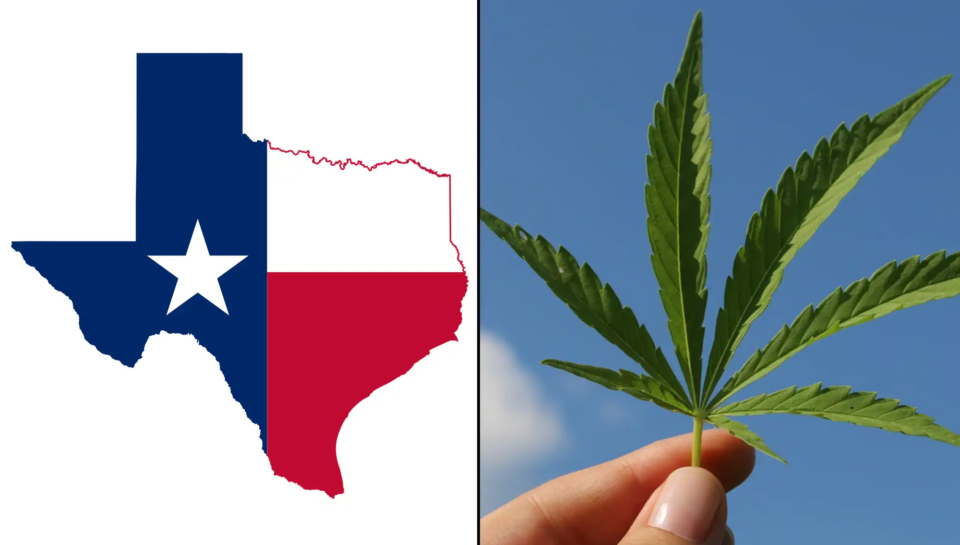
Image element courtesy of AnonMoos.
Tom Angell is the editor of Marijuana Moment. A 25-year veteran in the cannabis and drug law reform movement, he covers the policy, politics, science and culture of marijuana, psychedelics and other substances. He previously reported for Forbes, Marijuana.com and MassRoots, and was given the Hunter S. Thompson Media Award by NORML and has been named Journalist of the Year by Americans for Safe Access. As an activist, Tom founded the nonprofit Marijuana Majority and handled media relations, campaigns and lobbying for Law Enforcement Against Prohibition and Students for Sensible Drug Policy.
Add Marijuana Moment as a preferred source on Google.
All the cannabis news you need, all in one place. Copyright © 2017-2026 Marijuana Moment LLC ® and Tom Angell