
Overland Park Mayor Curt Skoog made a last-minute entry into the race for Kansas governor, joining state Sens. Ethan Corson and Cindy Holscher in the bid to win the Aug. 4 primary. Seven Republican candidates will face off in August, with the winner of each party moving on to the November general election.
Kansas Gov. Laura Kelly, a Democrat, endorsed Corson as her successor.
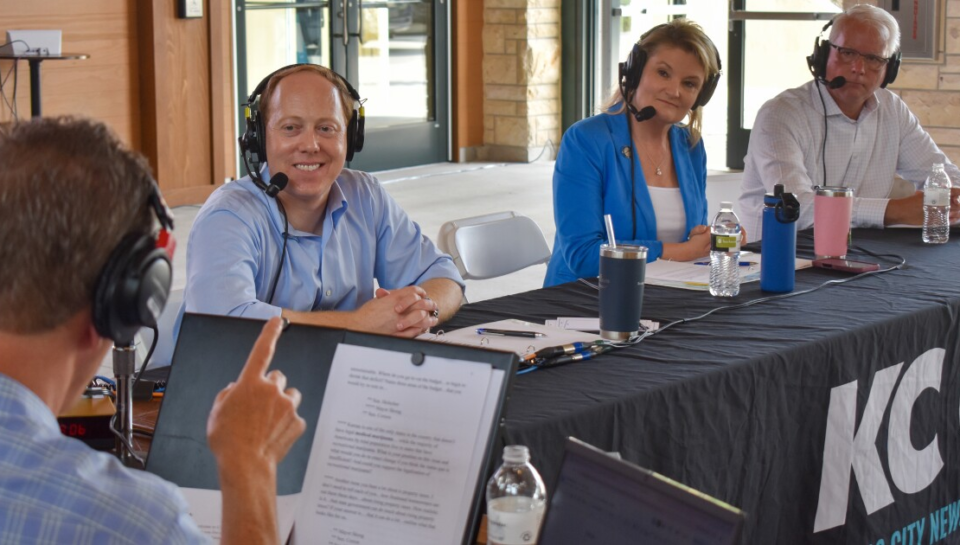
The three candidates spoke with KCUR’s Up To Date in front of a live audience at the Overland Park Farmers Market.
Corson said working for the U.S. Department of Commerce and running the International Trade Administration has given him the executive experience to lead the state.
“You need a governor who understands not just policy, but who knows how to lead government,” Corson said.
Serving in the Kansas House of Representatives from 2017 until being elected to the state Senate in 2021, Holscher leaned into her legislative track record of bills passed.
“I’m running on my record, not the coattails of the establishment or endorsements,” Holscher said.
As the mayor of the second largest city in Kansas, Skoog said he knows how to work with people and build community to get things done.
“This city is both, all parties and all backgrounds, and that’s what we need as governor, not somebody from the legislature,” Skoog said.
KCUR’s Up To Date plans to reach out to all of the governor candidates in Kansas ahead of the election.
In the legislature, Holscher and Corson voted in favor of a sales tax exemption for new and remodeled qualified data centers that meet state requirements.
Corson stands by his tax exemption vote and laid out parameters that would require all new centers have a decommissioning agreement, a payment plan for energy use, a commitment to a community benefits agreement and a closed loop system of operations.
“We want to put these structures in place, and we want to make our communities, which are very diverse all across the state, we want to give them the ability to make the decision that is best for themselves,” Corson said.
Holscher said she would have voted differently given the information she has about the data centers now. She wants a moratorium to ensure protections are in place to safeguard residents and natural resources.
“We have to make sure that parameters are in place. That’s what people are wanting, they’re wanting that protection. Because the fact of the matter is, they’re afraid that if these big tech companies come in and basically go right directly to the city council, they’re afraid they’re not going to get the protections,” Holscher said. “They’re asking the state to do this for them, and that’s what we’re looking for.”
Skoog said new infrastructure should be left up to local governments, and leaders should be talking with residents about the impact on the community.
“Each city needs to evaluate that on their own. What is the balance?” Skoog said. “And our job at the state level is to set parameters that say we need economic growth, we need jobs, we need private investment across the state, so our kids and grandkids can have a place to stay and work in their hometown and their community, and aren’t forced to leave their hometown or their local county to have a career.”
Skoog said property taxes are a local issue. He said he doesn’t want to see the state take actions like California, where he said decisions on property taxes limited revenue. But there should be more emphasis on prioritizing where money is spent, he said.
“I would work, as I said, build a consensus, unlike this dysfunctional legislature, where we can move forward with a plan that addresses property taxes. Property taxes is not as easy as a cap,” Skoog said.
Corson said he would focus on immediate relief and long-term reforms on property taxes if elected. Solutions would include restoring tax credits for renters and creating a vehicle registration tax credit.
“…We freeze property taxes for more of our fixed-income seniors. We have a really good program in place right now. The challenge is, not enough of our seniors qualify for it. We want to expand the parameters, so more folks can be included in that,” Corson said.
Holscher said large corporations and billionaires, including the Kansas City Chiefs, aren’t contributing their fair share.
“We have to fund schools, because when we don’t do that again, it shifts the burden to the local level, that makes the property taxes go up. We keep talking about caps, we keep talking about these other things, that’s not going to do it,” Holscher said.
Corson blamed Kansas’ Republican supermajority for pushing through last-minute spending proposals that don’t go through the typical hearing or vetting process. He said he would cut millions from the budget through line-item vetoes, and he wants to see how the state can use technology in state agencies to cut costs.
“As governor, I am going to use my line-item veto, and I will veto that kind of spending that does not go through the regular process. If it is a good expenditure of Kansas taxpayer dollars, it should go through the regular budget process. It should have a hearing on it,” Corson said.
Holscher said she has experience designing and implementing large-scale budgets. One priority for her is to make sure Kansas schools are funded.
“We got to make sure the critical services are funded, we got to stop the giveaways for the billionaires and the corporate interests and the special interest,” Holscher said.
Skoog said he has implemented a new budget every year as mayor. Updating operations and creating efficiencies by leveraging technology is one way to address budget shortfalls, he said. Growth also adds to the revenue, he added.
“We need more jobs, we need more people, we need our small and medium-sized cities to thrive,” Skoog said. “And that will be the experience I bring from being mayor, to help those communities thrive, which drives revenue, can reduce property taxes and address the hole we have in our future budgets that came from the dysfunctional legislature.”
Kansas is one of the few states that has not legalized medical marijuana, and also has not approved recreational marijuana use. In the 2025 statewide Kansas Speaks public opinion survey, more than 70% of respondents supported medical marijuana and more than 58% of respondents supported legalizing it for recreational use.
Skoog said he wants to see healthcare move forward, but he didn’t go so far as to give his support for any form of legalization.
“I think that we need to do the research and have a public discussion on the real data behind marijuana,” Skoog said.
Corson said a first step would be to legalize weed for medical purposes.
“I absolutely support medical marijuana. This is a way to provide critical relief for folks suffering from chronic pain,” Corson said. “I think the reality is, we as a state will start with medical marijuana. I just think that is a political reality.”
Holscher said she’s an advocate for legalizing medical marijuana.
“Seventy percent of Kansans support it. I’ve been the leading advocate on it, got it passed in the House. I will continue that focus on (making) it a reality for Kansans,” Holscher said. “We should be legalizing medicinal cannabis.”