
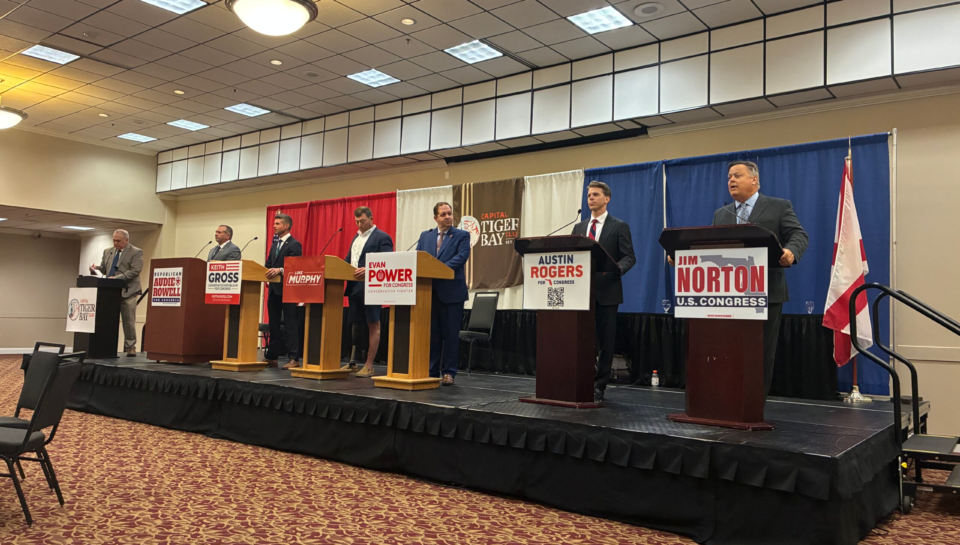
Few policy disagreements emerged at the GOP debate for Florida’s 2nd Congressional District in Tallahassee on Monday, with candidates instead attempting to distinguish themselves by touting their experience and conservative credentials.
The nonpartisan Capital Tiger Bay Club hosted the debate at the Donald L. Tucker Civic Center, with Tallahassee Democrat news director Jim Rosica moderating.
State GOP Chair Evan Power argued he had been on the front lines of Florida’s biggest political battles of the last decade, while Attorney Austin Rogers claimed he had drafted language in the One Big Beautiful Bill Act. Public speaker and Army veteran Luke Murphy pointed out he was the only one on stage who had opened a rally for President Trump.
In a week in which Louisiana Sen. Bill Cassidy was defeated by a Trump-backed Primary challenger and Kentucky Rep. Thomas Massie appears in danger of suffering the same fate, criticism of the President was virtually absent.
All candidates backed Trump’s tariff policy, called for increased ICE funding, condoned military strikes on alleged drug traffickers and supported mid-decade redistricting.
The closest anyone seemed to approach questioning Trump’s actions was when Gulf County Schools superintendent Jim Norton warned that a prolonged war in Iran would be costly for Republicans in the Midterms. He recounted spending $128 at the pump that morning to fill up his truck.
“We can’t afford to have this unnecessary inflation placed on the middle class — as much as I support the President, I hope it wraps up soon,” said Norton.
On affordability, which polls show as Americans’ top issue heading into the Midterms, candidates highlighted the rising cost of living as a major issue and blamed the Biden administration for worsening inflation. Power called for lowering insurance costs, while Murphy said bringing down diesel costs was key.
Businessman Keith Gross and retired law enforcement officer Audie Rowell offered the most libertarian solutions. Gross proposed eliminating roughly half of the federal Cabinet departments, and Rowell claimed that eliminating fraud and wasteful government spending would make Americans’ lives more affordable.
When asked to define the term “middle class,” several candidates claimed that the label described them personally. Rogers noted he was the son of a fighter pilot and a public school teacher, Murphy stated he was raised on a dirt road by a Marine, and Norton said he planned to accept the $174,000 annual congressional salary because his family needed it to live.
Gross, who has loaned his own campaign millions and has pledged to donate his congressional salary to charity, described being raised in a trailer and growing vegetables in the family’s backyard to save money.
“To me, growing up, middle-class people were rich,” said Gross.
On the issue of term limits, Power and Rowell said they had signed a pledge promising to serve only six years. While most candidates favored term limits, Norton suggested that seniority enabled representatives to bring home funding to the District.
One of the debate’s few clashes came when Rogers attacked Power for previously lobbying for the state’s hemp industry, which Power countered by arguing he’d led the fight against the state’s recreational marijuana amendment in 2024. All candidates stated their opposition to recreational marijuana, but none opposed Florida’s current regulations on medicinal marijuana.
The most heated moment of the debate occurred when Norton suggested the 2nd District wasn’t really home for Rogers, who moved back to Florida from Alexandria, Virginia. in January. In a brief back and forth, Rogers shot back that he only lived in Virginia for the three years his wife was completing her medical residency there, and argued Norton had spent a similar length of time attending law school out of state.
“You’ve been going around telling people I’m not from here. It’s the most ludicrous thing I’ve ever heard in my life,” said Rogers.
Responding to an audience-submitted question, all candidates declined to say President Trump should attempt to entice a conservative Supreme Court justice to retire so he could appoint a younger replacement.
Monday’s debate in Tallahassee followed a debate featuring the same six candidates two weeks ago in Bay County.
The only poll of the race conducted so far showed Gross leading with 34% support and Power close behind at 32%. With $5.6 million in campaign funds as of March 31, Gross has a massive fundraising advantage over the rest of the field, with Rogers raising the next most money at $722,000.
The Primary Election is Aug. 18, with the winner moving on to face one of the four Democratic candidates who have filed to run. The district is rated R+8 by Cook Political Report’s Partisan Voter Index and “safe Republican” by Sabato’s Crystal Ball.
Incumbent Republican Rep. Neal Dunn, who has represented the seat for the past decade, is facing health challenges and has opted not to seek re-election.
___
Fabrizio Gowdy reports.
Florida Politics is a statewide, new media platform covering campaigns, elections, government, policy, and lobbying in Florida. This platform and all of its content are owned by Extensive Enterprises Media.
Publisher: Peter Schorsch @PeterSchorschFL
Contributors & reporters: Phil Ammann, Drew Dixon, Roseanne Dunkelberger, Liam Fineout, A.G. Gancarski, Jesse Mendoza, Ryan Nicol, Jacob Ogles, Cole Pepper, Gabrielle Russon, Jesse Scheckner, Janelle Taylor, Drew Wilson, and Mike Wright.
Digital Services Manager: Daniel Dean
Email: [email protected]
Twitter: @PeterSchorschFL
Phone: (727) 642-3162
Address: 204 37th Avenue North #182
St. Petersburg, Florida 33704
© Copyright by Extensive-Enterprises 2026. All rights reserved. STAFF LOGIN