White House Pushes Congress To Keep Hemp CBD Products Legal By Amending Broad Ban That’s Set To Take Effect Later This Year
Connecticut Governor Signs Bill To Expand Psychedelics Pilot Program In Preparation For Federal FDA Approval
Congressional Committee Directs Feds To Keep Testing Truck Drivers For Marijuana, Regardless Of Trump’s Rescheduling Move
Louisiana Will Let Terminally Ill Patients Use Medical Marijuana In Hospitals After Governor Allows Bill To Take Effect Without His Signature
Alabama Medical Marijuana Sales Finally Launch, Years After Lawmakers Passed Legalization
2 In 3 Americans Who Use Marijuana Say It Helps Them Sleep Better, New Survey Shows
Hemp-Based Plastic Shows Promise As Environmentally Friendly Alternative To Traditional Packaging Materials, Study Finds
Marijuana Components Have ‘Consistent’ Anti-Tumor Effects In Glioblastoma And Other Cancers, Scientific Review Shows
Another Study Debunks Lazy Stoner Stereotype, Linking Marijuana Use To An Increase In Some Kinds Of Exercise
VA Launches New Study On MDMA To Treat Veterans With PTSD And Alcohol Use Disorder
WNBA Removes Marijuana From Banned Substances List And Sets Rules For Player Endorsements Of Hemp CBD Products
Americans Say Marijuana Is Less Cool Than Math And Country Music—But Is Cooler Than Guns Or Cryptocurrency, Survey Shows
Politicians And Major Brands Celebrate Cannabis Culture On 4/20
Woody Harrelson And Bill Maher Complain That Marijuana Taxes Are Too High While Smoking Joints At The Dispensary They Own Together
WNBA Offers To End Marijuana Testing For Women’s Basketball Players As Part Of Reported Deal With Union
Federal Labor Decision Inspires More Missouri Marijuana Workers To Seek Unionization
Missouri Marijuana Workers Win Union Vote After Federal Officials Reject Company’s Argument On Blocking Ballots
Target Is Launching Hemp THC Drink Sales In Three Of The U.S.’s Most Populous States
Target Expands Involvement In Hemp THC Drinks Market With 72 New Licenses In Minnesota
Marijuana Sales Are Rising And Alcohol Is On The Decline As Consumer Preferences Evolve, Government Data In Canada Shows
WNBA takes cannabis off banned list & sets player endorsement rules (Newsletter: June 5, 2026)
Wisconsin governor candidates pledge cannabis action if elected (Newsletter: June 4, 2026)
Amendments to save hemp THC from ban are blocked in Congress (Newsletter: June 3, 2026)
Trump sued over cannabis rescheduling (Newsletter: June 2, 2026)
GOP lawmakers push to save hemp from impending federal ban (Newsletter: June 1, 2026)
Published
on
By
A governor-appointed cannabis commission in North Carolina has issued an interim report after holding months of meetings focused on the issue. The group is recommending that the state move away from a criminalization-based approach to cannabis and toward a system of “robust” regulations that provide for adults’ legal access to THC products.
The North Carolina Advisory Council on Cannabis, which Gov. Josh Stein (D) convened last year, says in the new document approved on Thursday that the current “absence of regulation for North Carolina’s intoxicating cannabis market raises numerous concerns,” noting that hemp products are readily available yet largely unregulated and that marijuana remains prohibited altogether in the state, even for medical use.
“North Carolina’s intoxicating cannabis market currently exists in a dangerous policy gap that is neither true prohibition nor meaningful regulation.”
“Compared to regulated marijuana frameworks in other states, this environment presents identifiable risks,” the report says. “While some operators voluntarily implement consumer protection protocols, these safeguards are not required under state law.”
Stein, for his part, thanked the group for its “expertise, hard work, and thoughtful deliberation” in a press release and reiterated his support for legalizing marijuana.
“Last year, I charged this group with developing a comprehensive solution to the unregulated sale of cannabis that is grounded in public health and public safety, with a special focus on keeping young people safe,” the governor said. “This report provides the General Assembly with guidance and makes clear that a well-regulated market, including both oversight and enforcement authority, is a safer market for our state.”
“Our state’s unregulated cannabis market today is the Wild West and is crying for order,” he said. “Let’s get this right. Let’s protect our kids and create a safe, legal, and well-regulated market for adults.”
The council’s report notes that North Carolina is “at a pivotal moment,” given that the state is one of only 10 that does not allow legal and regulated marijuana access for either recreational or medical use.
“In the absence of a recognized, regulated marijuana market, North Carolina has one of the largest illicit marijuana markets in the United States, with an estimated $3 billion spent on illegal marijuana in 2022, ranking second in the nation. Additionally, North Carolina’s current market for intoxicating hemp-derived cannabinoid products is robust. These products have proliferated across the state through retail storefronts, vape shops, convenience stores, and online vendors. Intoxicating hemp-derived cannabinoid products, often marketed as legal alternatives to marijuana, are being sold in an environment without any uniform standards for manufacturing, testing, labeling, packaging, or age verification, and absent any enforcement or oversight authority.”
Under the prohibition approach that the state currently has, the report notes that there is an absence of age restrictions, packaging rules, purchase limits, licensing requirements, zoning guidelines and supply chain oversight. There is also a lack of tax revenue that can be used to address any health and safety concerns associated with marijuana use and commerce.
Looking ahead, the interim report recommends that rather than construct separate frameworks for hemp and marijuana, the state should enact molecule-based regulation focused on THC itself, saying that “the plant source is irrelevant and should not drive different treatment when the intoxicating compound is the same.”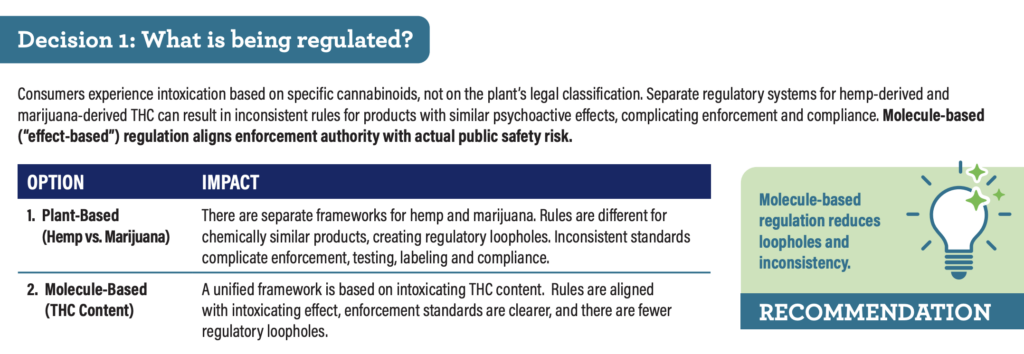
It also suggests that when choosing how to regulate THC and cannabis, North Carolina should enact “an adult access market with protections for medical consumers.”
The panel, however, “does not view a medical-only program as an effective interim step or compromise solution,” and the state should proceed to adult-use access immediately while considering the “availability of medical-consumer protections” as “an important component of a broader regulatory structure.”
“Under this framework, adults would be permitted to legally purchase, possess, and use cannabis through state-licensed retail outlets. An adult-use market provides the state with a full regulatory framework and the tools necessary to manage it responsibly. The recommended system also incorporates rigorous medical-grade safeguards, including low-THC product options, comprehensive testing standards, expanded product warnings, recall authority, and access to qualified medical consultation, among others. Importantly, this model would provide the most robust regulatory framework for the state, providing the oversight tools necessary to manage the industry responsibly while generating state revenue. It allows for structured licensing fees and tax revenue to support oversight, the development of clear and enforceable rules, sustained public health messaging grounded in prevention and education, and dedicated resources for compliance and enforcement. This recommendation provides a structure to reign in the rampant hemp market that exists today, while providing necessary guardrails for both public safety and public health.”
“Of all possible regulation models, an adult access model would bring the most revenue to the state, which could support public health education campaigns and enforcement efforts,” the advisory council recommended.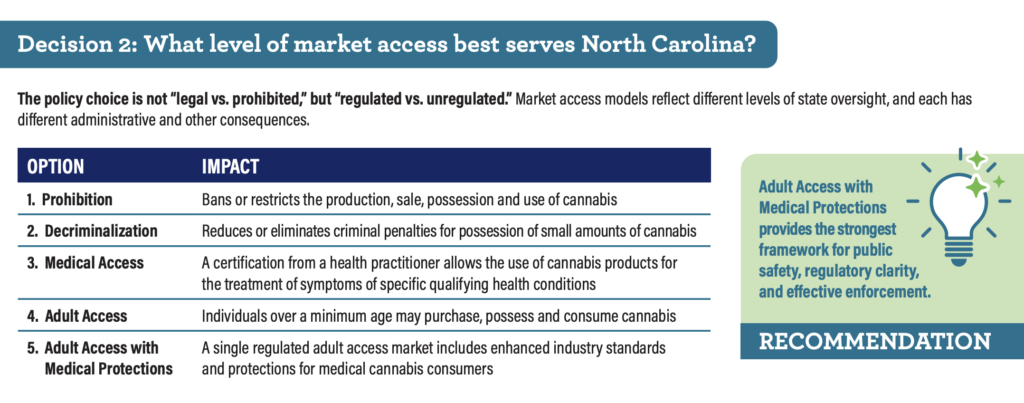
The report also noted problems that could be caused by the fact that the state is lagging behind its neighbors that are moving ahead with enacting marijuana policy reforms.
“If surrounding states adopt regulated cannabis programs while North Carolina does not, the state could effectively become a prohibition jurisdiction situated among regulated markets, a dynamic that may complicate enforcement and influence the flow of products and consumers across state lines,” the report said.
Because the council only has the ability to recommend policies and not to actually enact them, members put the onus on state lawmakers to do so.
“Ultimately, the authority to bring order to the unregulated, unsafe cannabis market rests with the General Assembly,” the report notes. “The question before policymakers—and this Council—is not whether intoxicating cannabinoid products will exist in the marketplace in North Carolina. They already do. Rather, the question is whether the General Assembly will allow intoxicating products to continue to be sold without enforceable state standards, or whether it will establish a regulatory system designed to protect public health and public safety.”
The advisory council was formed after Stein issued an executive order last year, and is comprised of legislators, law enforcement officials, agriculture industry stakeholders, health experts, tribal representatives, advocates and others charged with exploring possible regulatory models for adult-use marijuana and hemp.
The governor’s order said there’s a need for reform because the “current lack of regulation, including age, potency, and purity limitations, poses a threat to all North Carolinians, particularly our youth.” And “rather than allowing this unsafe and unregulated market to continue, smart and balanced regulation presents an opportunity not only to protect the health and well-being of our people, but also to generate revenue that can benefit our state.”
Members are tasked with developing and submitting initial recommendations on a “comprehensive cannabis policy, including any proposed legislation,” with a final report due by December 31 of this year.
The interim report approved this week says that the final document “will incorporate continued stakeholder engagement, data analysis, and policy development and will present a research-based and data-driven comprehensive framework intended to bring structure, accountability, and public confidence to a future North Carolina cannabis marketplace.”
In the meantime, the council is continuing its work with new subcommittees focused on regulatory structure, enforcement and criminal justice reform and revenue and federal compliance.
During his time as the state’s attorney general, Stein led a separate task force under then-Gov. Roy Cooper (D) that examined racial injustice issues and ultimately recommended decriminalizing marijuana and studying broader legalization in response to racially disparate enforcement trends.
In recent legislative sessions, multiple limited medical marijuana legalization bills advanced through the Senate, only to stall out in the House.
Meanwhile, a tribe in North Carolina, the Eastern Band of Cherokee Indians, launched the state’s first marijuana dispensary in 2024—despite the protests of certain Republican congressional lawmakers.
Photo courtesy of Philip Steffan.
Tom Angell is the editor of Marijuana Moment. A 25-year veteran in the cannabis and drug law reform movement, he covers the policy, politics, science and culture of marijuana, psychedelics and other substances. He previously reported for Forbes, Marijuana.com and MassRoots, and was given the Hunter S. Thompson Media Award by NORML and has been named Journalist of the Year by Americans for Safe Access. As an activist, Tom founded the nonprofit Marijuana Majority and handled media relations, campaigns and lobbying for Law Enforcement Against Prohibition and Students for Sensible Drug Policy.
Add Marijuana Moment as a preferred source on Google.
All the cannabis news you need, all in one place. Copyright © 2017-2026 Marijuana Moment LLC ® and Tom Angell