
By Theodore Ball, News Intern Nebraska Public Media and Maddie Ames  , Reporter
May 26, 2026, 8:42 p.m. ·
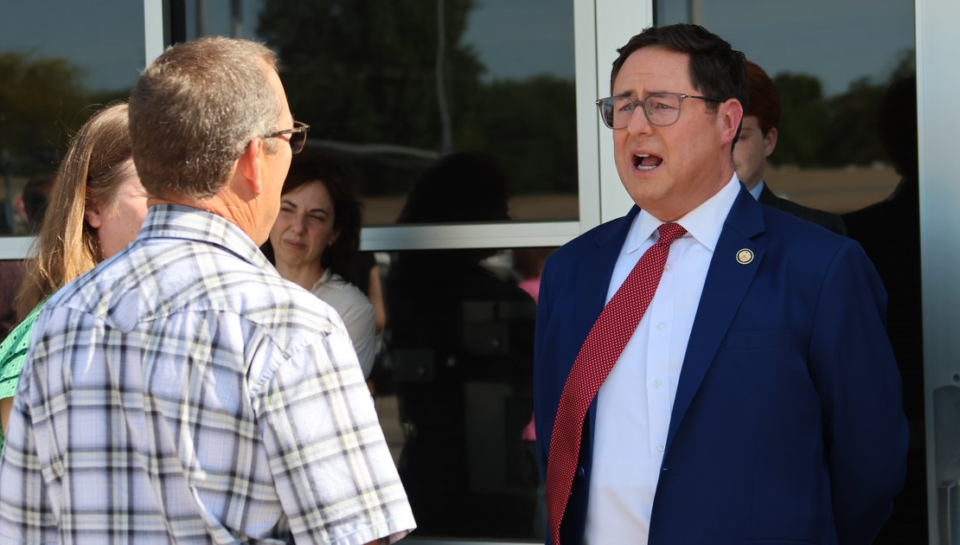
First District Congressman Mike Flood held his first town hall of the year Tuesday in his hometown of Norfolk. Despite the familiar setting, a smaller group of constituents echoed the contentious atmosphere of his Lincoln town hall meeting in August of last year.
Flood, the subcommittee chairman of the House Committee on Housing and Insurance, opened by touting his recently passed housing bill, the 21st Century ROAD to Housing Act, aimed at expanding affordable housing in rural Nebraska.
Flood said the bill reduces the cost of manufactured homes by up to 30%, saving buyers at least $25,000.
“It makes it so that builders can use federal funds without all the compliance issues that make it nearly impossible to build an affordable home,” Flood said.
Flood said the bill received 396 votes in the house, including from every House Democrat that was present. Flood said the legislation was proof he was doing what Nebraskans elected him to do – work across the aisle.
“You sent me to Washington to fix problems, to work with people and to do it in a bipartisan way. I think just by the very fact this bill passed by such a resounding number tells you that I am working to be bipartisan, I'm working to get you results.”
The housing legislation drew applause from the crowd of about 200. That was the last time the crowd responded warmly.
The Handmaids of Nebraska were in attendance, forming a line in their red cloaks outside of Flood’s town hall.
In previous town halls, questions were capped at 30 seconds. This town hall allowed up to 45 seconds.
For those 45 seconds, dozens of Nebraskans in the 1st District questioned Flood on term limits, blockades in Venezuela and Iran, and the Epstein files.
“My position has always been, unless the rules change, I am going to hopefully work to earn in your trust every two years to stay in the House to be able to deliver on those results, but I will vote for term limits when given the opportunity,” Flood said.
Questions about high prices in Nebraska for gas, groceries and farming supplies grew more adversarial. There was applause in the audience when Flood acknowledged the high prices Nebraskans are facing due to the Iranian conflict.
From the gas pump to grocery stores to affordable housing, Flood said he believes he’s on point when it comes to affordability.
“I can tell you with my work on housing, we are going to bring the price of housing down. We are going to make it easier to get into a manufactured home," Flood said. “We are going to make it easier for cities to use these funds and deliver for the American people.”
One constituent followed up Flood’s question later on in the town hall, asking how Congress is doing to keep costs low as the conflict in Iran continues.
“I can tell you that we have crippled, in a major way, Iran's capacity to do a lot more harm to us, but we got to finish the job," he said.
Democrat Chris Backemeyer, who is running against Flood, attended the town hall meeting, even though candidates running for office were not allowed to comment during Q&As.
Backemeyer, who had a campaign table outside of the event, said he chose to stay outside to avoid any conflict. Although he wasn’t in attendance, he fielded questions from attendees.
Backemeyer said Congress failed to assert its authority over the Trump administration regarding the Iran War, and has added pressure to the affordability crisis that Nebraskans are suffering from.
“The Strait of Hormuz was a real point of leverage for the Iranians and we're seeing exactly how much,” Backemeyer said. “Gas prices are up 50% since the beginning of the war, fertilizer prices are up – that hits Nebraskans doubly hard when they're going into planting season, when they're trying to make a profit after a year of taking losses last year.”
Backemeyer said he agrees with Flood that Iran should not have nuclear capabilities; however, he said his work on the Iranian nuclear deal during the Obama administration would have prevented Iran from generating a bomb.
“That deal kept Iran at least a year away from having enough nuclear material for just one nuclear weapon. Now they have enough material for 10” he said. “ There needs to be a plan going in, how you're going to get that uranium out, and then how we're going to exit this conflict, without it being a long-term forever war.”
Backemeyer also addressed Democratic Senate candidate Cindy Burbank’s decision to endorse independent candidate Austin Ahlman, who announced his bid for the 1st District following the May primary.
Michelle Moser, who previously asked questions to Flood at his Columbus town hall, asked about a Department of Justice $1.8 billion anti-weaponization fund, which could give money to those who participated in the insurrection at the Capitol on Jan. 6, 2021.
“I do not think one penny of any fund should ever go to any Jan. 6 insurrectionist that was in the capital on January 6, 2021,” Flood said. “I want to be very clear.”
Medical marijuana was another topic of discussion among constituents. The question comes at a time after Nebraska voters overwhelmingly supported medical cannabis in the state. With a medical marijuana commission moving slowly under Gov. Jim Pillen, Flood stood his ground on his opposition for medical marijuana.
“Respect the voters,” one constituent said from the audience.
Flood responded to constituents' cries, citing his concerns on the effects of marijuana on the overall health of Americans and the economy.
“When I talk to people on the East and West Coast, they tell me it's the worst thing they've ever seen happen in their home state,” Flood said.
Flood described Nebraska as the “wild west” when it comes to the indecisiveness of state lawmakers over the years.
After the town hall, Flood told a group of reporters that to “breed respect” for elections and democracy, state lawmakers need to respect the will of the voters.
“If the voters want something that I disagree with, they choose to do it. It should be carried out the way that it was supposed to be carried out without undue delay,” he said.
Crista Eggers, the executive director of Nebraskans for Medical Marijuana, asked “Are you going to continue opposing it as you did with a letter in December of last year to oppose the federal rescheduling that has now happened?” Another town hall attendee started his conversation, saying “Stop lying to these people. Cannabis is not going to kill you.”
Flood didn’t back down on his stance against medical marijuana toward anyone with questions about moving forward with medical cannabis in the state.
“I am going to do nothing on the state level, because it is the law of the land in the state of Nebraska. I am not going to use my advocacy efforts to help reclassify marijuana at the federal level,” Flood said.
DOGE remained a concern among town hall attendees. Flood’s response focused on federal spending cuts. Flood referenced the “One Big Beautiful Bill,” which cut federal spending by over $1.5 trillion. Those cuts affected SNAP, Pell grants and health care.
“It was the first time in our nation's history that we cut that much money out of there, and a lot of that happened because DOGE identified and pulled back the curtain on a lot of spending that didn't make sense,” Flood said.
Another question focused on Trump’s plan to use taxpayer funds to pay for security upgrades to his planned White House ballroom.
Flood focused his question on ballroom security following the assassination attempt made on president Trump during the White House press correspondence dinner in late April.
“This is bigger than a ballroom,” Flood said. “This is something that we, as American people, have to make sure that if you want to serve in public office, you don't have to sleep under a bulletproof case. We have to be in the communities where the people we serve, we cannot hide.”
“Tax the rich” chants erupted from the crowd, following Flood's answer.
“So your solution is to tax the rich?” Flood said.
Flood pushed back, saying there is an exodus of “people that have the resources.” He gave an example of higher income earners in New York City fleeing due to more progressive tax systems.
“So you leave a bunch of people that don't have the resources to pick up the mess,” Flood said.
Nuclear energy was another question raised from a Norfolk resident. Norfolk is one of the finalists for a state-funded feasibility study for a small modular reactor. Flood addressed how he will work to ensure small modular reactors are deployed efficiently in Nebraska while keeping energy rates level for Nebraskans.
Flood also addressed education, immigration, campaign finance, and the Epstein transparency act.
Flood plans on having two more town halls in the metro areas in his district. The dates have yet to be determined.
While this town hall was less contentious than his last, he said that listening to unhappy constituents was a part of being a civil servant.
“Our country is not always civil. It's people are either really happy with what's happening – a lot of people are really mad with what's happening,” Flood said. “…My job is to stand on the town square, to be accessible, to answer people's questions, to give people some perspective on why I'm there.”
Get the latest from around Nebraska delivered to your inbox
Connecting Nebraska through PBS, NPR and original content since 1954. Engaging Nebraskans through television, radio, online and mobile platforms.
Your support is essential!