New Hampshire Lawmakers Take Up Bipartisan Bills To Legalize Psilocybin For Medical Use
New Jersey Marijuana Businesses Could Engage In Interstate Commerce Under Senate President’s New Bill
Ohio Attorney General Rejects Cannabis Referendum Petition, Saying It’s ‘Misleading’
Canadian Support For Marijuana Legalization Is Increasing, New Poll Shows
Joe Rogan Surprised After GOP Senator Says Marijuana And Alcohol Industries Jointly Backed Push To Ban Hemp THC Products
More Than A Third Of Rap And Hip Hop Music Videos Feature Marijuana, Government-Funded Study Shows
CBD Has ‘Substantial Promise’ To Combat Tumors From Cancer, Scientific Review Shows
Marijuana Users Are Being Unjustly Jailed For Allegedly Driving Under The Influence, Government-Funded Study Shows
California Officials Award $30 Million In Marijuana Revenue To Support Research On THC Drinks, Terpenes And Tribal Cannabis Sales
Medical Marijuana Use Is ‘Prevalent’ Among People With Disabilities—And It Helps Treat Pain, New Federally Funded Study Shows
State Marijuana Regulators Share Tips On How To Stay Safe And Legal Around The Holidays
One In Three Americans ‘Pre-Game’ With Marijuana Before Family Holiday Gatherings, Survey Finds
As More Americans Choose Marijuana Over Alcohol, Mainstream Media Notices The ‘Cousin Walk’ Thanksgiving Tradition
Joe Rogan Slams ‘Really Bad’ Federal Hemp Ban Trump Signed, Blaming Alcohol Industry For Influencing Congress
New Netflix Documentary Shows How Psychedelics Help Military Veterans Heal Trauma
Pre-Rolls Are A Key Driver Of The Cannabis Retail Market’s Success (Op-Ed)
Massachusetts Hits $10 Billion Marijuana Sales Milestone, With Top Official Saying Consumption Lounges Will Bolster Industry In 2026
Ohio Dispensaries Sold More Than $1 Billion Worth Of Legal Marijuana In 2025
Marijuana Consumers Are More Likely To Shop At Target Following Decision To Sell Cannabis-Infused Drinks, Poll Shows
Marijuana Company Sues DoorDash, Total Wine And Others Over Alleged Illegal Sales Of Hemp THC Products
Federal hemp THC ban would be delayed for two years under new bill (Newsletter: January 14, 2026)
Congress moves to keep blocking cannabis sales in DC (Newsletter: January 13, 2026)
DOJ won’t delay cannabis rescheduling, GOP congressman says (Newsletter: January 12, 2026)
Federal medical cannabis protections approved in Congress (Newsletter: January 9, 2026)
Trump drug czar pushed to back full cannabis legalization (Newsletter: January 8, 2026)
Published
on
By
A new bill in the North Carolina House of Representatives would legalize medical marijuana for patients with a variety of specified conditions, including cancer, epilepsy, HIV/AIDS, Parkinson’s disease, PTSD, end-of-life care and other serious ailments.
The measure, HB 1011, was filed on Tuesday by Rep. Aisha Dew (D) and has been cosponsored by several other Democratic lawmakers.
The 28-page bill, titled the North Carolina Compassionate Care Act, is considerably more detailed than a separate Democrat-led medical marijuana bill introduced this week that would allow access only for patients enrolled in a “registered research study.”
Advocates have been awaiting House introduction of a comprehensive bill, especially since Senate President Phil Berger (R) said his chamber is deferring to the House to move first on medical marijuana reform this session.
“Glad to finally see a real medical cannabis bill get introduced,” Kevin Caldwell, Southeast legislative manager for the advocacy group Marijuana Policy Project, told Marijuana Moment in an email Wednesday.
The new bill, HB 1011, appears to be based largely on an earlier medical marijuana proposal from Sen. Bill Rabon (R), SB 3, filed in the 2023–2024 legislative session. That measure passed the Senate but failed to advance in the House due to an informal rule that requires a majority of the chamber’s GOP caucus to support a bill in order to bring it to the floor.
Caldwell at MPP said he would have liked to see the new House medical marijuana bill be sponsored by a Republican, which he reasoned would increase its chances of being heard in the GOP-controlled body. But he added that “legislators have known a medical bill has been in the works, and I hope they take this opportunity to provide relief to the tens of thousands of North Carolinians who are suffering from debilitating conditions.”
The new measure says in its findings section that “medical research has found that cannabis and cannabinoid compounds are effective at alleviating pain, nausea, and other symptoms associated with several debilitating medical conditions.” A majority of states and four of five U.S. territories have already legalized medical marijuana, it continues, and “North Carolina now takes similar action to preserve and enhance the health and welfare of its citizens.”
Under the proposal, the new medical cannabis program would be overseen by the state Department of Health and Human Services (DHHS).
The newly introduced measure has been referred to the House Committee on Rules, Calendar and Operations of the House.
Here are some of the key features of the new bill, HB 1011:
In light of last session’s Senate-passed bill languishing in the House, Berger said recently that the chamber will wait for House lawmakers to send them a bill.
“I don’t know that the Senate will be passing anything initially in this session,” he said earlier this month. “I think we’re going to wait and see what comes out of the House.”
Introduction of HB 1011 comes on the heels of another Democratic-led medical marijuana bill. That proposal—HB 984, from Rep. Julia Greenfield (D) and five other Democratic lawmakers—would more narrowly legalize medical cannabis, allowing access only for patients enrolled in a “registered research study” conducted by a state-registered hospital, university, lab, pharmaceutical manufacturer or private medical research company.
The legislation specifies no age limit for patients, but registered caregivers would need to be at least 18. As for qualifying conditions, it lists no specific maladies but mandates that patients obtain a signed statement from “a physician with whom the patient has a bona fide physician-patient relationship indicating that, in the physician’s professional opinion, the patient has a medical condition and the potential health benefits of the medical use of cannabis would likely outweigh the health risks for the patient.”
It’s not immediately clear how accessible the research-focused program would be in practice, though it appears that authors intend the program to be relatively open.
The measure states, for example, that it’s the General Assembly’s intent “that any physician who issues a written certification to a patient be permitted to participate in objective scientific research.” It also defines research broadly to include “the development of quality control, purity, and labeling standards for cannabis; sound advice and recommendations on the best practices for the safe and efficient medical use of cannabis; and analysis of genetic and healing properties of the many varied strains of cannabis to determine which strains may be best suited for a particular medical condition or treatment.”
Two other measures introduced so far this session would legalize cannabis in North Carolina. In the Senate, S350 would create medical and adult-use marijuana systems, while H413 in the House would legalize only recreational marijuana.
—
Marijuana Moment is tracking hundreds of cannabis, psychedelics and drug policy bills in state legislatures and Congress this year. Patreon supporters pledging at least $25/month get access to our interactive maps, charts and hearing calendar so they don’t miss any developments.
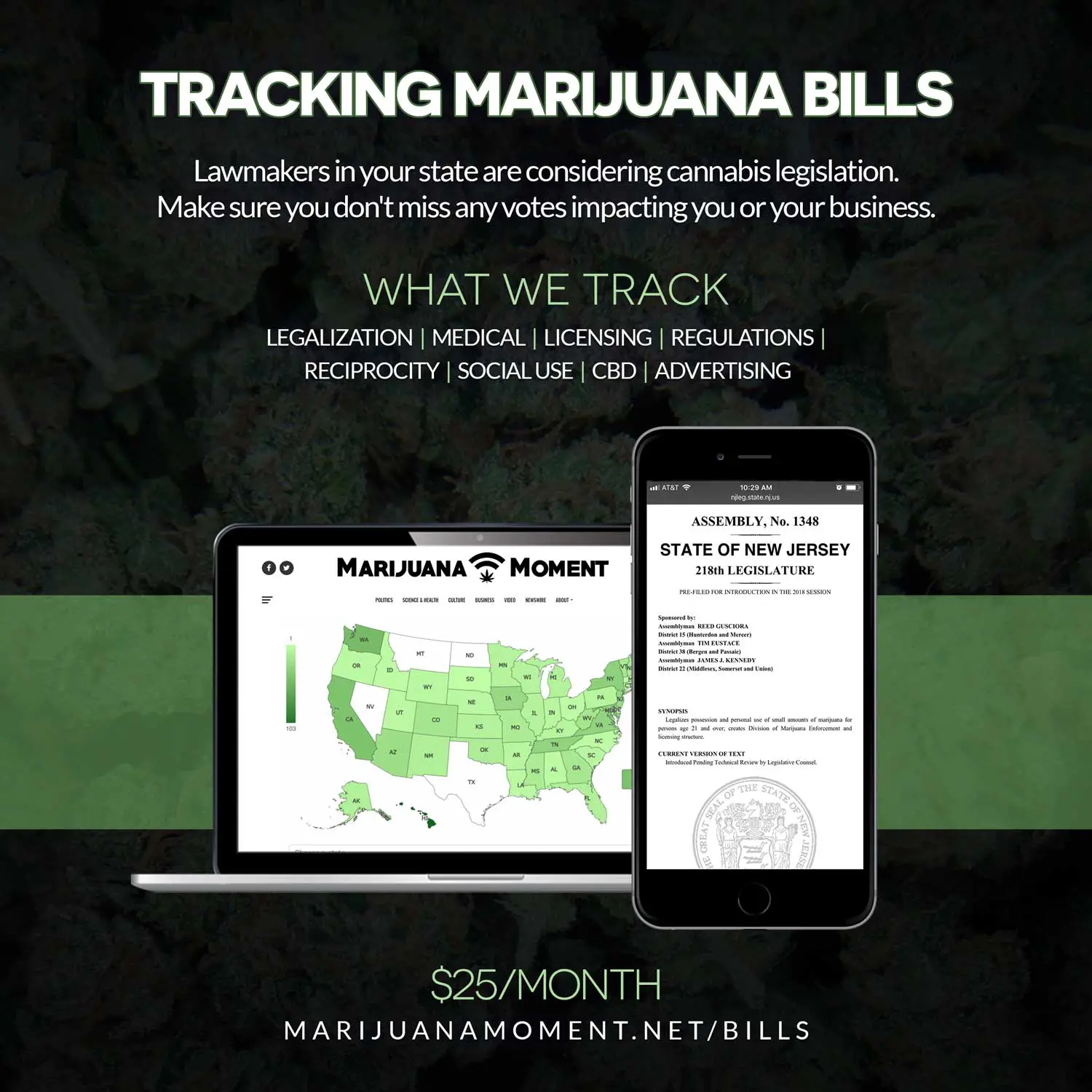
Learn more about our marijuana bill tracker and become a supporter on Patreon to get access.
—
House Speaker Destin Hall (R) said in early March that Republicans in his chamber could be willing to consider medical marijuana legalization this session. But he didn’t indicate any forthcoming House bills, instead suggesting legislation would come from the Senate.
In a wide-ranging interview with the The News & Observer, the publication reported that Hall “said House Republicans could be more open to what the Senate sends over to them” than they have in past sessions.
Voters, for their part, seem to be on board with cannabis reform. A poll published in February found that 71 percent of likely voters in North Carolina support legalizing medical marijuana in the state, with majorities across party lines and in every surveyed demographic—aside from people over the age of 80—in favor.
Lawmakers have also shown an appetite to take up hemp regulation, with Berger saying earlier this year that “it seems to me that there’s an opportunity there to address the medical marijuana issue,” as well as hemp-derived cannabinoids “at some point during the session.”
Last summer, the state Senate approved a bill that would legalize medical marijuana—but it stalled out in the House once again.
The legislation was similar to a bill from Rabon, a cancer survivor who has sponsored multiple medical marijuana proposals. The senator previously described his interest in using the hemp legislation as a potential vehicle after his most recent standalone died in the House.
The senator has emphasized that he’s speaking from personal experience when he discusses his support for the legislation. As he’s previously disclosed, Rabon said his doctor advised him to use marijuana before he went through serious chemotherapy, and he visited his local law enforcement to tell them that he intended to break the law to use the plant for therapy.
Former House Speaker Tim Moore (R) said last year that while he personally supports legalizing medical marijuana, there is an informal rule in the chamber that at least 37 GOP members must back any given bill in order to bring it to the floor.
Current House Speaker Hall, for his part, has in the past voiced opposition to medical cannabis reform.
Rabon’s standalone legislation moved through the Senate and was taken up by a House committee last year, but it did not advance further in that chamber.
Former House Majority Leader John Bell (R) said in 2023 that while there were “still discussions going on” about medical marijuana legislation, he was “very sure you won’t see that bill move” due to insufficient support among Republicans. He said that was “unfortunately” the case.
A previous version of the North Carolina Compassionate Care Act from Rabon passed the Senate but did not get a vote in the House of Representatives in 2022.
The Senate president previously acknowledged that opinions are shifting when it comes to marijuana in the state, and he said that Rabon specifically “for a long time has looked at the issue.”
Rabon also took another step, including medical marijuana regulatory appointments for the yet-to-be-enacted program in a separate measure that passed the Senate last year.
An Indian tribe in North Carolina launched the state’s first medical marijuana dispensary last April—despite the protests of certain Republican congressional lawmakers. More than a week after legal marijuana sales kicked off to all adults at The Great Smoky Cannabis Co. in Cherokee last year, thousands from across the region made purchases.
Largest-Ever Analysis Of Medical Marijuana To Treat Cancer Symptoms Shows ‘Overwhelming Scientific Consensus’ On Benefits
Ben Adlin, a senior editor at Marijuana Moment, has been covering cannabis and other drug policy issues professionally since 2011, specializing in politics, state legislation, litigation, science and health. He was previously the senior news editor at Leafly, where he co-led news coverage and co-hosted a critically acclaimed weekly podcast; an associate editor at The Los Angeles Daily Journal, where he covered federal courts and municipal law; and a Coro Fellow in Public Affairs. He’s a graduate of Occidental College in Los Angeles and currently lives in Washington State.
Add Marijuana Moment as a preferred source on Google.
All the cannabis news you need, all in one place. Copyright © 2017-2026 Marijuana Moment LLC ® and Tom Angell