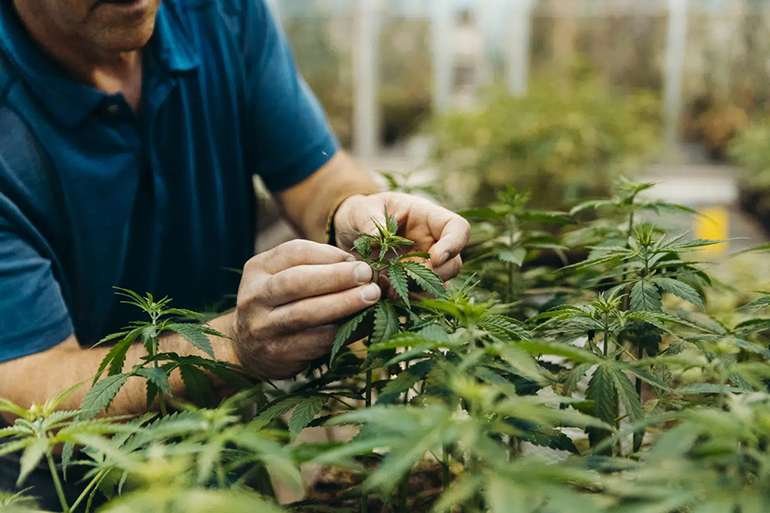
Even as state lawmakers continue to waffle over marijuana legalization, placing residents in a confusing holding pattern where certain hemp products are allowed and others aren’t, two universities have seen their cannabis research programs blossoming as of late, as they focus on the burgeoning potential for the cash crop.
North Carolina State University (NC State) and North Carolina Agricultural and Technical State University (N.C. A&T) each host programs that are focused on the best ways to grow hemp as an agricultural entrepreneur, including the most efficient and cost-effective means to extract the plant’s beneficial properties while maintaining soil health.
The budding industrial hemp industry kicked into gear after the passage of the Agriculture Improvement Act of 2018, better known as the United States Farm Bill.
Among the provisions of the legislation, which has been extended through September 2025 by the American Relief Act, universities are allowed to obtain approval from the Industrial Hemp Commission (IHC) to grow industrial hemp for research purposes.
The IHC is a state body that develops rules and licensing so growers stay within federal laws and guidelines. Legally, hemp is defined as a cannabis plant that contains 0.3% or less THC, the chemical that gets people high, while marijuana is a cannabis plant in which the THC surpasses that limit.
Although hemp is far from new in the Carolinas — in A New Voyage to Carolina, published in 1709, English explorer, surveyor and naturalist John Lawson mentions hemp several times as an important crop — the 2018 Farm Bill has been seen as a boon to farmers in North Carolina’s rural, formerly tobacco-dependent and economically distressed communities.
There are caveats to the state’s budding hemp production and its potential as a lucrative business for North Carolina farmers.
“The economic risks and production practices for plant growth and disease prevention are still largely unexplored,” reads the website for The Industrial Hemp Program at NC A&T.
Noting that the perceived financial benefits that hemp promises have heightened interest in NC farmers in the post-tobacco era, the site warns that farmers are getting into hemp production without having a full understanding of its economic viabilities and risks.
To address those risks, NC A&T, a historically Black, land-grant research university in Greensboro, launched the Industrial Hemp Program (IHP) through its College of Agriculture and Environmental Sciences.
In an email to Queen City Nerve, CAES spokesperson Lydian Bernhardt laid out the goals of the school’s research program.
“The College of Agriculture and Environmental Sciences at N.C. A&T State University is currently conducting research on best hemp-growing practices for North Carolina farmers, and invites those who are interested in learning more about how to grow hemp as a commodity crop to contact us directly [at the program’s website].”
The university website notes that industrial hemp (Cannabis sativa L.) not only delivers seed, fiber and medicinal cannabidiol (CBD), but also has the potential to improve soil health and provide environmental benefits.
Under Guochen Yang, Ph.D, horticulture professor and oversight coordinator of the university’s hemp program, IHP focuses on identifying the best hemp varieties for growing and producing CBD in North Carolina, determining the varieties of hemp that will grow in various parts of the state, assessing soil health and growing conditions and investigating the use of hemp in new energy technologies.
The program explores various uses of hemp including using hemp extracts as a potential disinfectant.
Another part of the IHP examines extraction and purification of CBD oil from hemp flowers and researches processing and distillation techniques designed to achieve greater purity for processed hemp.
The program also identifies plants and strains suitable to grow in North Carolina and provides information on pests, pollinator activity and soil health to farmers to help them make informed decisions about hemp production.
In addition, the program develops education initiatives, training programs, workshops and demonstrations for small-scale and limited resource farmers. The profitability of hemp farms is also examined, identifying potential risks associated with hemp production and testing nutrient combinations designed to enhance plant growth and reduce incidence of disease.
According to its website, NC State’s Cannabis Research Program is focused on environmental optimization — light, temperature, CO2, irrigation — of controlled-environment cannabis in order to increase the production in both the nursery market, where cannabis clones are grown, and in the market for flower related compounds such as CBD.
CBD has shown promise in alleviating anxiety, depression, epilepsy and inflammation. Unlike THC, CBD is not psychoactive, meaning it does not result in a high for users.
NC State, a public land-grant research university in Raleigh, is recognized as a research powerhouse. Overseen by Dr. Ricardo Hernández, professor and director of the Controlled Environment Ag Coalition (CEAC), NC State’s Cannabis Research Program launched at the end of 2018.
CEAC is a multidisciplinary, controlled environment research group based at the university as part of a nationwide effort to increase the viability of cannabis as a crop.
Cristian E. Collado, Ph.D, a researcher with the Department of Horticultural Science at NC State, is a CEAC member who works closely with Dr. Hernández.
In an email to Queen City Nerve, Collado outlined the research program’s intent.
“Our goal has been to solve industry challenges such as low propagation rates, crop growth, quality and high water usage,” Collado wrote.
The program, Collado continued, is focused on three areas of research. One is micropropagation, a method of plant propagation widely used in commercial horticulture where small pieces of plant tissue are taken from a carefully chosen and prepared mother plant and grown under laboratory conditions to produce new plants.
Another area, macropropagation, uses larger portions of the parent plant to produce new plants. Compared to micropropagation, it’s a faster and more cost-effective way to mass-produce planting material.
The third focus is on greenhouse and plant factory production. Both are controlled-environment agricultural facilities, but greenhouses primarily rely on natural sunlight and have a more open structure, while plant factories are closed systems that use artificial lighting.

NC State’s Cannabis Research Program highlights hands-on educational opportunities for students. Collado noted that the students engage each area of research, from PhD students leading projects to undergraduates and technicians assisting on those projects.
“The students and trained people significantly involved [in research] have been two PhD and one master’s student, about five undergraduates, one visiting scholar, and three technicians,” Collado wrote. “Additional undergraduate and graduate students working on other crops have also collaborated during specific needs.”
In April 2024, 22 state attorneys general, including then-NC Attorney General and Democratic gubernatorial candidate Josh Stein, sent a letter to federal lawmakers asking them to roll back many of the freedoms granted hemp producers and distributors in the 2018 Farm Bill.
In May 2024, the $1.5-trillion Farm Bill, which is normally extended every five years, was held up when Republican lawmakers on Capitol Hill sought to impose a ban on all hemp-derived THC through the bill.
Rep. Mary Miller, an Illinois Republican, filed a proposed amendment to the bill that would have rendered most products containing Delta-8 THC and other cannabinoids such as HHC illegal under federal law.
Miller’s proposed amendment put the hemp industry in legal limbo nationwide and increased the public’s confusion about the differences between hemp and marijuana as well as between THC and HHC.
Read more: NCGA Newcomer Jordan Lopez Takes up Fight for Marijuana Legalization
Both HHC and THC are cannabinoids, but HHC is a hydrogenated form of THC and is typically less potent than THC. HHC is also considered to have a milder psychoactive effect than Delta-9 THC but a stronger effect than Delta-8 THC, the chemicals found in non-CBD, THC-derived gummies and other edibles. All of these compounds currently comply with NC state law, limiting THC content to less than 0.3% for such products.
The hemp industry weathered the unease fostered by the actions of those attorneys general and Capitol Hill lawmakers, and the 2018 farm bill was extended through September 2025 without including the proposed changes.
State lawmakers, however, can impose limits on the sale of hemp-derived products. In January 2025, the United States Court of Appeals for the Fourth Circuit in Richmond, Virginia ruled that the 2018 farm bill doesn’t preempt states from restricting retail sales of intoxicating hemp-derived products.
Federal law gives states the “primary regulatory authority over the production of hemp [and it] “expressly permit[s] states to regulate the production of hemp more stringently [sic] than federal law,” the judges said.
With the current farm bill renewed for less than a year, North Carolina’s hemp industry, retailers selling hemp-derived projects, and university programs researching hemp could soon be in limbo again.
Another crackdown on THC products by state politicians could further destabilize hemp growers and merchants. In addition, the federal government’s unreliability creates a climate of uncertainty.
Actions by the Trump administration, such as tariffs, punish small farmers while enriching billionaire inside traders. Widespread funding cuts to universities, such as those implemented by DOGE, could potentially curtail or shutter NC State’s and N.C. A&T’s research programs.
Taken together, it remains to be seen whether these agents of instability and uncertainty will torpedo the industrial hemp industry and sever its lifeline to North Carolina growers.
Your email address will not be published.
Log in
Manage Subscription
Reset Password
Email: info@qcnerve.com
OR
(f)(last name)@qcnerve.com
(704) 817-8996
PO Box 6007
Richmond, VA 23222