
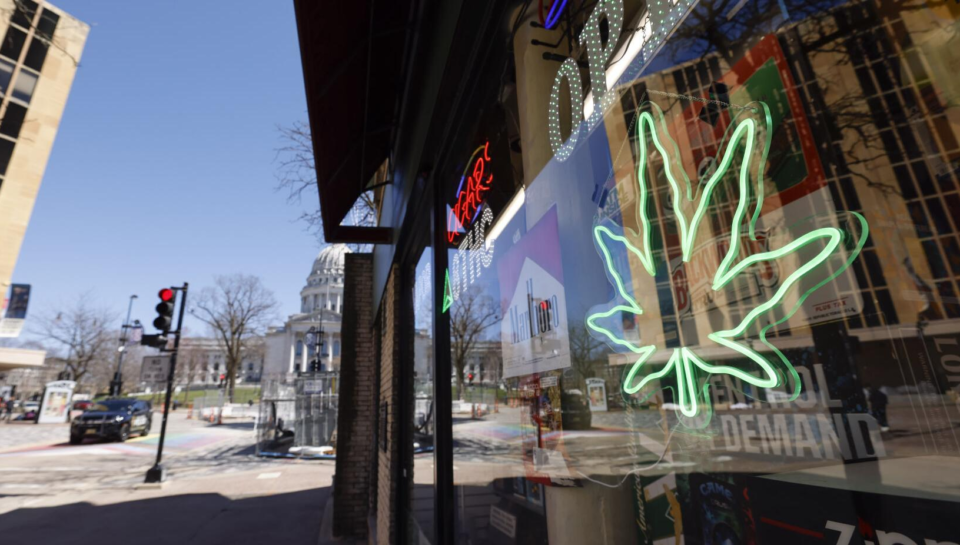
A store on State Street has a cannabis neon sign in its window. The 2018 Farm Bill redefined hemp and opened the door for purveyors to make and sell hemp-derived products with less than 0.3% THC, even in states like Wisconsin that have not legalized cannabis.
Erik Rasmussen is the owner of The Flower Shoppe on North Frances just off State Street. He has years of experience growing and cultivating hemp and his store attracts clients specifically seeking out his expertise.
Inside The Flower Shoppe, owner Erik Rasmussen built a space where people can smell different kinds of flower buds.
The Flower Shoppe has all sorts of hemp-derived THC products, from gummies and flower to pre-rolls and candies.
Pinebox is the retail location for 3 Tall Pines, a hemp business that grows and sells its own products. Owner Craig Thran said he picked the location, which is on the 100 block of State Street, because he “wanted to make a statement that this industry is organized.”
Some of the stores on State Street that sell hemp-derived THC products have signs like “Stoner Ave” or “Mary Jane Lane.”
Tony Herman, co-owner of Dank of America, said he’s never seen “something be decriminalized and then recriminalized.” He remains hopeful, despite impending legislation, Madison’s hemp industry will find a way to prevail.
Features Reporter
A store on State Street has a cannabis neon sign in its window. The 2018 Farm Bill redefined hemp and opened the door for purveyors to make and sell hemp-derived products with less than 0.3% THC, even in states like Wisconsin that have not legalized cannabis.
On an afternoon in March, a patron walked into The Flower Shoppe, a cannabis store tucked into a basement space near State Street. The customer said he’d moved to Madison from Massachusetts, a state that legalized recreational cannabis in 2016.
“First time in here,” he said. “Just looking around. Haven’t bought from a shop around here. The laws are pretty strange in Wisconsin.”
After searching online through the stores around State Street, he determined that The Flower Shoppe on North Frances Street “seemed the most like legal dispensaries I remember.”
The Flower Shoppe, opened by Erik Rasmussen in April 2024, carries all kinds of products: flower, gummies, canned THC drinks, infused candy bars and pre-rolls. Before entering the space, patrons enter a small foyer where they have to present their IDs before being buzzed in.
The foyer has a display with old cannabis and hemp books Rasmussen nabbed from the closing Paul’s Bookstore. He’s also hung some of his acrylic paintings, like a picture of Brewers Racing Sausages, some smoking a joint or hitting a bong.
Rasmussen asks customers questions to help figure out what products might work for them, from something to relax to a product that’ll help them deal with pain or sleep issues.
Recreational and medicinal cannabis use remains illegal federally and in Wisconsin. But in 2018, an exception was carved out on the federal level by the Farm Bill, which redefined hemp and opened the door for purveyors to make and sell hemp-derived products with less than 0.3% THC, the compound generally associated with producing a high.
Since then, there’s been a proliferation of stores selling hemp-derived THC products, particularly on State Street. Many have opened in the last five years.
Erik Rasmussen is the owner of The Flower Shoppe on North Frances just off State Street. He has years of experience growing and cultivating hemp and his store attracts clients specifically seeking out his expertise.
While smoke shops like Sunshine Daydream and Knuckleheads have been on the block for decades, spots serving hemp-derived products opened more recently: Hemp 1848 opened in December 2022; Puffin Pass (which now has another store on University and another in Milwaukee) in April 2025; and Madison Extracts in October 2025.
This list is not exhaustive, and doesn’t account for corner and liquor stores that also sell hemp-derived THC products. Many of these stores — not just on State Street but throughout Wisconsin — face an uncertain future come November.
In a law to end the 2025 federal government shutdown, members of Congress added a provision redefining hemp again in an attempt to prevent “the unregulated sale of intoxicating hemp-based or hemp-derived products.” The law could make many of the products retailers in Wisconsin sell illegal. The law is set to come into effect in November.
In March, Gov. Tony Evers sent a letter to the state’s congressional delegation urging them to change the new federal hemp law. The letter stated that Wisconsin’s hemp industry is worth $700 million and employs 3,500 people.
Cannabis is virtually unregulated in Wisconsin, despite pressure from stakeholders to create regulations or pass laws that would legalize its use. The 2025 hemp definition change won’t affect states with legal cannabis laws on the books.
“This is an inflection moment within the state. This is an important point for … politicians to figure out the direction of cannabis policy in the state,” said Lucas Richert, a historian of medicine and pharmacy at the University of Wisconsin-Madison.
Without state action, retailers and growers still have many questions. Will the new guidelines lead to store closures? Who will enforce new standards? And will the state eventually take measures to regulate or legalize cannabis in some way when the Legislature goes back into session?
“Retailers care about what’s going on … because their livelihoods are at stake, and their ability to operate within Madison is at stake,” Richert said.
Despite the industry’s rapid growth, there are few answers, and many are preparing for a future with dozens of possible outcomes.
Inside The Flower Shoppe, owner Erik Rasmussen built a space where people can smell different kinds of flower buds.
After taking a walk down State Street to tally stores selling hemp-derived or cannabis products (many in this story used cannabis and hemp-derived products interchangeably), Ald. MGR Govindarajan said he quickly “lost count.”
Govindarajan, who represents District 8 on the Madison City Council, commented that there weren’t as many of these stores “a year and a half ago, and now it feels like every block has one.”
There are new stores all around Madison, but growth may feel the most acute on State, a pedestrian walkway that has historically been “no stranger to the more… progressive youth‑movement type of products and services,” said Matt Tramel, executive director of the Madison Central Business Improvement District.
Tramel said there are 12 hemp-related stores in the downtown business improvement district and 10 on State Street specifically (which is in the district). The stores represent 5.2% of storefronts on State.
One of those spots is The High Crowd Cafe, a cannabis cafe on the 100 block of State Street. Manager Alex Almaraz says it’s one of the few spaces on the block that’s open late and doesn’t serve alcohol.
The spot is not your “typical stoner place,” Alamraz said. He works to combat stereotypes about cannabis. He often stands outside the cafe, saying hello to people.
“This is somewhere where you don’t have to cover your drink when you go to the bathroom. This is somewhere where you don’t have to worry about some drunk asshole bumping into you or hitting on you. … It’s a place to exist without judgment,” Almaraz said.
Rasmussen, owner of The Flower Shoppe, has years of experience growing and cultivating hemp. Part of the reason he wanted to open a store was to get out of the greenhouse and share his knowledge with others.
“I have a passion for trying to provide this plant for people, especially to get rid of the taboos … because I’ve seen it help in so many ways.”
Rasmussen says he has a diverse clientele and that demand is growing. “Most of the others down here are more focused on the college market. I have a lot of people 30-plus referred to me, from all over the Madison area, knowing they can trust what I’m going to recommend.”
Rasmussen’s not sure what he’ll do come November, and he’s halted some projects due to legal ambiguity. But he won’t shut down — the space houses a glass studio and he can rely on consulting work to float him for a bit. Whether he has to pivot or cut his stock down to only certain products, he’s determined to figure it out.
The Flower Shoppe has all sorts of hemp-derived THC products, from gummies and flower to pre-rolls and candies.
‘This industry is organized’
Craig Thran is the owner of 3 Tall Pines, a grower and seller of hemp-derived products. The brand is vertically integrated and has a retail location, called Pinebox, at 109 State St., which opened in 2024. The store sells a mix of items, like flower, pre-rolls, gummies, topicals and tinctures.
In the lead up to April 20 — a day that celebrates cannabis consumption — they’ve put together a 420 rescue kit filled with products like an infused cookie and 3 Tall Pines-grown flower, as well as lip balm, rolling papers and a sticker pack.
Thran said he picked the location, for which he pays $7,000 a month, because “I wanted to be right next to the Capitol. I wanted to make a statement that this industry is organized.”
“One of the things we pride ourselves on here is that we control everything from seed to the point of sale, and that ensures quality, and it helps us keep prices reasonable,” said Jeff McIntyre, manager of Pinebox.
McIntyre has also noticed the proliferation of cannabis stores. “I’m seeing some people lowering their prices. I’m seeing people having to adjust to the competition.”
McIntyre says he sees a range of customers, from people who are just walking up and down State to professionals and knowledgeable cannabis users seeking the store out. Days when there are outdoor events tend to draw the most customers.
“I think the proliferation of cannabis shops is an outcry saying, ‘Hey, we’re here. We want this. We can support it,’” Thran said. People opening cannabis stores on State are making calculated business decisions, he said.
“When you put your business hat on, you think, ‘What can I make money at selling?’ You’re not gonna pay $7,000 a month selling pants and shirts downtown,” he said.
Tramel noted that the COVID-19 pandemic changed the retail landscape on State Street, leading many retailers to close and creating space for new stores. “The pandemic … created vacancy. At the same time, you had this hemp bill create a new market. It’s just natural economics.”
Heather Ewing is the founder of ABSTRACT Commercial Real Estate, where she brokers deals for many downtown landlords and tenants. She thinks about alignment, or the idea that businesses near each other often complement one another, but said State Street is different from retail spaces like malls, which often have a single owner and can be more intentional in their curation.
“State Street is the opposite. It’s more (about) the entrepreneur, the individual.”
Pinebox is the retail location for 3 Tall Pines, a hemp business that grows and sells its own products. Owner Craig Thran said he picked the location, which is on the 100 block of State Street, because he “wanted to make a statement that this industry is organized.”
Serving a younger demographic
Whether there are too many stores selling hemp products on State Street might depend on who you ask.
“I have not actually heard that from constituents. I’ve heard that more from people who live outside of my district and visit State Street,” said Will Ochowicz, the alder for District 2, which covers State Street from West Gorham to North Lake Street.
Ochowicz noted the majority of residents in his district are under 35. Part of that has to do with the proximity of his district to the university, but he also pointed out that more young professionals are moving into the area. According to a report from Downtown Madison Inc., almost 80% of downtown Madison residents are between 15 and 34 years old.
“State Street …. it’s not (just) a destination for people who live outside of downtown to come to. It’s part of downtown, and it serves the people who live there,” Ochowicz said.
The balance between access and oversaturation can be tricky. However, it’s unlikely that more stores will open in the future. In November 2025, the Madison City Council passed an ordinance regulating the sale of hemp-derived THC products in the city.
The ordinance created age restrictions (buyers have to be 21 and older), but also restricted stores from selling hemp-derived THC products within a quarter mile radius of “youth-serving organizations,” including city and county parks.
The location of Elizabeth Link Peace Park, which is on the 400 block of State Street, effectively makes most of the block ineligible for new stores. (Existing stores are grandfathered in.)
“The intention was from more of the public safety aspect, rather than stopping the growth of these stores,” Govindarajan said. The ordinance also prevents retailers from selling hemp-derived products from vending machines and requires them to be displayed behind a counter.
This isn’t the first time the city has taken regulation into its own hands in the absence of state legislation. In 2020, the City Council allowed people 18 and older to possess up to 28 grams of cannabis.
But city ordinances don’t address the larger issue, and both Govindarajan and Ochowicz expressed uncertainty about what will happen to business owners who carry hemp products come November.
“I am not going to say, ‘Well, now it’s illegal, and we have to enforce it,’” said Ochowicz. “I’m going to be taking the opposite approach, which is: How can we hold off enforcement until this is clarified, until the state can do something about this?”
Both alders are waiting for state action. “I think the state should legalize it and then regulate it, both medical and recreational. That’s my personal and political stance,” Govindarajan said. “And I think that aligns with most of my district and my generation, frankly.”
Some of the stores on State Street that sell hemp-derived THC products have signs like “Stoner Ave” or “Mary Jane Lane.”
Hemp’s uncertain future
During the most recent legislative session, lawmakers in both the Wisconsin Assembly and the Senate tried introducing bills related to hemp-derived THC products. Senate Bill 1045 sought to legalize recreational cannabis use for adults 21 and older. Assembly Bill 747 would provide a framework to regulate the state’s existing hemp industry while also protecting children and consumers.
Neither bill passed before the 2025-2026 session ended in March.
“There is a vacuum here because the state has failed to act,” said Rep. Andrew Hysell, D-Sun Prairie. Hysell was the lead Democrat on Bill 747, which had bipartisan support.
Hysell said the lack of legislation means there are really no guidelines on what purveyors are selling. A Milwaukee Journal Sentinel investigation published in February tested 30 different hemp-derived products and found that some products contained more THC than what is allowed in states where cannabis is legal, and some had contaminants like mold.
“You’ve got some really good actors out there that (use) standard operating procedures, and they operate at a very high level,” Hysell said. The Journal Sentinel piece was “a great example that we need specific rules, regulations, so that people can have confidence … in terms of what they’re purchasing.”
“Most of the saturation in this market that we’re seeing is people jumping in to grab money,” said Tony Herman, co-owner of Dank of America, which has two stores in Madison selling THC products. “It’s like they’ll buy products from a wholesaler because there’s a good margin and not really understanding what the product is or what it’s made for.”
He noted the peculiarity of this moment. “Never before with this loophole have we questioned it being taken away,” Herman said. “I’ve never seen something be decriminalized and then recriminalized.”
Tony Herman, co-owner of Dank of America, said he’s never seen “something be decriminalized and then recriminalized.” He remains hopeful, despite impending legislation, Madison’s hemp industry will find a way to prevail.
Some speculated that stores will close. Others mentioned that the federal legislation might scare off actors with a lower stake in serving hemp-derived products, and only serious purveyors will remain.
Hysell encourages business owners to hang on and not overreact. He noted that Wisconsin has its own, standalone definition of hemp (Statute 94.55, which allows for the sale and distribution of hemp-derived THC products with less than 0.3% delta-9 THC). While cannabis is illegal federally, he reiterated that, to date, the government hasn’t interfered with states that have legalized its use.
“Why would hemp‑derived THC be any different?” he said.
But he’s also hopeful for the future. “If there is a change in leadership in the fall in the Legislature, I will tell you this: One of the first things we’ll need to do is address this. … We will need to address this ASAP.”
Herman is watchful, but not worried. He recently renovated Dank of America’s Williamson Street space — the back area is full of couches for people to sit and hang out. Dank hosts comedy nights and book clubs, surrounded by art made by local artists.
“There are few places you can go and just hang out, and we’re sober when it comes to alcohol,” he said.
He also knows that no legislation will stop people from getting high.
“At the end of the day, people are gonna smoke cannabis,” Herman said. “Before prohibition (laws) were lifted, people were drinking alcohol. We’re just talking about what they’re doing on paper.”
Ashley Rodriguez is the Madison culture reporter for the Cap Times. Ashley covers entertainment, cultural events, public art, restaurants, unique local businesses, neighborhoods and trends, among other features. Email story ideas and tips to adrodriguez@captimes.com.
Please consider supporting Ashley’s work by becoming a Cap Times member or sponsor. Sustaining local journalism in Madison depends on readers like you.
The Cap Times welcomes tips from readers to help us inform our community. Email tips@captimes.com or visit captimes.com/tips for more options.
Features Reporter
Your browser is out of date and potentially vulnerable to security risks.
We recommend switching to one of the following browsers:
Get up-to-the-minute news sent straight to your device.