
eEdition
Sign up for email newsletters
Sign up for email newsletters
eEdition
Trending:
It’s been nearly a decade since California voters legalized recreational cannabis, but production and sales remain outlawed in most of the state — and the black market dominates.
In fact, eight times more marijuana is cultivated illegally than through approved channels. It’s a far cry from the vision of Prop. 64, the 2016 ballot initiative that promised to legitimize the lucrative cannabis industry and usher in the end of the War on Drugs. Now it is clear, much of that “didn’t happen,” said Keith Humphreys, a Stanford University professor of behavioral sciences who studies drug policy.
“It was packaged as a free lunch,” he said. “There are no free lunches.”
That doesn’t mean the doomsday predictions of Prop. 64’s opponents materialized either. On the campaign trail, school board members and alarmed parents predicted marijuana would increasingly find its way into the hands of children and stoned drivers would cause more traffic collisions. State data shows neither happened.
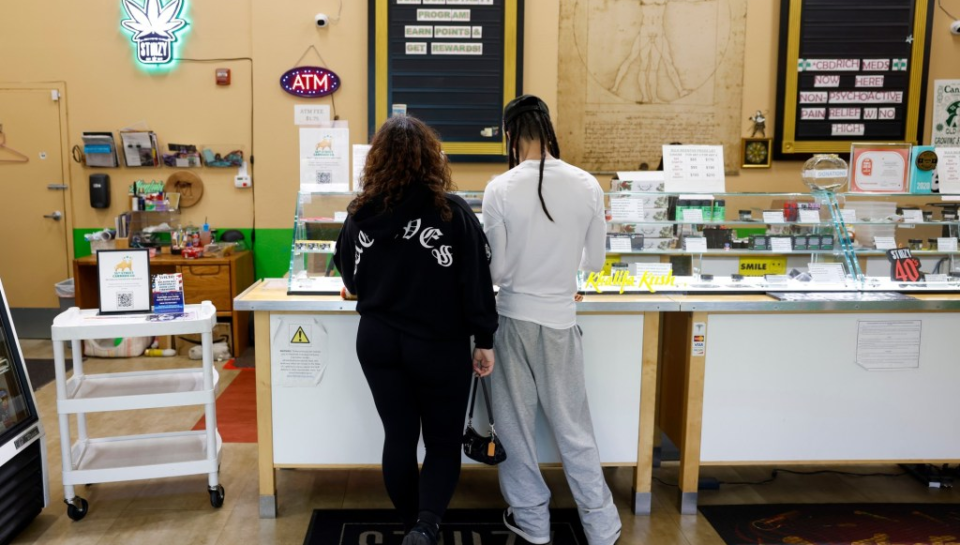
Entrepreneurs bemoan the state of the legal marijuana industry, and experts describe a mix of policy failures. The hefty black market competition, local bans on the marijuana industry and a years-long slide in the price of pot have strained business owners, they said. Mom-and-pop shops, especially, can’t afford to eat losses. Retail sales grew a paltry 4% from 2020 to 2025, state data shows. Meanwhile, the number of licensed cannabis businesses declined in recent years across every category, including retailers, distributors and growers.
In San Jose, Brando Duong, 34, sighed as he took stock of his licensed marijuana dispensary on a recent Wednesday. A veteran of the cannabis industry, Duong opened a medical dispensary in 2009 with his dad. Several of his employees manned the shop, who outnumbered the customers trickling in.
“We’ve just been, you know, hanging on,” he said. “We’re surviving.”
To entice customers, Duong slashed prices to $10.99 for an eighth of an ounce of pot. Before legalization, that was as much as one-fifth of the going price on the black market in California, he said. Still, that deal may not be enough to prevent customers from buying a cheaper bag down the street from some illicit dealer, he said, or heading to a rival dispensary for an even better deal.
“It’s kind of bittersweet,” Duong said. “I like to have something cheap, so that it’s affordable for people. But I also like to make money, like to survive, for real.”
The San Jose pot merchant’s experience isn’t unique. The state also isn’t getting the hoped-for returns. Gov. Gavin Newsom and state lawmakers have cut taxes on the faltering market to bolster businesses, doing away with the state’s special tax on cultivators in 2022 and then pausing a planned excise tax increase on retailers last fall.
State regulations for above-board cannabis farms are often described as a web of confusing and costly red tape. Meanwhile, the risk of growing pot without a license is low. Farmers of big, illicit cannabis farms faced felonies before Prop. 64. The measure downgraded the criminal penalty to an up to $500 fine and six months in jail, unless other crimes were committed in the process, such as environmental damage.
To deal with illegal producers, Newsom has also directed the California Department of Cannabis Control and other agencies to target grow operations — which, by all estimates, remain dominant in California. It’s believed thousands of these illegal farms dot the state, posing a challenge for authorities tasked with limiting their environmental damage and exploitation of off-the-books laborers, often immigrants without legal status in the U.S.
The numbers paint a dire picture for the legal industry: While licensed pot farmers produced 1.4 million pounds in 2024, the black market pushed out 11.4 million pounds — eight times more — according to a consultant report for the state cannabis agency in 2024. Antioch and Contra Costa County have become notorious for black market grow operations, often hidden in nondescript suburban homes.
State officials tout raids on illicit farms throughout the state, sometimes carried out by California Department of Fish and Wildlife agents with special forces-like tactical garb and assault rifles. According to Attorney General Rob Bonta’s office, state and local officials raided 617 illegal grow sites in 2025, averaging nearly two a day.
Newsom’s office said agents seized $134 million worth of cannabis, or 81,000 pounds, in Alameda County last year alone. In August, investigators discovered illegal farmers had cut a swath of manzanita shrubs in Napa County to grow about 150 plants, fed by water diverted from a creek in Robert Louis Stevenson State Park. Authorities shut down the operation but made no arrests related to the illicit farm, said Jeremy Stinson, a state parks spokesperson.
In the new wave of operations, Kevin McInerney, chief of enforcement at the California Department of Cannabis Control, said investigators are focusing less on lower-level pot farmers without licenses.
“Organized crime is behind a lot of this,” he told this news organization in the fall. “Targeting low-level offenders is not a good means of impacting the illicit market. We’ve been focused on middle managers and the upper-level people, the people legitimately making large amounts of money off the illicit market.”
Prop. 64 allowed cities and counties to ban marijuana businesses as they saw fit, creating a patchwork of laws where legal marijuana can be grown or sold in the state.
Today, 56% of cities and counties do not allow any retail cannabis sales, according to the California Department of Cannabis Control, including nearly all cities in Silicon Valley outside of San Jose. Personal use of pot at home is legal throughout the state.
“That local control issue has been a real big hindrance,” said Michael Polson, who leads UC Berkeley’s Cannabis Research Center. “What this often meant was just shutting down any option for legal participation at all, which ended up kind of ballooning the unlicensed market.”
Businesses have long leveraged that geography by setting up shop on municipal borders.
A stone’s throw from San Jose’s border with Santa Clara, where pot shops are banned, customers trickled into PLU2O Dispensary. The new shop is a sterile storefront lined with glass-topped shelves of marijuana flower, mini vapes and potent edibles.
Since the dispensary’s grand opening on Super Bowl weekend, inventory manager Sonny Roldan said many customers are tourists visiting Valley Fair, one of Silicon Valley’s premier malls, which is across the street. Hailing from as far as Taiwan and Texas, they’re amazed they don’t have to look for marijuana in “dark alleyways,” he said, or on the mobile messaging platform Telegram, “or whatever people use these days” where marijuana is still criminalized.
Customers are also driving in from other Silicon Valley cities — Milpitas, Sunnyvale, and Santa Clara. While neighboring communities banned dispensaries, officials in San Jose embraced them and reaped the tax benefits, to the tune of $13 million in the last fiscal year.
PLU2O’s head of retail Mariko Cooley still hopes the industry could become “massive,” harkening back to a more optimistic time in California cannabis, the early days of the “green rush” in 2018, when the first licensed businesses opened. Industry analysts are closely watching changes to the longtime federal classification of marijuana as among the most dangerous and addictive drugs. President Donald Trump and his predecessor Joe Biden have moved to loosen restrictions. If cannabis is eventually decriminalized, California could see a windfall.
“Who knows where it’s going to be in five years, or ten years,” Cooley said.
Copyright 2026 The Press Democrat. All rights reserved. The use of any content on this website for the purpose of training artificial intelligence systems, algorithms, machine learning models, text and data mining, or similar use is strictly prohibited without explicit written consent.