Home » Alabama
Five years after Alabama legalized medical cannabis, the state’s first dispensary is finally opening. The commission that got it here just received one of the most critical audits in the program’s history.
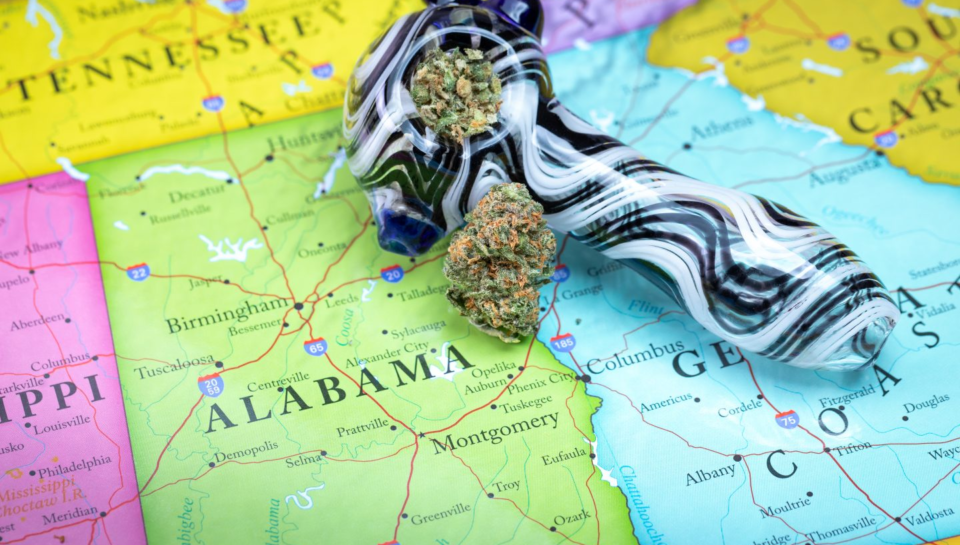
Alabama is about to make history. Callie’s Apothecary in Montgomery is set to serve its first patient on May 4, becoming the first licensed medical cannabis dispensary in the state’s history, five years after the Alabama legislature approved medical marijuana in 2021.
The Alabama Medical Cannabis Commission announced the opening date at its April 9 meeting, as reported by WSFA-12. AMCC Chairman Dr. Sam Blakemore described the facility in terms that speak to how carefully the state has approached the rollout.
“Callie’s Apothecary put me at home,” Blakemore said. “It reminded me of being back at a pharmacy.”
AMCC Director John McMillan was more specific about the security infrastructure. “A patient will not be able to even enter the door unless a picture is taken of their medical cannabis card and relayed through the system,” he said. “Cameras everywhere, lights everywhere, locks everywhere.”
Callie’s is the first of nine dispensaries operated by three licensed companies expected to be open by summer, as reported by MJBizDaily. A fourth license is still caught up in ongoing litigation, but the commission says it will not affect the May rollout. Blakemore expects all 12 locations to be operational by Q4 2026.
Dispensaries are planned for the following locations, according to the Alabama Medical Cannabis Commission website:
As of the April meeting, more than 40 physicians have been approved to prescribe medical cannabis by the Alabama Board of Medical Examiners, and 66 patient cards have been issued. Those numbers are expected to grow significantly once dispensaries are operating and access becomes real rather than theoretical.
66
Patient cards issued in Alabama as of the April 9 commission meeting. More than 40 physicians are currently approved to prescribe. The commission expects both numbers to grow significantly once dispensaries open.
On pricing, Blakemore said he has been studying comparable markets. “I’ve found a lot of price data from Minnesota, because they initially utilized products that were medical cannabis and non-flower, and typically the price is around $150 to $200 a month,” he said. “That can change based off of diagnosis.”
The launch is a milestone. It is also arriving under a cloud.
A state audit of the AMCC, reported by MJBizDaily, found serious problems with how the commission has operated. The findings include noncompliance with open meetings laws, overpayment of $204,000 to an external law firm, inadequate record-keeping and failure to adopt a compliant fee structure.
The audit findings align with allegations from lawsuits filed by unsuccessful license applicants, which delayed the program’s rollout — forcing the AMCC to cancel and redo multiple licensing rounds and pushing the sales launch from 2024 to 2026.
Source: State audit of the Alabama Medical Cannabis Commission, as reported by MJBizDaily.
That two-year delay from 2024 to 2026 is not an abstraction. It represents patients who have been waiting — some of them for years — for legal access to medicine their state approved in 2021. The audit’s findings are notable precisely because they surfaced on the eve of the market’s launch, not before.
State law, as reported by MJBizDaily, allows for a maximum of five vertically integrated businesses, each permitted to operate up to five retail locations; 12 licensed cultivators; four processors; and four dispensary-only permits, each of which can operate up to three locations. As of earlier this year, the commission had licensed four dispensary companies, nine cultivators and four processors.
Ongoing litigation around the integrated licenses continues, but the commission is clear that it will not affect the May rollout. Ray French, CEO of Specialty Medical Products — which is seeking an integrated license — struck a measured tone at the April meeting. “At the end of the day, getting patients medicine is what it’s all about,” he said. “We’re very encouraged by the proceedings with the independent licenses and we’re hopeful that at the end we’ll also have an opportunity to participate.”
Alabama joins a growing list of states where the distance between legalization and actual patient access has stretched into years. The five-year gap between the 2021 vote and the first dispensary opening reflects a program that struggled with its own governance as much as with outside opposition.
Whether the audit findings will have lasting consequences for the commission remains to be seen. For now, the more immediate question is whether 66 patient cards and 40 physicians represent the beginning of a real program — or just the beginning of a slow build that patients have already been waiting on for half a decade.
May 4 will be the first answer.
Get notified of our the latest cannabis news, exclusive brand deals, events updates and more!