Texas Voters Support Legal Medical Marijuana Access But Are Largely Unaware Of The State’s Existing Program, Poll Shows
States Could Opt Out Of Federal Hemp THC Product Ban Under New Bipartisan Senate Bill
Louisiana Senate Passes Bill To Create Psychedelic Therapy Pilot Program Funded By Opioid Settlement Dollars
Marijuana Is Safer Than McDonald’s French Fries, Cory Booker Says
Bipartisan Bill To Save Hemp Industry From Renewed Federal Criminalization Could Be Filed This Week, Rand Paul Says
Medical Marijuana Helps People Stop Using Opioids, Sleeping Aids And Other Prescription Drugs, Study Shows
Vaporizing Marijuana Reduces Harmful Inhaled Byproducts By 99% Compared To Joint Smoking, New Study Shows
Federally Funded Study Reveals Marijuana Breathalyzer Breakthrough With 3-D Printed Roadside Tool Able To Detect THC
Alcohol And Tobacco Are More Damaging To Users And Society Than Marijuana Is, Government-Funded Study Concludes
High Marijuana Taxes Don’t Effectively Deter Use, Study Shows, Contrary To NYT Editorial Board’s Claim
WNBA Offers To End Marijuana Testing For Women’s Basketball Players As Part Of Reported Deal With Union
DEA Promotes Anti-Marijuana PSA Contest Inviting Students To Warn Peers About THC Dangers On 4/20
Largest Entertainment Arena In US Partners With Cannabis Businesses To Sell THC Drinks At Concerts And Live Events
Woody Harrelson Got Kicked Out Of Two Bars For Smoking Marijuana With Matthew McConaughey’s Mom
State Marijuana Regulators Share Tips On How To Stay Safe And Legal Around The Holidays
Target Expands Involvement In Hemp THC Drinks Market With 72 New Licenses In Minnesota
Marijuana Sales Are Rising And Alcohol Is On The Decline As Consumer Preferences Evolve, Government Data In Canada Shows
Feds Deny Snoop Dogg Request To Trademark ‘Smoke Weed Everyday’ Because Marijuana Is Illegal And Song Lyric Is Too Popular
Marijuana Kiosks For Seniors Are Coming To Independent Living Communities Across Arizona
Montana Retailers Have Sold More Than $1 Billion Worth Of Recreational Marijuana Since Legalization Took Effect
Trump is planning a psychedelics executive order (Newsletter: April 17, 2026)
IRS addresses cannabis industry worker tips (Newsletter: April 16, 2026)
Virginia lawmakers push back on governor’s cannabis amendments (Newsletter: April 15, 2026)
Virginia governor wants cannabis bill changes (Newsletter: April 14, 2026)
Texas hemp product ban paused by judge (Newsletter: April 13, 2026)
Published
on
By
Using medical marijuana appears to help people reduce the use of other medications, including opioids, sleeping aids and antidepressants, according to a new study involving more than 3,500 patients. They also experience far fewer negative side effects after switching to cannabis from prescription drugs.
The results of the survey show that across all medication categories, patients were able to reduce use of other prescription drugs by an average of 84.5 percent after beginning medical cannabis consumption.
More than half the patients (58.9 percent) stopped use of other prescription medications completely.
The study, conducted and published by the medical cannabis and telehealth company Bloomwell, involved an online survey of 3,528 patients in Germany last month.
“Through the use of medical cannabis, patients were able to reduce the use of other prescription medications by an average of 84.5% across all categories.”
It found that 93.4 percent of patients taking prescription sleeping pills were able to reduce their use by at least half after starting medical marijuana, and 75.5 percent were able to quit taking the meds completely.
For methylphenidate, an ADHD medication sold under the name Ritalin, 77.3 percent of medical marijuana patients were able to stop completely.
Sixty-one percent of patients who previously relied on opioids were able to completely discontinue their use with the help of medical marijuana.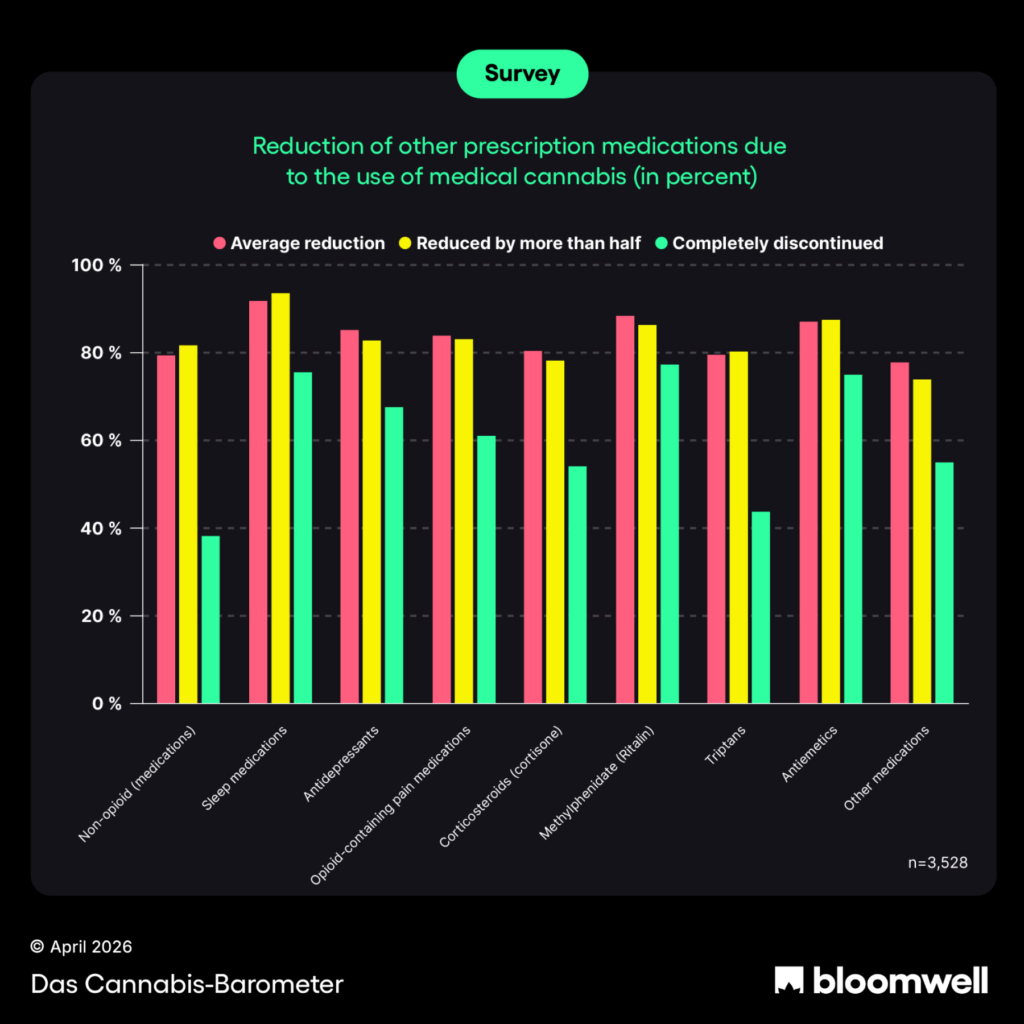
Ceasing to use the prescription drugs also led to a large reduction in medication-associated side effects, with 60.7 percent reporting they were no longer experiencing any.
“These patient reports prove that in many cases, besides the actual symptom treatment, one of the essential reasons for an individual therapeutic trial with medical cannabis is the absence or reduction of medication-associated side effects,” the study concluded.
“60.7% of patients report no longer experiencing medication-associated side effects due to the use of medical cannabis.”
There were positive side effects reported, however, with 67.8 percent saying medical cannabis helped them concentrate better, 61.9 percent saying it helped them foster more social contacts and 53.9 percent experiencing fewer sick days off from work.
“The main reason for prescribing medical cannabis, besides symptom treatment, is the reduction or avoidance of side effects from other medications,” Julian Wichmann, co-Founder and CEO of Bloomwell, said in a press release. “For example, anyone who can completely discontinue opioids by using medical cannabis has a good chance of managing their daily life and work free of side effects.”
“We should therefore not demand restrictions on access to medical cannabis, but rather ensure that doctors are more willing to attempt an individual therapeutic trial with medical cannabis, or at least recommend it and refer patients to colleagues,” he said. “At the same time, our survey shows that we should finally discuss the great benefits of medical cannabis more openly, instead of exclusively warning about empirically unproven risks and discrediting flowers.”
This is not the first study to position medical cannabis as a safer alternative to opioids and other prescription drugs.
About one in three Americans who use CBD say they take it as an alternative or supplement to at least one medication—particularly painkillers—according to a federally funded study published in February.
Similarly, another recent federally funded study, published by the American Medical Association (AMA), added more evidence that marijuana can serve as an effective substitute for opioids in chronic pain treatment.
Other AMA-published research has found that legalizing marijuana for medical or recreational purposes is “significantly associated with reduced opioid use among patients diagnosed with cancer.”
A separate paper published in October similarly found that medical marijuana legalization is “associated with significant reductions in opioid prescribing.”
In August, meanwhile, Australian researchers published a study showing that marijuana can serve as an effective substitute for opioids in pain management treatment.
Another study published last year in the journal Drug and Alcohol Review found that, among drug users who experience chronic pain, daily cannabis use was linked to a higher likelihood of quitting the use of opioids—especially among men.
Other research also found that legalizing medical cannabis appeared to significantly reduce monetary payments from opioid manufacturers to doctors who specialize in pain, with authors finding “evidence that this decrease is due to medical marijuana becoming available as a substitute” for prescription painkillers.
Other recent research also showed a decline in fatal opioid overdoses in jurisdictions where marijuana was legalized for adults. That study found a “consistent negative relationship” between legalization and fatal overdoses, with more significant effects in states that legalized cannabis earlier in the opioid crisis. Authors estimated that recreational marijuana legalization “is associated with a decrease of approximately 3.5 deaths per 100,000 individuals.”
“Our findings suggest that broadening recreational marijuana access could help address the opioid epidemic,” that report said. “Previous research largely indicates that marijuana (primarily for medical use) can reduce opioid prescriptions, and we find it may also successfully reduce overdose deaths.”
Another recently published report into prescription opioid use in Utah following the state’s legalization of medical marijuana found that the availability of legal cannabis both reduced opioid use by patients with chronic pain and helped drive down prescription overdose deaths statewide. Overall, results of the study indicated that “cannabis has a substantial role to play in pain management and the reduction of opioid use,” it said.
President Donald Trump said in December that marijuana can “make people feel much better” and serve as a “substitute for addictive and potentially lethal opioid painkillers” as he issued an executive order to federally reschedule cannabis and promote access to CBD for therapeutic purposes. He clarified, however, that he personally has no interest in using marijuana himself.
Tom Angell is the editor of Marijuana Moment. A 25-year veteran in the cannabis and drug law reform movement, he covers the policy, politics, science and culture of marijuana, psychedelics and other substances. He previously reported for Forbes, Marijuana.com and MassRoots, and was given the Hunter S. Thompson Media Award by NORML and has been named Journalist of the Year by Americans for Safe Access. As an activist, Tom founded the nonprofit Marijuana Majority and handled media relations, campaigns and lobbying for Law Enforcement Against Prohibition and Students for Sensible Drug Policy.
Add Marijuana Moment as a preferred source on Google.
All the cannabis news you need, all in one place. Copyright © 2017-2026 Marijuana Moment LLC ® and Tom Angell