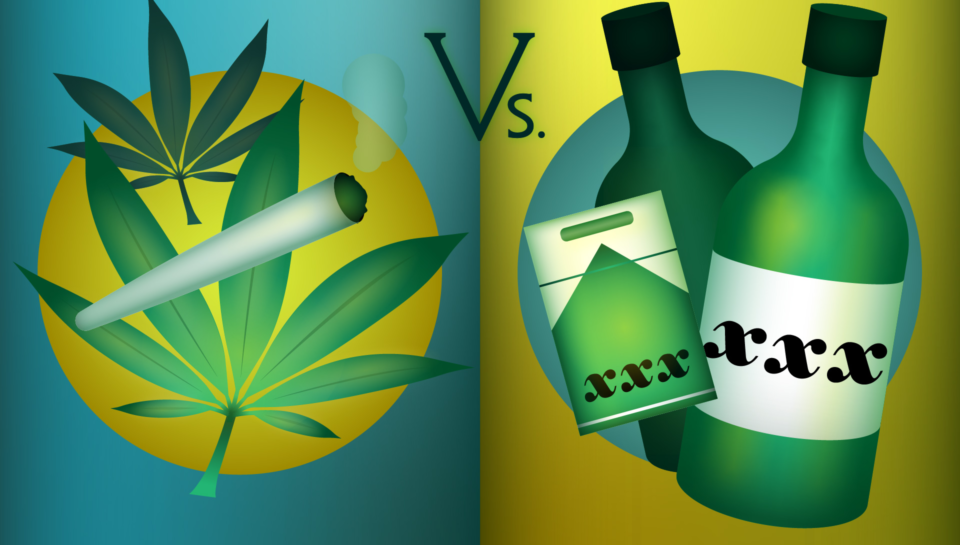
Studies show that many Americans believe marijuana is a healthier alternative to alcohol and tobacco. But DePaul experts say this perception is not backed by current scientific evidence.
The perspective that marijuana is safer than alcohol and tobacco is relatively new. In 2006, according to Pew Research, only 32% of Americans thought that marijuana should be legalized, compared with about 70% in their most recent 2025 survey. A past survey in 2025 also stated that one of participants’ primary reasons for legalization was the view that marijuana is safer than other drugs.
Don Opitz, an associate professor and director of DePaul’s cannabis studies, said that the public perception of marijuana is bad in a new way.
“There has been this cultural shift from seeing marijuana as this bad gateway drug and being associated with the undesirables of society,” Opitz said. “Now there is an embrace of marijuana as potentially beneficial.”
Cudaback, who has studied the impacts of cannabis, believes that a change in the marketing of marijuana is partially responsible for the shift in perceptions.
“Now it’s fruity flavors, and it’s pot brownies, and it’s gummies, and it’s cool names …,” Cudaback said. “You’re pushing a narrative that it is fun and safe. Even if you don’t purposefully do it, even if it’s not conscious.”
But both Cudaback and Opitz said marijuana is still a dangerous drug. It affects the body and mind in a different way than alcohol or tobacco, and the younger you are, the greater the impact on the brain.
“If you’re a 12-year-old and you go through a decade of chronic use, that changes who you are,” said Eiron Cudaback, an associate professor of neuroscience at DePaul.
Cudaback said the brain develops well into a person’s 20s and that chronic marijuana use over a long period of time can block social development.
“Essentially, some parts of your mind could be stuck at 12 years old,” Cudaback said.
But despite weed’s dangers, many like sophomore Eliran Masti, an acting major in The Theatre School, feel that weed simply has a different impact on the body.
“I think weed is safer than alcohol and tobacco because those are both addictive,” Masti said. “Tobacco products are usually infused with nicotine, so you just have that layer of easy addiction.”
However, cannabis is classified as an addictive substance by the National Library of Medicine. According to the Cleveland Clinic, marijuana users may develop Cannabis Use Disorder, a mental health condition where a person’s repeated marijuna use causes distress and impairs aspects of their life such as fulfilling responsibilities at school, work or home.
Brianna Murray, a freshman PR and advertising major at DePaul, felt that, based on her own experience, many different influences can impact the safety of a given drug.
“It depends on the individual and their mental state, and it varies person to person and depends on your family’s health history,” Murray said. “If your family has a history of alcoholism then alcohol would be worse, or if you had contributing factors for weed then weed would be worse.”
Ultimately, there is no definitive scientific answer on which of the three substances is safest. Each affects the human body in different ways. According to the American Psychological Association, tobacco is the most addictive of the three, and the CDC says it leaves users at higher risks of developing cancer. The CDC also states that alcohol is detrimental for liver health and leaves heavy users at risk of chronic diseases.
Cudaback believes that comparatively, weed has less of an impact on the body and a greater impact on the mind.
“There can be certain psychosocial deficits that can come about when you use cannabis,” he said. “There are certain developmental blocks, blockades and interruptions that happen that could lead to bad decision-making, poor outcomes and poor health outcomes.”
Cudaback said this means heavy weed users have a higher risk of slowing brain development and exacerbating mental health issues. Those who exhibit mental health disorders or are predisposed to developing them are at a higher risk of weed impacting their brain.
Related Stories:
Support Student Journalism!
The DePaulia is DePaul University’s award-winning, editorially independent student newspaper. Since 1923, student journalists have produced high-quality, on-the-ground reporting that informs our campus and city.
We rely on reader support to keep doing what we do. Donations are tax deductible through DePaul’s giving page.
The DePaulia is DePaul University’s award-winning, editorially independent student newspaper. Since 1923, student journalists have produced high-quality, on-the-ground reporting that informs our campus and city.
We rely on reader support to keep doing what we do. Donations are tax deductible through DePaul’s giving page.
Your email address will not be published.