
To stream 9NEWS on your phone, you need the 9NEWS app.
Next up in 5
Example video title will go here for this video
Next up in 5
Example video title will go here for this video
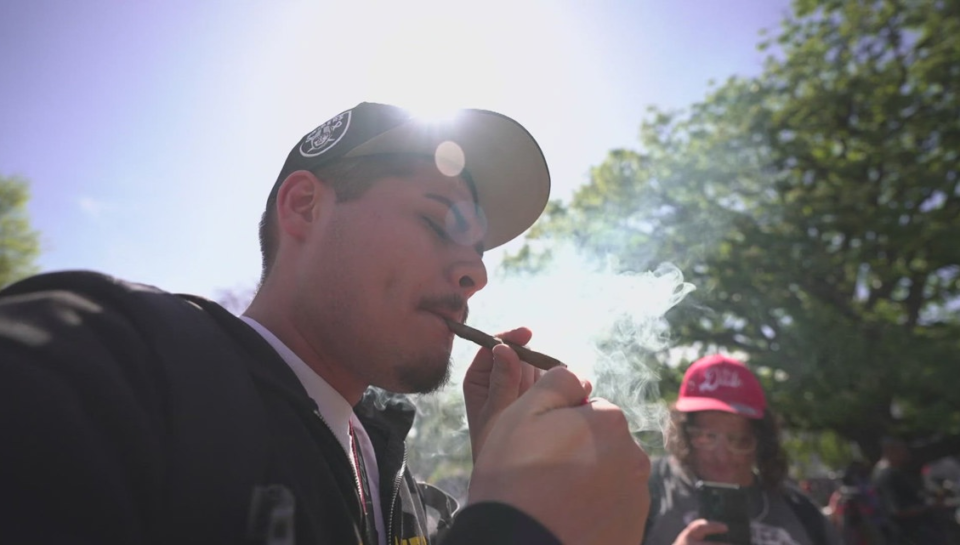
DENVER — Thousands gathered in Civic Center Park on Monday for Denver’s annual 420 festival, but behind the celebration, Colorado’s marijuana industry is in the middle of a years-long economic downturn that shows no signs of reversing.
Denver marijuana sales peaked at $514 million in 2020 and fell to $272 million by 2025 — a decline of nearly 47%. Statewide, Colorado marijuana sales have dropped more than 40% since their 2021 peak of more than $2.2 billion.
“The marijuana industry has been in a prolonged recession in Denver and across Colorado since it really hit its peak during the pandemic,” said Eric Escudero, a spokesman for the Denver Department of Licensing and Consumer Protection.
Escudero said the industry’s struggles are tied in part to the rapid spread of marijuana legalization across the country, which has eroded the novelty and destination appeal that once drove cannabis tourism to Colorado.
“In the early days of marijuana legalization, if people wanted to consume and take part in this, from all over the country they’d come to Denver,” Escudero said. “Now, as legalization has spread, you don’t see people coming as they used to.”
At Monday’s festival, attendees appeared unconcerned with market trends. Danielle, a festivalgoer who declined to provide her last name, pointed to a marijuana leaf tattoo she said she got with her husband.
“It’s legal, and it’s our right, and we can,” she said.
The contraction has extended beyond sales figures. The number of marijuana stores and cultivation operations in Denver has declined significantly since 2022. Burglaries of marijuana businesses have also fallen sharply over the same period, according to Denver Police Department data provided by the licensing department: from 193 in 2022 to 124 in 2023, 112 in 2024, and 84 in 2025.
The industry’s financial pressures may soon be compounded by a pending state bill. House Bill 26-1409 would eliminate the state shareback — a portion of state retail marijuana tax revenue that Colorado currently distributes to local jurisdictions.
The Denver Department of Licensing and Consumer Protection said that shareback funding helps cities shoulder the regulatory burden that state law places on them. Under Colorado’s dual-licensing system, local authorities are responsible for licensing and inspecting marijuana businesses for compliance. Denver inspects all 331 of its licensed marijuana businesses annually.
The department noted that the Colorado Marijuana Enforcement Division has limited capacity to conduct inspections statewide, leaving local agencies to fill the gap. Local law enforcement, not the state, is also responsible for enforcing criminal violations of marijuana laws involving unlicensed individuals or businesses.
The department warned that eliminating shareback revenue “may impact Denver and other jurisdictions’ ability to fill the gap in state regulation and enforcement.”
Escudero said the broader picture reflects a market in transition.
“The marijuana industry in Denver is definitely in a transition,” he said. “This has been going on since 2020.”
Despite the headwinds, the 420 festival drew its usual crowd — a sign that demand, if not the industry itself, remains very much alive.