
Bills aimed at legalizing recreational marijuana lack support – The Garden Island Newspaper
JAMM AQUINO / JAQUINO@STARADVERTISER.COM
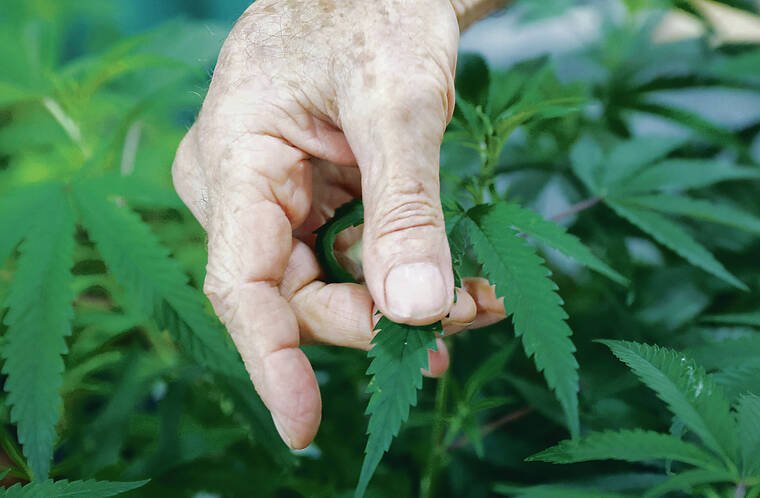
Two House bills aimed at legalizing recreational marijuana will not be moving forward. Afghan Skunk strain cannabis plants are displayed at the 2026 Hawaii Cannabis Expo.
Two bills aimed at legalizing recreational marijuana — or even creating marijuana guardrails — are effectively dead, according to House Speaker Nadine Nakamura and Rep. David Tarnas, who has pushed for legalization for years.
Two bills aimed at legalizing recreational marijuana — or even creating marijuana guardrails — are effectively dead, according to House Speaker Nadine Nakamura and Rep. David Tarnas, who has pushed for legalization for years.
House Bill 1624 would have asked voters on the November ballot if they want to pass a constitutional amendment legalizing adult-use recreational marijuana.
And HB 1625 attempted to change the regulatory framework that would go into effect only if the federal government removes marijuana from its schedule of controlled substances.
HB 1625’s companion bill, Senate Bill 2421, remains alive in the Senate and Tarnas (D, Hawi-Waimea- Waikoloa) remains hopeful it will cross over to the House at the midpoint of the legislative session.
Despite close votes and growing public support, Nakamura (D, Hanalei- Princeville-Kapaa) said neither of the House bills would move ahead.
“We’re the same members from last year … and when we checked around, it didn’t sound like it would change anyone’s mind,” she said Friday. “… It’s just not a clear-cut ‘let’s do it.’”
She explained that legislative support for legalization varies geographically, with neighbor island communities showing higher levels of support, while opposition, in general, continues in parts of Oahu.
On Kauai, Nakamura said nearly every attendee supported legalization at a town hall she attended with fellow Kauai Reps. Luke Evslin (D, Wailua-Lihue) and Dee Morikawa (D, Niihau- Hanapepe- Waimea).
An estimated 50 to 60 people showed up, and Nakamura said that when she asked who supported legalizing marijuana, “all of the hands went up, except for one.”
After both bills were referred to House committees in January, Nakamura said an informal head count of House members found little change in attitude compared to previous sessions.
“We represent 1.4 million people,” she said. “The constituencies are so different and they have to represent their constituencies.”
Tarnas attempted a new strategy this year by tying legalization to action by the federal government to decriminalize marijuana.
HB 1625 also would have reorganized oversight of Hawaii’s legal marijuana markets under the Department of Commerce and Consumer Affairs.
“I think the bill we put out this year addressed the concerns better than the bill last year,” Tarnas said. “So I think we got more votes from our internal polling but it’s not enough. So I still need to keep working on it.”
His other bill proposing that voters consider a constitutional amendment legalizing recreational marijuana faced a high bar in both the House and Senate, where it would have to be approved by a two-thirds vote in each chamber.
According to Nakamura, some legislators oppose the use of a constitutional amendment to decide marijuana policy, arguing the issue should be left up to them.
“The feedback we were getting from members is that this doesn’t rise to the level of a constitutional amendment where we’re changing the way government operates,” she said. “This is more of an issue that should be addressed within the body.”
A report this year from the Hawaii Alliance for Cannabis Reform calculated that an adult-use cannabis market in Hawaii could reach between $59 million and $95 million per month by its fifth year, with tourists contributing an additional $11.5 million per month.
The report also estimates Hawaii would need approximately 65 retail outlets statewide in the first year of adult-use sales to meet consumer demand.
Advocates such as Nikos Leverenz, board president of the Drug Policy Forum of Hawaii, said the findings highlight the potential for adult-use cannabis to strengthen multiple sectors of the state’s economy, particularly agriculture and tourism.
“While this report did not specifically address potential tax revenues, it shows significant demand for marijuana and marijuana products among local and tourist markets,” Leverenz was quoted in comments attached to the report.
While neither of the House bills are likely to survive the session, Tarnas said he plans to hold an informational briefing to hear objections from his colleagues. He remains committed to one day seeing Hawaii legalize recreational marijuana use for adults.
“I’m being courteously persistent,” Tarnas said. “I think it’s incumbent upon me to continue the conversation in a productive way and a collaborative way to address the concerns of House members and the concerns of the chairs of those committees that have referred the bill.”
State and local environmental leaders strongly condemned President Donald Trump’s move o…
Should all cats five months or older in Hawaii be sterilized?
Despite strong support from environmental and Native Hawaiian stewardship groups, a bill t…
Your email address will not be published.
*
*
By participating in online discussions you acknowledge that you have agreed to the TERMS OF SERVICE. An insightful discussion of ideas and viewpoints is encouraged, but comments must be civil and in good taste, with no personal attacks. If your comments are inappropriate, you may be banned from posting. To report comments that you believe do not follow our guidelines, send us an email.