
Legislature overrides Meyer’s labor bill veto, Senate advances vetoed marijuana bill override – spotlightdelaware.org
We translate complex Delaware policy into actionable information you can actually use. Join 10,000 Delawareans who start their day with Spotlight. Sign up for our free newsletter.
Spotlight Delaware
Empowering Delawareans with Local News and Information
Why Should Delaware Care?
In a surprise move on Wednesday, the State Senate voted to override Gov. Matt Meyer’s two vetoes issued on bills last year. The move underscored longstanding tensions between Delaware’s governor and lawmakers within his own party, and sparked outcry from Republican lawmakers about process and local control.
Longstanding tensions between Delaware’s governor and lawmakers within his own party revealed themselves again on Wednesday.
The State Senate voted to override Gov. Matt Meyer’s two vetoes issued on bills last year – one that would close what advocates call a wage theft loophole, and another that would limit restrictions on where marijuana shops can be located. The House later sealed the override on the labor bill, but has not yet voted on the marijuana override.
Know what’s happening today, so you know what to do tomorrow. Get our free newsletter delivered right to your inbox – six days a week.
In each of the three votes, legislators cleared the three-fifths margin needed to override a governor’s veto.
The governor originally vetoed the Senate Bill 63, meant to close wage theft loopholes that occur when a general contractor improperly claims a subcontractor as an independent contractor, last August, citing concerns over the “unintended consequences” of the legislation – particularly on Delaware’s immigrant communities.
But lawmakers – despite vocal Senate Republican opposition to the surprise move – bucked those concerns Wednesday, voting almost entirely along party lines to override Meyer’s veto. Rep. Josué Ortega (D-Wilmington) was the only Democrat to vote against the measure.
“It’s not an attack on our governor,” State Sen. Jack Walsh (D-Stanton), who sponsored SB 63, said about the decision to override Meyer’s veto. “I think the governor had some very valid points. He notices [in his statement] there is a problem in this construction industry. He notices that. But I think we just have different ways of going about the fix.”
The State Senate also voted to override Meyer’s veto of Senate Bill 75, which would loosen zoning regulations around the state’s marijuana industry. The House of Representatives, however, has yet to vote on the SB 75 veto override, and likely will not do so until after the legislature returns in mid-March from its upcoming break to conduct Joint Finance Committee hearings.
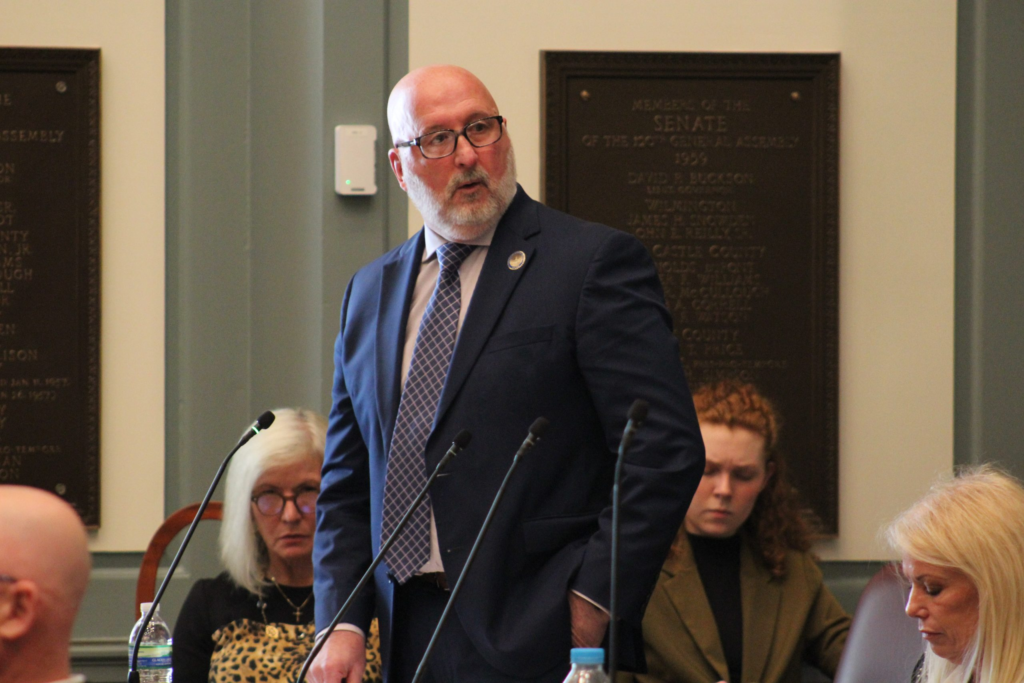
Senate Republicans lambasted their Democratic colleagues before each override vote, particularly for introducing the measures without giving the minority party advance notice. According to the Senate rules, giving advance notice across party lines – or even putting veto override votes on the Senate’s publicly accessible agenda – is not required.
“I’m amazed – dumbfounded – at the fact that we’re even here right now.” State Sen Eric Buckson (R-Dover) said. “This was thrown at me at this time. At this particular minute. And this, to me, is not process. A simple heads up would have been more than fair.”
But Democrats pushed back against Republican objections, saying they were simply following the chamber’s rules, and that last week’s winter storm had caused delays and miscommunications between the leadership of each party.
And after nearly 90 minutes of debate, the Senate voted to override Meyer’s veto of both SB 63 and SB 75.
When asked about the overrides Wednesday, Meyer stood by his vetoes. On the marijuana bill override specifically, Meyer stated he believes marijuana should be legal. Then added that he doesn’t think “the state should require every county and certainly localities to have marijuana stores 500 feet from the local elementary school.”
“I think it’s a local decision. That’s what I think. If Senate Democrats disagree, then they can disagree,” he said.
On SB 63, he tied the legislation to federal actions over the past year to scoop up personal data from states, including some that contain details about a person’s immigration status. He said he frequently hears about fears that voters have of the federal government “coming and doing horrific things in our state – of ICE coming and doing what we’re seeing in Minneapolis.”
“That has not happened here. By God’s grace, it will never happen here, but ICE is sniffing around,” he said, citing Spotlight Delaware reporting last year about federal officials trying to access Department of Labor records.
Last summer, the Delaware Hispanic Commission expressed concerns about SB 63, issuing a statement applauding Meyer’s veto.
The commission feared the bill would have resulted in “unintended harm” to immigrant and non-English speaking workers, “particularly in industries such as construction and landscaping.”
The bill aimed to close wage theft loopholes that occur when a general contractor improperly claims a subcontractor as an independent contractor. In doing so, the general contractor does not pay into income tax withholding, unemployment insurance, minimum wage, and workers’ compensation.
The bill would also make general contractors liable for their subcontractors in enforcing those requirements, because currently employers who do not register as subcontractors cannot be punished by the Department of Labor.
The Hispanic Commission’s concerns are centered around this extension of liability. Undocumented immigrants are not able to be hired by employers, but they can start their own businesses as independent contractors while they pursue an immigration status. A push toward registering more workers as subcontractors, the commission said, created real concerns in the Latino community.
Despite these concerns, a coalition of national immigrant rights groups – including the National Immigration Law Center and the Labor Council for Latin American Advancement – wrote a letter to lawmakers earlier this month expressing support for overriding Meyer’s veto.
Walsh, SB 63’s sponsor, also said his bill will help protect immigrant workers.
“This is a protection bill,” Walsh said. “This is a worker protection bill to make sure that workers don’t get exploited, and aren’t misclassified and get the benefits that they deserve.”
While the House of Representatives voted to override Meyer’s SB 63 veto almost immediately after the measure passed the Senate, it did not take a vote on overriding the governor’s veto of SB 75 on Wednesday.
The bill, which would loosen regulations around where marijuana businesses can locate in Delaware, sparked fierce outcry from Republicans at Legislative Hall and faced strong opposition from county leaders, who argued it was among a handful of bills seeking to squash “home rule,” or the principle of self-governance by locals.
Meyer’s SB 75 veto earlier this summer was his first, followed shortly after by his veto of SB 63.
State Sen. Trey Paradee (D-Dover), who led the push for SB 75, admonished Meyer in a statement shortly after the veto was made public last summer.
“If you give someone your word and you later back out or do not deliver as you promised, you will irreparably tarnish your name and reputation,” he said at the time. “Once that happens, no one will trust you or want to work with you again.”
But today, when introducing the veto override measure for his bill on the Senate floor, Paradee struck a much less pointed tone.
Voting to override Meyer’s veto, he said, is about lawmakers standing behind their own policies and supporting the state’s recreational marijuana industry instead of letting it flounder.
The override passed the Senate largely along party lines. Russ Huxtable (D-Lewes), the only Democratic state senator from Sussex County, abstained from voting, and all Senate Republicans voted no on the measure.
Many Republicans again decried what they called a violation of the principle of local control, saying elected officials in Delaware’s three counties – specifically Sussex County – should be able to decide where marijuana dispensaries can operate.
And while the override measure is now in the hands of House Speaker Melissa Minor-Brown (D-Delaware City), she said she was not prepared to take a vote on it during Wednesday’s session.
“I will not put an override on the floor if it does not have the votes,” Minor-Brown said.
She declined to elaborate further, saying there is “more conversation” that needs to be had about the measure during the legislative break for Joint Finance Committee hearings.
Paradee, however, said he remains confident that an override to Meyer’s SB 75 veto is possible.
“I think it’s just some hand holding, and some assurances,” he said “And I think eventually we’ll get it done.”
Karl Baker and Jacob Owens contributed to this report.
Spotlight Delaware is an independent, nonprofit newsroom covering how decisions at every level of government affect Delawareans. Your gift helps us report on the issues that matter most and keeps our work free and accessible for all.
Tim Carlin came to Delaware after spending several years working for both for-profit and nonprofit news organizations. Most recently, he served as a community engagement and government solutions reporter… More by Tim Carlin
Empowering Delawareans with Local News and Information
Sign in by entering the code we sent to , or clicking the magic link in the email.
By signing up, you agree to our Privacy Policy. This site is protected by reCAPTCHA and the Google Privacy Policy and Terms of Service apply.