
Loose cannabis is like spilled beer, not open container in car, state Supreme Court rules – Los Angeles Times
This is read by an automated voice. Please report any issues or inconsistencies here.
California cops can’t stop or cite drivers under the state’s “open container” rules for cannabis unless the product is rolled or otherwise ready to consume, the California Supreme Court ruled Friday.
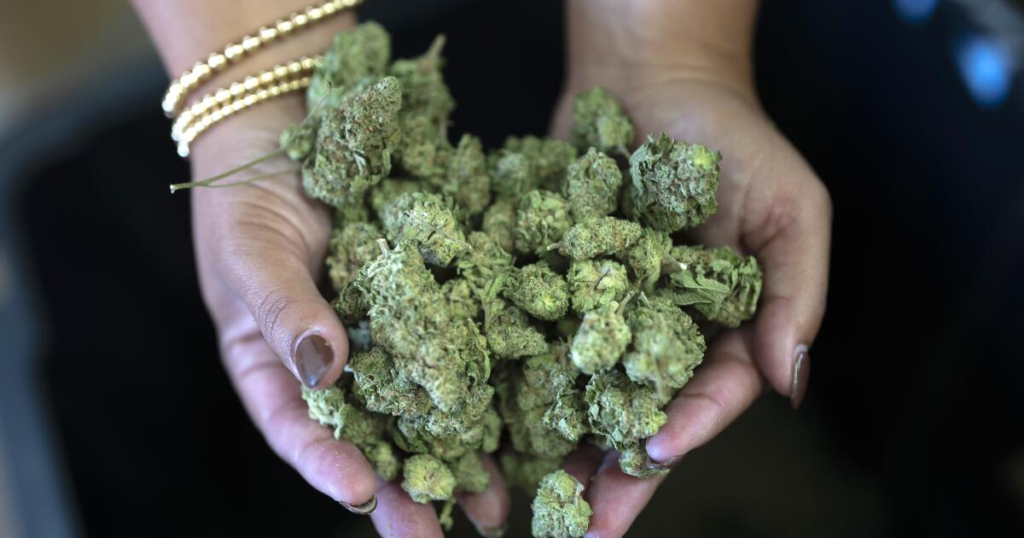
“The question before us is whether a small amount of loose marijuana scattered on the rear floor of a car violates [the open container] provision,” Justice Goodwin Liu wrote for the court. “We hold it does not.”
The case arose after Sacramento police spotted a dusting of loose “crumbs” in the back of a car they had pulled over for a rolling stop. The debris weighed about a third of a gram — roughly the same as a dollar bill, or the contents of an average joint — and was not “accessible for consumption,” according to the decision.
California
Jury selection was scheduled to began in L.A. County Superior Court on Tuesday in the first of a series of closely-watched lawsuits seeking to prove social apps inflict harm on children, but a last-minute agreement by TikTok left uncertainty around how the case would proceed.
Nevertheless, police cited the “open container” law as probable cause to search the car, and turned up an unregistered handgun, for which the passenger was charged.
“No officer suggested he was concerned that [the driver or passenger] could have somehow, while riding in the front of the car, collected the scattered bits of marijuana from the rear floor behind [the passenger] for imminent consumption,” Liu wrote. “The officers had no reason to believe that any marijuana was recently rolled, and the officers did not suspect impaired driving, underscoring the disconnect between the scattered bits of loose marijuana on the rear floor and potential for imminent consumption.”
Friday’s decision draws a much sharper boundary around what can be considered an “open container” under California law. Liu wrote that, until recently, the “provisions have been relevant primarily in the context of alcohol.”
“Although the ‘open container’ concept as applied to marijuana reflects the same purpose, alcohol and marijuana are materially different,” the judge said.
It’s relatively easy to grab an open beer from the back seat while driving, but much harder to pack a pipe or roll a joint with bits of flower off the floorboards, the court held.
Courts have previously ruled that an “unburned blunt” on the lap of a passenger violates the open container law because it’s ready to be used, while remnants of ash and flecks of pot in the center console and the driver’s lap did not, because it fell below the threshold of a “usable amount.”
California
The state’s high court handed down a decision Monday that vacated court fines for an alleged prison gang leader, setting a precedent that advocates said will help indigent defendants in other cases.
Friday’s decision sets aside that “usable amount” metric in favor of an accessibility test.
“Marijuana that is not in a state to be consumed or that cannot be reached ‘while driving, operating, or riding’ in a vehicle has no potential for impaired driving,” Liu wrote. “While marijuana in a sealed container is neither readily accessible nor imminently usable and thus does not violate the open container statute, marijuana in a vehicle need not be in a sealed container to be lawful.”
The most important California stories and recommendations in your inbox every morning.
By continuing, you agree to our Terms of Service and our Privacy Policy.
Follow Us
Sonja Sharp is a legal affairs reporter for the Los Angeles Times and a founding member of the Society of Disabled Journalists. Before joining the newsroom in 2019, she worked as an NYPD-credentialed member of the New York City press corps, writing stranger-than-fiction stories of crime and culture for VICE, the Wall Street Journal and the Village Voice, among others. She is a Bay Area native, a graduate of UC Berkeley and Columbia, and a proud Jewish mother.
California
California
California
Taped Jan 8, 2026, a year after the Eaton Fire, this episode features Ondi Timoner. After losing her home, she began documenting the displacement and financial struggles of her neighbors, joining My Tribe Rise to help Altadena rebuild and recover.
Attorney Frank Carson defended the accused for decades. Framed for murder and later acquitted, a star witness admitted he lied. Stanislaus County paid $22.5M to settle his estate’s lawsuit.
In this specially released bonus episode, Madison McGhee and Jami Rice share some extremely opinionated opinions about everything from the Menendez Brothers to Jax Taylor. And just so you know, they are absolutely, one hundred percent right about everything.
California
California
California
California
Subscribe for unlimited access
Site Map
Follow Us
MORE FROM THE L.A. TIMES