
Op-Ed | Virginia Hemp Farmers Stuck Between Marijuana and Big Government – rvamag.com
by | Jan 26, 2026 | CANNABIS CULTURE, COMMUNITY, OPINION & EDITORIAL, SMALL BUSINESS
Editor’s Note: Redfern Hemp Co. has been a supporter of RVA Magazine over the past year, helping make our continued coverage of the Virginia cannabis marketplace and the evolving hemp laws affecting Virginia and the nation possible. This piece is a first-person perspective from within the hemp industry and reflects the views and experiences of the author.
If you work in the “Hemp World,” you learn to wear a lot of hats. And fast.
My name is Joe Domino, and I work with Redfern Hemp Co., founded by Graham Redfern with the assistance of many of his long-term employees. In the span of any given day, I might be doing marketing, attending advocacy meetings, making wholesale deliveries, handling customer complaints, or ending up on Graham’s farm doing a myriad of different grunt jobs.
Over the past several years, I’ve experienced most facets of the business.
As a first-hand account, I can attest that Graham puts a lot of weight on his shoulders every day, not only to meet payroll but also to stay compliant with a laundry list of regulations.
Here are only a few of the things he has to do. In order to grow hemp on his 42-acre Caroline County farm, he must get an FBI background check every year, which he has done for the last six years. After that, he has to let the state’s hemp regulatory agency, under the Virginia Department of Agriculture and Consumer Services, know every time he plants a field and what variety.
If the crop is successful, Graham then has to pay for a cannabinoid profile test of the plant’s floral material for each field, with each test costing $100 or more, to ensure the biomass of the harvest is under the federal USDA limit of 0.3 percent total THC. If the tests are good, then Graham must, by law, harvest that crop within 15 days and, in turn, inform the state once he has.
There needs to be one clarification, or scientific explanation, about the new federal hemp ban that McConnell snuck into the bill that reopened the government. McConnell did not change the federal limit of 0.3 percent THC content from the farmer’s harvest.
What the ban did was sever the 0.3 percent THC threshold from being carried over to hemp products being sold at retail. McConnell’s spending bill amendment replaced the 0.3 percent standard with a strict cap of 0.04 mg of THC per packaged product.
That means Richmond’s Bingo Beer’s 2 mg seltzer would be considered marijuana.
The general consensus within the industry is that, for most THC consumers, a 5 mg drink is equivalent to a beer. From firsthand accounts, these infused beverages act almost like a nicotine patch, meaning these low-THC beverages have helped a lot of people get off booze.
On the federal level, the recent industry push is to postpone McConnell’s hemp ban at least two years, which would, hopefully, give the FDA time to create clearer guardrails for operators.
This is an important distinction between percentages and milligrams, because end consumers will never be able to buy hemp straight from the farmer, off the field. More likely than not, Graham’s hemp will be processed by another Virginia-owned third-party processor into valuable wellness oils and ingredients like CBD, CBG, and CBN.
These cannabinoids, which many of us view as an agricultural commodity that should benefit the farmer, will be extracted either as a full-spectrum oil or isolated into their pure forms, such as CBD isolate. These pure ingredients help Graham create THC-free products for teachers and healthcare workers.
This brings us to the last step that Graham must complete in order to sell a Virginia-compliant hemp product. Once he receives his ingredients back from the processor, he must add them in extra-precise measurements to every batch of edibles, gummies, chocolates, and tinctures that his team creates.
Each batch, before being sold, must be tested by a third-party laboratory. In return, the lab effectively certifies Redfern products with a Certificate of Authenticity, or COA. Every product must have a scannable QR code that allows customers to know the precise contents of the product they’re consuming.
But if Graham misses his mark, meaning the product doesn’t meet Virginia’s strict standards of 2 mg or a 25:1 CBD-to-THC ratio, then that whole batch of product ends up in the trash. There are a lot of inherent risks, but for operators like Redfern that truly commit to these high standards, it’s a competitive advantage. It’s a way for compliant brands to separate good actors from bad actors. And it’s these bad actors, such as unregulated imported hemp vapes, which many critics erroneously point toward as representing the industry as a whole.
Here is where the big marijuana companies come in. From my six-year activism experience of going to public meetings and engaging all players of this nascent industry, it’s my belief that Virginia’s Cannabis Control Board, which represents five marijuana medical licensees, will not be happy until all cannabis products, hemp included, are under their purview.
It’s our contention that keeping Virginia’s Hemp Enforcement Program under VDACS will not only be better for farmers, but will be best for consumers as well. Currently, there are approximately 1,500 stores paying $1,000 for the exclusive opportunity to sell hemp products, along with the exclusive risk of receiving steep fines from one of VDACS’ hemp enforcement officers.
Virginia passed SB903 in 2023, which created a statewide hemp regulatory body. In short, the industry collapsed. But looking back, there are a lot of silver linings which other states could possibly emulate, such as 21+ and child marketing restrictions, as well as the steep fines on non-compliant retailers, which have effectively corrected a lot of problems in a relatively short span of time.
With everything outlined above, I believe it’s vitally important to project what a vibrant hemp industry in Virginia could look like down the road. We’re not asking to sell high-potency THC products disguised as hemp. We foresee a marketplace where low-dose and functional hemp products are sold in their own grocery sections, beside wine.
Because a lot of big-box stores have been scared away from the hemp marketplace due to uncertainties in the law, our industry has more or less been relegated to privately owned smoke shops. But with Virginia’s breweries coming online with THC seltzers, as well as a restaurant industry awakening to the hempen possibilities, we foresee a quadrupling of hemp licenses in the marketplace in the next couple years. This will give the state of Virginia a whole new tax revenue source.
We foresee a harmonious relationship with multi-state big marijuana operators alongside Virginia’s hemp farmers, the former needing minor-cannabinoid ingredients like CBD from the latter. Because Virginia took this industry seriously from its inception, we foresee the Commonwealth leading the nation on best hemp practices, from food and child safety to fair and equitable regulations.
But this will not happen if the operators, or “plant-touchers,” as farmers have been dubbed by regulators, are refused a seat at the table about the destiny of the industry that they’ve had a BIG hand in establishing.
If you read this through, I hope I have piqued your interest in looking a little more into the unique and emerging industry of industrial hemp and cannabinoids.
We are not marijuana. We are not vapes or kratom. We see the promise of rejuvenating an ancient crop and healing our immediate community in the process.
I’ll end my statement with an improvisation of one of John Lennon’s iconic lyrics: Give Hemp a Chance!
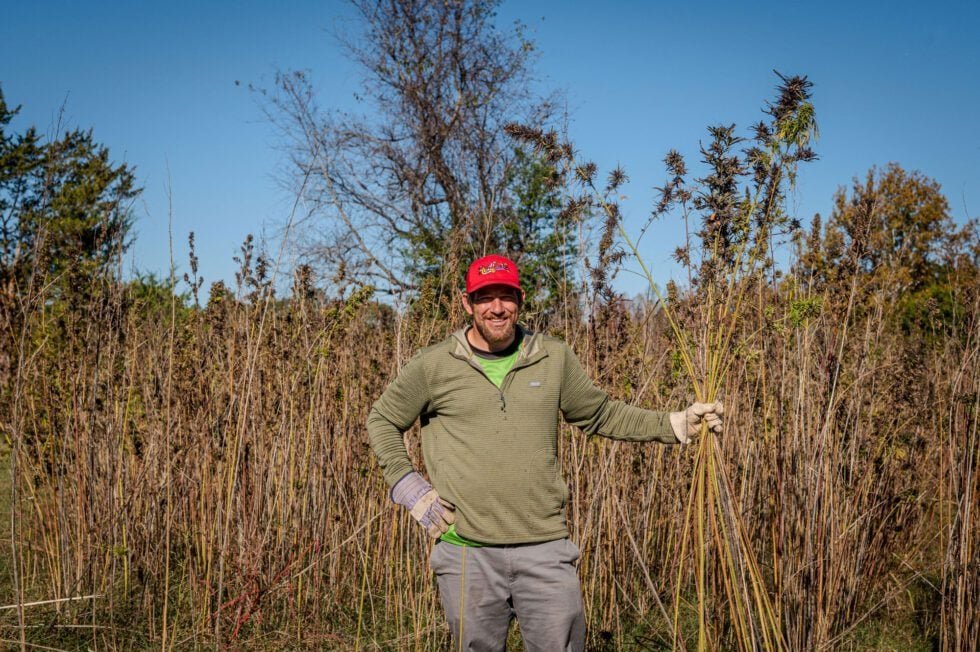
Main photo: Joe Domino, photo by R. Anthony Harris
Support RVA Magazine. Support Independent Media in Richmond.
At a time when media ownership is increasingly concentrated among corporations and the wealthy, RVA Magazine has remained one of Richmond’s few independent voices. Since 2005, the magazine has provided grassroots coverage of the city’s artists, musicians, and communities, documenting the culture that defines Richmond beyond the headlines.
But we can’t do this without you. A small donation, even as little as $2, one-time or recurring, helps us continue to produce honest, local coverage free from outside interference. Every dollar makes a difference. Your support keeps us going and keeps RVA’s creative spirit alive. Thank you for standing with independent media. DONATE HERE.
We’ve got merch HERE
Subscribe to the Substack HERE
And Reddit HERE
And YouTube HERE
In my twenties, snow days in Richmond were not a crisis. They were a gift. You walked to the local market, and back then there were only a handful, stocked up on whatever counted as “supplies,” and then wandered off under the sacred banner of “snow law.” That…
Editor’s Note: We are an official media sponsor for February Fire which will be held February 28th at Homegrown VA. Weed has been the diadem of rebellious youth for generations, a product so diametrically opposed to the capitalist urge that its use conjures images of…
Before we go any further, no, you’re not crazy. There is no King James Shakespeare play. Rajiv Joseph’s very recent 2022 play is decidedly not Elizabethan and contains far more garbage can basketball than Hamlet. The only thing I love more than Richmond Shakespeare’s…
Virginia Beach legend Pusha T will headline Governor-elect Abigail Spanberger’s Made in Virginia Market on Friday, January 16, as part of inaugural weekend events in Richmond. The Spanberger Inaugural Committee announced Tuesday that Pusha T will take…
Renee Nicole Good, a graduate of Old Dominion University, was fatally shot by a U.S. Immigration and Customs Enforcement officer during a federal enforcement operation in Minneapolis on Wednesday. The shooting has drawn national attention as questions continue to…
Editor’s note: In December 2025, the The Joint Commission on the Future of Cannabis Sales wrapped its final public meeting on the future marketplace. This interview with Eric Spencer happened at a CSBA meetup at Bingo Beer Co. in Richmond. Eric Spencer said it…
The American Dream is about coming here to build a better life. You work hard, follow the rules, take care of your family, and contribute to your community. In return, you are meant to belong as a citizen, live with stability, and be treated with respect. That is the…
A group of Buddhist monks making a 2,300-mile trek across the United States for peace and compassion is expected to pass through Richmond this February as part of their “Walk for Peace” pilgrimage from Fort Worth, Texas, to Washington, D.C., a journey drawing…
CONTACT US: hello@rvamag.com
Copyright © • InkWell Ventures Inc.
