We use cookies to understand how you use our site and to improve your experience.
This includes personalizing content and advertising.
By pressing "Accept All" or closing out of this banner, you consent to the use of all cookies and similar technologies and the sharing of information they collect with third parties.
You can reject marketing cookies by pressing "Deny Optional," but we still use essential, performance, and functional cookies.
In addition, whether you "Accept All," Deny Optional," click the X or otherwise continue to use the site, you accept our Privacy Policy and Terms of Service, revised from time to time.
New to Zacks? Get started here.
Don't Know Your Password?
Don't Know Your Password?
You are being directed to ZacksTrade, a division of LBMZ Securities and licensed broker-dealer. ZacksTrade and Zacks.com are separate companies. The web link between the two companies is not a solicitation or offer to invest in a particular security or type of security. ZacksTrade does not endorse or adopt any particular investment strategy, any analyst opinion/rating/report or any approach to evaluating individual securities.
If you wish to go to ZacksTrade, click OK. If you do not, click Cancel.
OK Cancel
Image: Bigstock
Sundeep Ganoria
CGC TLRY ACB
 Better trading starts here.
You follow Analyst Blog – edit
You follow Sundeep Ganoria – edit
Aurora Cannabis (ACB – Free Report) sits at the intersection of a shifting regulatory landscape as the Trump administration moves to reclassify marijuana. While the decision marks a constructive step for the cannabis industry, its financial implications are uneven across operators.
Notably, ACB stock has lost over 5% in the past month despite the positive regulatory development, suggesting investors are weighing company-specific fundamentals more heavily than sector-wide policy momentum.
Let’s delve into the company’s fundamentals to gain a better understanding of how to play the stock amid this recent development.
Aurora Cannabis continues to derive the majority of its growth from its medical cannabis segment, underscoring the company’s strategic focus on higher-margin, regulated markets. For the six months of fiscal 2026 (year ended March 2026), Aurora delivered solid top-line growth, driven primarily by record performance in global medical cannabis.
Medical cannabis revenues rose nearly 25% year over year to C$135.3 million, accounting for 72% of total revenues. Growth was fueled by higher sales in international markets like Australia, Germany, Poland and the UK, as well as increased revenues in Canada from insurance-covered and self-paying patients.
The higher sales also helped improve adjusted gross margin numbers for the medical cannabis segment. While Aurora did not disclose these numbers on a six-month basis, it reported a year-over-year improvement in medical cannabis margins in each of the first two quarters of fiscal 2026, reflecting a favorable mix of international sales, premium products and ongoing production efficiencies.
These margin gains, combined with disciplined cost control, helped adjusted EBITDA rise 92% year over year to C$26.2 million for the six months ended September 2025, highlighting the operating leverage embedded in Aurora’s medical-focused model.
Looking ahead, Aurora expects the trend of growth in international medical cannabis sales to continue in the fiscal third quarter, supported by new product introductions and market expansion initiatives. It also expects to generate positive cash flow during the quarter, driven by improved operating cash yield.
Aurora Cannabis continues to face pressure in its consumer cannabis business, even as its medical segment delivers consistent growth. Persistent price compression and intense competition in Canada’s adult-use market have weighed on revenues and margins, limiting the segment’s contribution to overall performance.
In response, Aurora Cannabis has deliberately scaled back its exposure to low-margin recreational products and redirected resources toward higher-value opportunities. It is now prioritizing the production and supply of GMP-certified medical cannabis, where pricing power and regulatory barriers support more attractive margins and greater earnings visibility.
This strategic realignment reflects management’s focus on profitability over volume. While the weaker consumer cannabis performance remains a near-term headwind, Aurora’s emphasis on premium medical offerings and ongoing cost optimization is expected to help stabilize earnings and reduce reliance on Canada’s challenged recreational market.
Aurora Cannabis operates in a highly competitive market where growth opportunities remain limited and fragmented. It faces stiff competition from its peers like Canopy Growth (CGC – Free Report) and Tilray Brands (TLRY – Free Report) , both of which are also focused on international expansion and cost efficiency.
As ACB continues to expand its presence in regulated medical cannabis markets, competitive responses from CGC and TLRY are likely to intensify. This could lead to more aggressive moves from these peers and possibly further consolidation in the sector.
The stock has outperformed the industry in the past year, as seen in the chart below.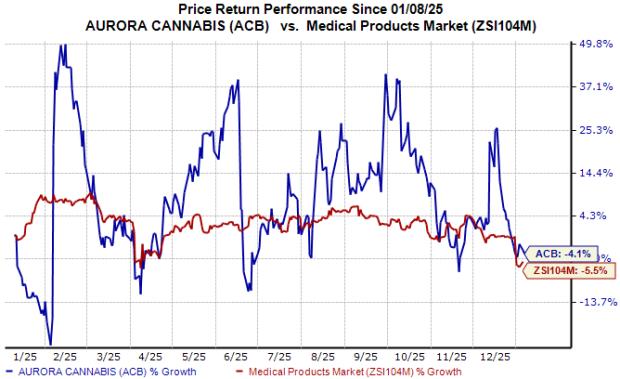
Image Source: Zacks Investment Research
While loss per share estimates for fiscal 2026 have remained unchanged at 80 cents in the last 30 days, those for 2027 have widened from 13 cents to 26 cents during the same time frame.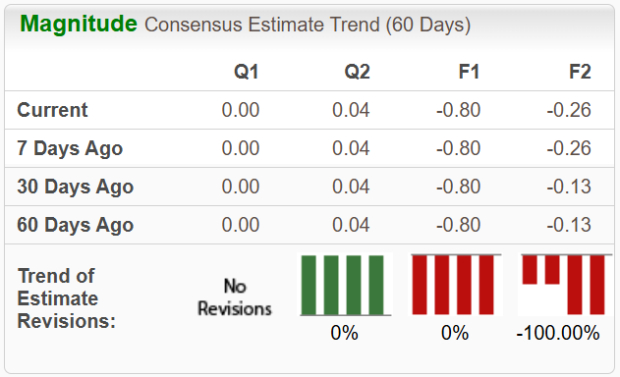
Image Source: Zacks Investment Research
While marijuana reclassification is expected to favor medical cannabis, the benefits are uneven across the industry. Aurora Cannabis, despite being listed in the United States, has minimal operating exposure to the U.S. market, limiting its ability to benefit directly from potential federal reforms.
At the same time, valuation signals remain mixed. Loss estimates for fiscal 2027 have widened sharply, doubling over the past month. This shift points to a more cautious analyst outlook and suggests rising uncertainty around the sustainability of earnings momentum beyond the near term.
Given these factors, investors may want to hold off on initiating or adding to positions until Aurora reports its fiscal fourth-quarter results. A cautious approach toward this Zacks Rank #3 (Hold) stock remains warranted.
You can see the complete list of today’s Zacks #1 Rank (Strong Buy) stocks here.
Canopy Growth Corporation (CGC) – free report >>
Tilray Brands, Inc. (TLRY) – free report >>
Aurora Cannabis Inc. (ACB) – free report >>
Our experts picked 7 Zacks Rank #1 Strong Buy stocks with the best chance to skyrocket within the next 30-90 days.
Recent stocks from this report have soared up to +97.3% within 30 days – this month’s picks could be even better. See our report’s fresh new picks today – it’s really free!
Privacy Policy No cost, no obligation to buy anything ever.
Past performance is no guarantee of future results.
This page has not been authorized, sponsored, or otherwise approved or endorsed by the companies represented herein. Each of the company logos represented herein are trademarks of Microsoft Corporation; Dow Jones & Company; Nasdaq, Inc.; Forbes Media, LLC; Investor's Business Daily, Inc.; and Morningstar, Inc.
Copyright 2026 Zacks Investment Research 101 N Wacker Drive, Floor 15, Chicago, IL 60606
At the center of everything we do is a strong commitment to independent research and sharing its profitable discoveries with investors. This dedication to giving investors a trading advantage led to the creation of our proven Zacks Rank stock-rating system. Since 1988 it has more than doubled the S&P 500 with an average gain of +23.90% per year. These returns cover a period from January 1, 1988 through December 1, 2025. Zacks Rank stock-rating system returns are computed monthly based on the beginning of the month and end of the month Zacks Rank stock prices plus any dividends received during that particular month. A simple, equally-weighted average return of all Zacks Rank stocks is calculated to determine the monthly return. The monthly returns are then compounded to arrive at the annual return. Only Zacks Rank stocks included in Zacks hypothetical portfolios at the beginning of each month are included in the return calculations. Zacks Ranks stocks can, and often do, change throughout the month. Certain Zacks Rank stocks for which no month-end price was available, pricing information was not collected, or for certain other reasons have been excluded from these return calculations. Zacks may license the Zacks Mutual Fund rating provided herein to third parties, including but not limited to the issuer.
Visit Performance Disclosure for information about the performance numbers displayed above.
Visit www.zacksdata.com to get our data and content for your mobile app or website.
Real time prices by BATS. Delayed quotes by Sungard.
NYSE and AMEX data is at least 20 minutes delayed. NASDAQ data is at least 15 minutes delayed.
This site is protected by reCAPTCHA and the Google Privacy Policy, DMCA Policy and Terms of Service apply.