© 2026 Griffin Media. Privacy Policy, Terms of Service, Legal Notices, EEO Report, Ad Choices, Public Inspection File Contact, KWTV Public Inspection File, KSBI Public Inspection File, Closed Captioning Assistance, FCC Applications, VPAT (Voluntary Product Accessibility Template)
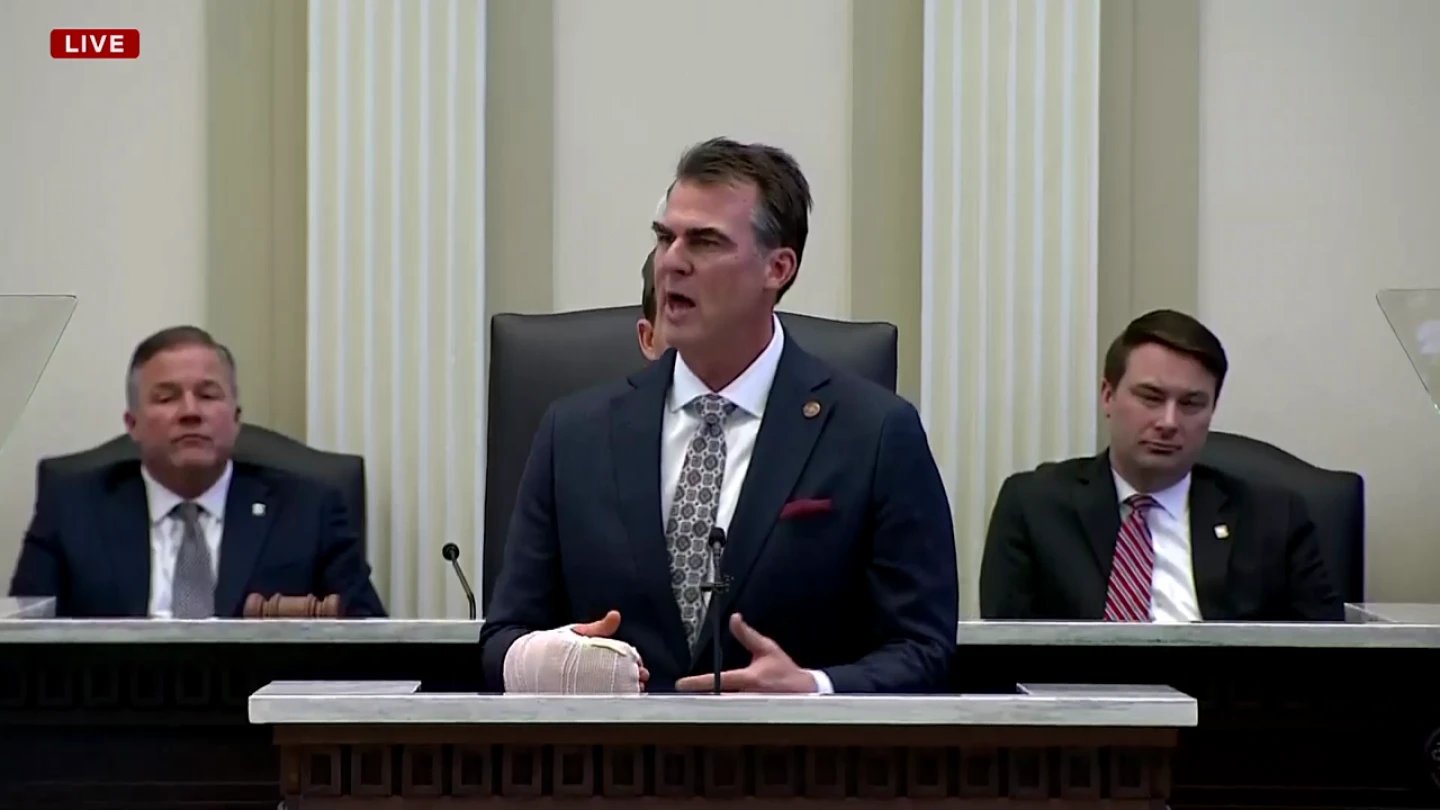
Gov. Kevin Stitt outlined his priorities for Oklahoma’s future in his final State of the State address. Here’s what he says comes next.
Gov. Kevin Stitt used his final State of the State address Monday to say that Oklahoma has undergone a seven-year turnaround and to outline an aggressive agenda for his last year in office, including limits on government growth, major education changes, welfare reforms, and renewed challenges to tribal jurisdiction and medical marijuana.
Speaking to a joint session of the Legislature, Stitt framed his priorities around what he called a limited-government approach aimed at securing Oklahoma’s long-term future.
Stitt opened by thanking legislative leaders, including Lt. Gov. Matt Pinnell, House Speaker Kyle Hilbert and Senate President Pro Tem Lonnie Paxton, along with members of the judiciary, his cabinet and longtime staff.
Stitt credited former state officials who returned to government service, what he called his “boomerang team,” with helping engineer Oklahoma’s progress. Stitt also acknowledged family members in attendance, noting the recent birth of his first grandson and referencing a hand injury from a recent fall.
Stitt pointed to what he described as cultural and economic milestones, including the Oklahoma City Thunder winning an NBA championship, which he cited as a sign of the state’s growing national profile.
Stitt said Oklahoma has increased public education funding by more than the previous 25 years combined, enacted $1.6 billion in tax cuts, diversified its economy, and maintained one of the lowest unemployment rates in the country. According to Stitt, median household income has increased by about $11,000 during his tenure, while the state’s prison population has declined by 25 percent.
Stitt said his administration’s approach has centered on reducing regulation, protecting vulnerable populations and securing Oklahoma’s future. He argued that tight spending discipline since 2019 allowed the state to build record savings, with cash reserves peaking at about $5.5 billion.
He urged lawmakers to place a state question on the ballot that would cap recurring state spending growth at 3 percent annually and praised the Legislature’s creation of a “path to zero” personal income tax.
Stitt also proposed investing $750 million from state savings into a taxpayer endowment fund, modeled after sovereign wealth funds in other states, to generate long-term revenue.
Calling government dependency “a trap,” Stitt said welfare programs should serve as a “trampoline, not a hammock.” He warned that Medicaid spending could consume 37 percent of the state budget within a decade, reaching roughly $6 billion annually.
He called for work requirements for Medicaid, SNAP, and other assistance programs, arguing reforms are needed to preserve benefits for those most in need.
Education was a major focus of the address, with Stitt emphasizing literacy and workforce readiness. He argued that Oklahoma’s education challenges stem from a one-size-fits-all system rather than lack of funding.
Stitt highlighted open transfer policies, charter school expansion and the parental choice tax credit, urging lawmakers to remove the program’s enrollment cap. He criticized the Oklahoma Secondary School Activities Association, saying students should not be barred from athletics after transferring schools, and called for eliminating the organization.
He also renewed his call for the state superintendent to be appointed by the governor rather than elected.
Stitt said public safety remains his top priority and described medical marijuana as a continuing threat. He said Oklahoma was “sold a bill of goods” when voters approved the program in 2018 and thanked state regulators for cracking down on illegal operations.
Calling the system fundamentally broken, Stitt said he believes the state should shut down medical marijuana entirely.
Stitt closed by returning to the impact of the McGirt decision, which affirmed tribal jurisdiction over large portions of eastern Oklahoma. He criticized U.S. Supreme Court Justice Neil Gorsuch for the ruling and said he has worked to preserve what he called “one Oklahoma,” where laws apply equally to all residents.
He argued Native Americans should be subject to the same treatment as other Oklahomans and urged voters to elect leaders who share that view.
Stitt said Oklahoma has ranked among the top 10 states for inbound migration for the third straight year and called for a statewide property tax freeze to prevent rising home values from pricing families out of ownership.
He also praised former President Donald Trump for promoting savings accounts aimed at education, housing and business ownership and encouraged Oklahoma companies to participate.
Quoting Ronald Reagan, Stitt ended by urging Oklahomans to prioritize equal opportunity over equal outcomes and to preserve what he called a “rendezvous with destiny” for future generations.
© 2026 Griffin Media. Privacy Policy, Terms of Service, Legal Notices, EEO Report, Ad Choices, Public Inspection File Contact, KWTV Public Inspection File, KSBI Public Inspection File, Closed Captioning Assistance, FCC Applications, VPAT (Voluntary Product Accessibility Template)