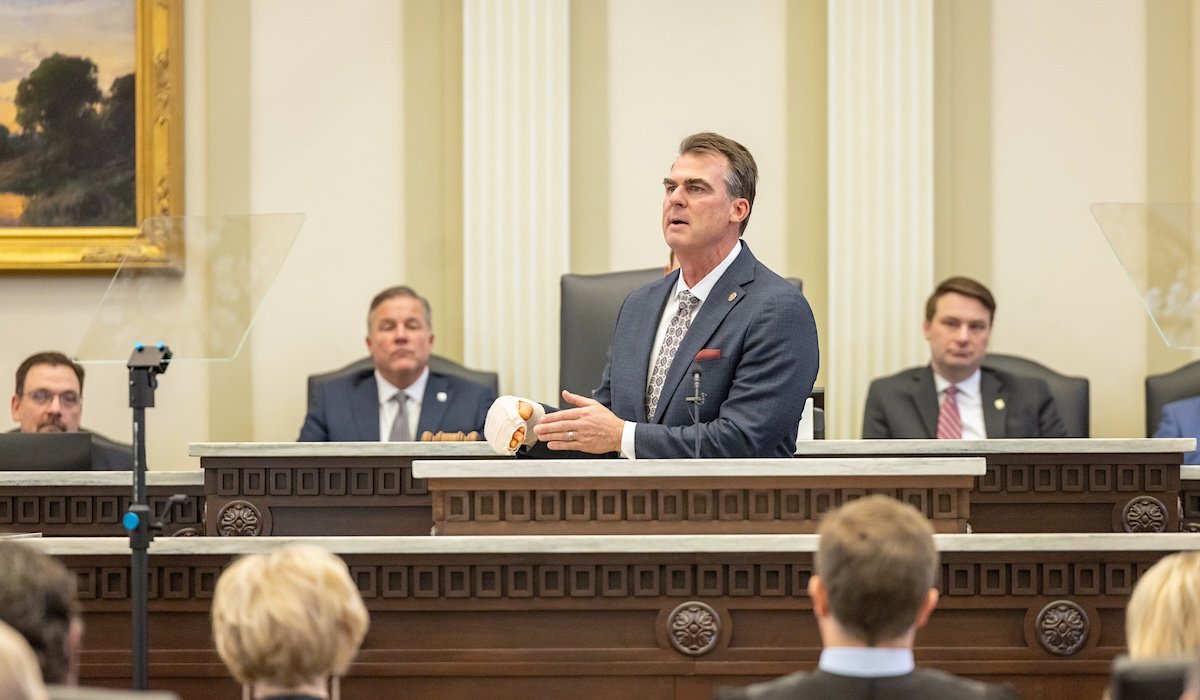
While term-limited Gov. Kevin Stitt is barred from seeking reelection in 2026, he will be supporting a slate of “conservative state questions” during this year’s election cycle if the Oklahoma Legislature accedes to his requests.
What lawmakers will do — and how their often-rocky relationship with Stitt will end in May — remains to be seen, but the governor outlined his proposed slate of constitutional changes during his final State of the State address today, one in which he emphasized past fights intentionally and unintentionally.
“I’m calling for a state question that freezes property tax growth across the board. Send it to the people,” Stitt said, gesturing with a bandaged right hand that he injured in a recent “slip and fall.”
Undeterred by his damaged right wing, Stitt called for the Legislature to put several other state questions on 2026 ballots as well:
“This industry is plagued by foreign criminal interests and bad actors, making it nearly impossible to rein in. We can’t put a Band-Aid on a broken bone,” Stitt said. “Knowing what we know, it’s time to let Oklahomans bring safety and sanity back to their neighborhoods.”
Stitt’s call to end medical marijuana drew a standing ovation from most Republican legislators, as well from Chickasaw Nation Gov. Bill Anoatubby, Lt. Gov. Chris Anoatubby and Legislator Lisa Johnson Billy.
“I think it’s been a problem all over Oklahoma,” Chris Anoatubby said, noting would “absolutely” support “reforming” the program.
As they’ve done for most of Stitt’s State of the State speeches, the Anoatubbys sat in the House gallery with other tribal leaders and bristled at his remarks about criminal and civil jurisdiction.
“In the wake of the McGirt decision, I have worked tirelessly to hold the line to keep ‘one Oklahoma’ and protect the rights of every Oklahoman. We need to come together and protect the vision cast in 1907. We need to stop any effort to federalize half of our state,” Stitt said. “I want to make a few truths abundantly clear. All laws should apply equally to all Oklahomans. No exceptions. An Indian named Kevin Stitt shouldn’t be treated differently than a single mom of a different race.”
Stitt’s continued casting of the state-tribal jurisdiction dispute as an issue of “race” — as opposed to one of political classification — irked Cherokee Principal Chief Chuck Hoskin Jr., who shook his head as Stitt referred to tribal governments as “the state’s largest political donors.”
“If we can have a governor that understands the tribes are here to stay, then you can work on those sometimes really complicated things — taxation, criminal justice — but we can’t work on them in a meaningful way if we have a governor that thinks we shouldn’t exist,” Hoskin said after the speech. “Gov. Stitt thinks we shouldn’t exist, and he proved it again today.”
Amid a pending U.S. Supreme Court challenge to state income taxation authority across the affirmed reservations in eastern Oklahoma, Stitt framed the issue as a matter of basic fairness.
“If you live in Oklahoma, you drive on Oklahoma roads, you attend Oklahoma schools, and you vote in Oklahoma elections, you absolutely should not have different tax treatment than any other Oklahoman,” Stitt said. “These things shouldn’t be controversial. I challenge Oklahomans to elect people who are committed to these values and protect these simple truths. (…) Many of us in this room have decried the DEI programs of the Biden administration, yet stand by quietly when some say an Indian should be subject to a different set of laws. We either believe in equal rights for all, or we don’t, and it’s time to choose. This issue will continue to split our state, both literally and figuratively, unless we address it head on.”
Stitt’s remarks on Indian Country jurisdiction issues received a smattering of applause from Republican legislators, with only Sen. Warren Hamilton (R-McCurtain) rising in support.
Muscogee Nation Principal Chief David Hill said he was unsurprised by Stitt’s rhetoric, although he did reference the Legislature’s looming discussion about lagging reading rates in state schools.
“Some points he hit on, some not so well. But that’s his last time at the podium,” Hill said. “One comment he did (make) that I liked was, when you’re young, you learn to read. As you get older, you read to learn. It sounded like he needs to start reading more.”
Hoskin noted Stitt’s reliance on the term “race” as evidence that the governor — a fellow Cherokee Nation citizen — “seems to have a lower knowledge base and a lower understanding of the facts and the law and the policy on an issue than when he started.”
“That’s where he’s bankrupt of knowledge about the facts and the law,” Hoskin said. “He does that, though, in service of connecting tribes to this larger DEI debate in the country in hopes that it can somehow torpedo tribes. It’s not going to work. It’s not the first time we’ve heard it. And again, he’ll leave office, and we’ll have a breath of fresh air — whoever comes in office.”
As they’d done seven times before, Oklahoma’s supermajority Republican legislative caucuses stood and cheered, applauded and lauded, and gave grand adulation to a governor many find feckless by the time each session ends.
When lawmakers adjourned last year, House Speaker Kyle Hilbert (R-Bristow) and Senate President Pro Tempore Lonnie Paxton (R-Tuttle) bemoaned how Stitt handled the end of a session where he received legislative approval for many of his requests.
“There was a video put out from the governor’s office calling on everybody to watch our votes come the next primary election season,” Hilbert said during their midnight press conference May 30. “We felt like that was pretty much out of bounds to do that, because everything that we had been doing was in good faith with everything that we had committed to doing with the governor.”
But as Merle Haggard crooned, time changes all it pertains to, and Hilbert and Paxton sang optimistic tunes Monday about working with the literal lame duck whose veto pen and special-session penchant stands between them and an early adjournment ahead of this year’s June 18 Republican primary.
“We’re looking forward to working with him in his eighth year in office,” Hilbert said to open the pair’s press conference.
Hilbert and Paxton each expressed support for making the state superintendent — and potentially other offices — appointed instead of elected.
“I personally think it is a good concept. It’s something I supported when Gov. (Mary) Fallin was governor, so it’s not something new for me to support,” Hilbert said. “Now, I think part of that conversation we’re going to have to work through throughout the legislative session is, what is oversight? What could that potentially look like? Because as it stands, currently, the governor has six appointments to the State Board of Education, which is effectively seven since the governor appointed Lindel Fields. So all seven people on the State Board of Education were appointed by the governor. I think if we’re going to do something in terms of changing the appointment structure, the oversight structure of the State Board of Education should also be considered.”
Paxton agreed, saying he would support asking voters to make state superintendent, commissioner of labor and insurance commissioner appointed positions.
“We had the conversation with the governor about (how) we can’t rest all the power into the governor,” Paxton said. “We’d probably need a different way to make up the [State Board of Education]. He did not seem to object to that at all. And so I think that’s something we can work our way through.”
In terms of Stitt’s call to change the voter-approved Medicaid eligibility requirement, both Republican legislative leaders cited the looming $494 million funding shortfall facing the Oklahoma Health Care Authority for Fiscal Year 2027.
“The question is, what does it look like long term?” Hilbert asked. “Say we give the OHCA a flat budget instead of the $494 million increase that they’re asking for. We’re going to have to have hard conversations about what that looks like. So you can choose to fully fund the request, which is a massive increase, or you can choose to make some revisions on — what are some ways that we can reduce the cost of Medicaid for the state of Oklahoma? And those are difficult conversations that I believe we’re going to have in both chambers coming forward this session.”
In her own press conference responding to Stitt’s proposals, House Minority Leader Cyndi Munson decried Stitt’s call to minimize Medicaid as an insult to state voters.
“I want to remind the governor that Oklahomans are the ones who passed Medicaid expansion,” said Munson (D-OKC). “They demanded that we do something for the hundreds of thousands of Oklahomans who are uninsured, and to make sure that our hospital doors stay open and our hospitals stay whole. They demanded more access. And the impact of Medicaid cuts? Should he get what he wants by putting a state question on the ballot and undoing Medicaid expansion, nearly 300,000 Oklahomans will lose their health insurance.”
As justification for revisiting the issue, Stitt said “the federal government isn’t a reliable partner” and noted his recent executive order to implement work requirements for Medicaid beneficiaries.
“In 10 years, Medicaid is projected to eat up 37 percent of our annual budget — $6 billion,” Stitt said. “We have to make a change.”
Senate Minority Leader Julia Kirt also challenged Stitt’s other proposal to undo prior policy passed by the people.
“This Legislature, before our time, could have made a decision to put guardrails in place before the state question (on medical marijuana) passed,” said Kirt (D-OKC). “Instead, they stuck their head in the sand and let that question pass and be mayhem. It’s taken a lot to try to get any kind of order around medical marijuana. So, I think proactive policy making would be a very wise idea, and I hope that we’re doing that for all those state questions that could pass this year, because what we need to think about is how we can make it better, and if the people tell us that’s what they want, let’s make sure we implement it correctly. So, I’m not into revisiting state questions. I think we should trust the people and that we should actually implement them well.”
With so many major measures proposed for 2026 ballots, Munson saw irony in the initiative petition limitations Republican legislative leaders passed last session.
“With Senate Bill 1027, there was this whole push by elected Republicans who wanted to make it more and more difficult for people to put a question on the state ballot,” Munson said. “Now, they’re coming to us with all these state question ideas that they want to place on Oklahomans. So that’s interesting.”
Stitt also proposed a litany of other ideas:
Paxton expressed hesitation about Stitt’s tax credit talk.
“I’m going to say what I’ve always said: I think lifting the cap on anything is irresponsible,” Paxton said. “When we both came in here, there was no cap on the zero-emissions tax credit, which was the wind turbine tax credit. And so one of the first things the Legislature did when we first got here was to stop that. So the uncapped credits of any kind can be very detrimental. You know there’s going to be a bill out there, but you don’t know how much that bill’s going to be. So I’m not against conversations about raising the cap, but I will not reduce the cap.”
Legislators are set to learn their official FY 2027 appropriation authority at the State Board of Equalization’s next meeting on Feb. 13.
Tres Savage (William W. Savage III) has served as editor in chief of NonDoc since the publication launched in 2015. He holds a journalism degree from the University of Oklahoma and worked in health care for six years before returning to the media industry. He is a nationally certified Mental Health First Aid instructor and serves on the board of the Oklahoma Media Center.
Tres Savage (William W. Savage III) has served as editor in chief of NonDoc since the publication launched in 2015. He holds a journalism degree from the University of Oklahoma and worked in health care for six years before returning to the media industry. He is a nationally certified Mental Health First Aid instructor and serves on the board of the Oklahoma Media Center.