
The complicated legal status of cannabis in North Carolina explained – qcitymetro.com
Ellen Segal-Tacher gets a lot of the same questions while working in her legal hemp store in Charlotte, Prime Sunshine.
During her work day on a Tuesday afternoon, a North Carolina visitor called to ask her one of the most commonly asked questions: “Is cannabis legal here?”
The answer to that question is complicated. Yes, and no.
You can buy hemp products with limited amounts of Delta 9 THC, the part of cannabis that gets you high. But marijuana remains illegal.
In North Carolina, definitions of marijuana and hemp are pegged to the concentration of delta-9 THC specifically.
“If it has more than 0.3% delta-9 THC, it's considered illegal marijuana,” Phil Dixon, Jr., director of public defense education and a teaching assistant professor at UNC-Chapel Hill, explained.
That's because, in 2018, the federal government removed all hemp products from its list of controlled substances so long as it has less than .3 % Delta 9 THC, the psychoactive component of marijuana.
In June 2022, North Carolina lawmakers brought the state's hemp laws in line with the federal regulations—specifically allowing hemp to be used in all products, including cloth, food, fuel, paint, paper, plastics and seed.
Regarding regulations – standard practices around quality assurance, minimum age for sales, where sales can happen, etc – in North Carolina, Dixon says there are none.
“The only regulation that exists is only what individual retailers impose upon themselves,” Dixon told QCity Metro. “We don't have so much as an age limit on the purchase or possession of these products.”
A downfall of not having regulation, Dixon said, is that clients may not know the quality of hemp products they're buying, which leaves the possibility open for products being impairing or containing heavy metals or molds.
Another downfall is the lack of standardization. Dixon told QCity Metro that he's heard of people trying the same product at different shops and having different experiences.
But, Dixon said most retailers create their own standards by limiting purchases to adults only and testing their products for quality.
“People involved in this industry want this industry to survive,” Dixon said. “They have a vested interest in putting out quality products that aren't going to make their consumers sick.”
Dixon compared the hemp industry to the spinach industry, which occasionally has E.coli in some batches but is generally considered safe to consume.
“For the most part, these products are relatively safe, but it's all relative to where you're getting it from, who you're getting it from,” Dixon said.
Dixon said that law enforcement can also seize hemp products if they are suspected to be over the legal limit of THC, but this doesn't happen often.
In September 2021, Greensboro Police Department raided a hemp shop. but the charges against the storeowners were later dropped.
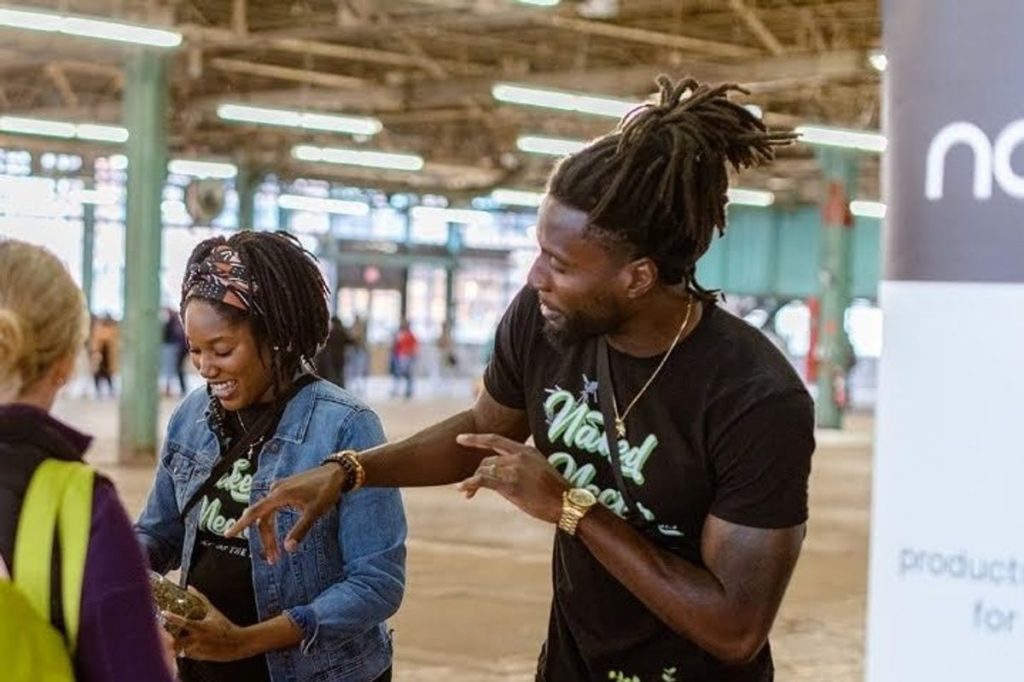
Naked Nectar, a Charlotte-based Black-owned hemp company, opened in 2020. It offers customers various products like muscle rubs, edibles like gummies and baked goods and pre-rolled joints through an online shop that delivers directly to customers' homes.
Courtney Doctor, the owner of Naked Nectar, told QCity Metro that some of her customers are looking for a recreational high, while others are seeking more medicinal effects.
All of the products at Naked Nectar are tested at a third-party lab to ensure they have the correct amount of THC or CBD and for pesticides, heavy metals and other toxins, Doctor said. Once tested, the lab will send a Certificate of Analysis for consumers to see on Naked Nectar's website.
Doctor said that though the business operates legally, companies like e-mail servers and banks, have all hesitated to work with Naked Nectar.
“When people see THC, they think it's all marijuana, but cannabis is like the umbrella,” Doctor said. “There are marijuana plants, and there are hemp plants. Everything we sell has to come from hemp.”
Doctor also noted that as one of few Black-owned hemp shops, she attracts many Black customers. Some of them, she said, are just learning about hemp products because of stigma and fear of discrimination.
“Black people feel more comfortable when they see us because they're like, ‘I've always wanted to know about this, but I've just been too nervous to ask somebody at [another] dispensary or somebody who doesn't look like me,' ” Doctor said.
Segal-Tacher – who owns Prime Sunshine, a hemp shop located on Greenwich Road in Charlotte – discovered the world of hemp while looking for menopause treatments, she said.
Her company has primarily focused on the medicinal effects of hemp, like sleeping, anxiety, depression and pain management, since it started in 2015.
“It was a feeling of hope, it's hard to explain,” Segal-Tacher said about how using hemp products helped her. “I realized that it helped my mood.”
Most of the products clients want from Prime Sunshine are for pain, sleep problems, anxiety, and weight loss, Segal-Tacher told QCity Metro. But other products, like a smokeable flower version of THC-A, can give a recreational high-like effect, she said.
Segal-Tacher says her products are tested for quality control in their raw state before being shipped from the farm in Kentucky that supplies her.
Dixon says a push for more legislation is complicated and is at what he called an “impasse.”
Broadly speaking, Dixon said, law enforcement favors increased regulation, while farmers in the hemp industry want fewer regulations regarding the products that can be sold. Some, he said, are in support of the outright legalization of marijuana.
But others in the hemp industry, like Doctor, are in support of regulation.
“With the legalization comes some guidelines, right? And I would love more guidelines,” Doctor said.
She said that with more guidelines, testing and regulations, customers will have a more standardized experience across all hemp shops, leading to better experiences with safer products.
Doctor said she is also in support of the legalization of marijuana.
“I would love to push for legalization,” Doctor told QCity Metro. “I'm not opposed to marijuana legalization…I think it is a wonderful medicinal product.”
Doctor believes that marijuana is stigmatized and often used as a “last resort” for medical treatment, but if used correctly, it can have several benefits like helping with depression or anxiety. She said the legalization of it would help to destigmatize it.
She also pointed out the irony of the industry, noting that many people – particularly Black people– are currently in prison for marijuana-related charges, while others get to sell it freely today.
“If it's legal in their state now, I just don't see how that's fair to keep them locked up,” Doctor said.
On the other hand, Segal-Tacher is not of support of regulation and doesn't see the benefit for her business.
“[Legislation] is perfect the way it is,” Segal-Tacher said. “Changing it won't change anything about my business.”
She also said that the legalization of marijuana isn't needed, noting the usefulness of hemp.
“If pot became illegal, my products wouldn't change,” Segal-Tacher said. “We don't need marijuana; we have what we need to get high.”
Fuel the Future: When you support QCity Metro, your donation allows our newsroom to amplify Black voices in Charlotte. This builds strong communities where people are informed about issues that impact their lives.
Make a gift to support our work. Since 1827, the Black Press has played a vital role in advancing social and economic justice in America. Especially now, that mission has never been more important.
Donate Now
