September 9, 2025
Listen to this story (8 minutes)
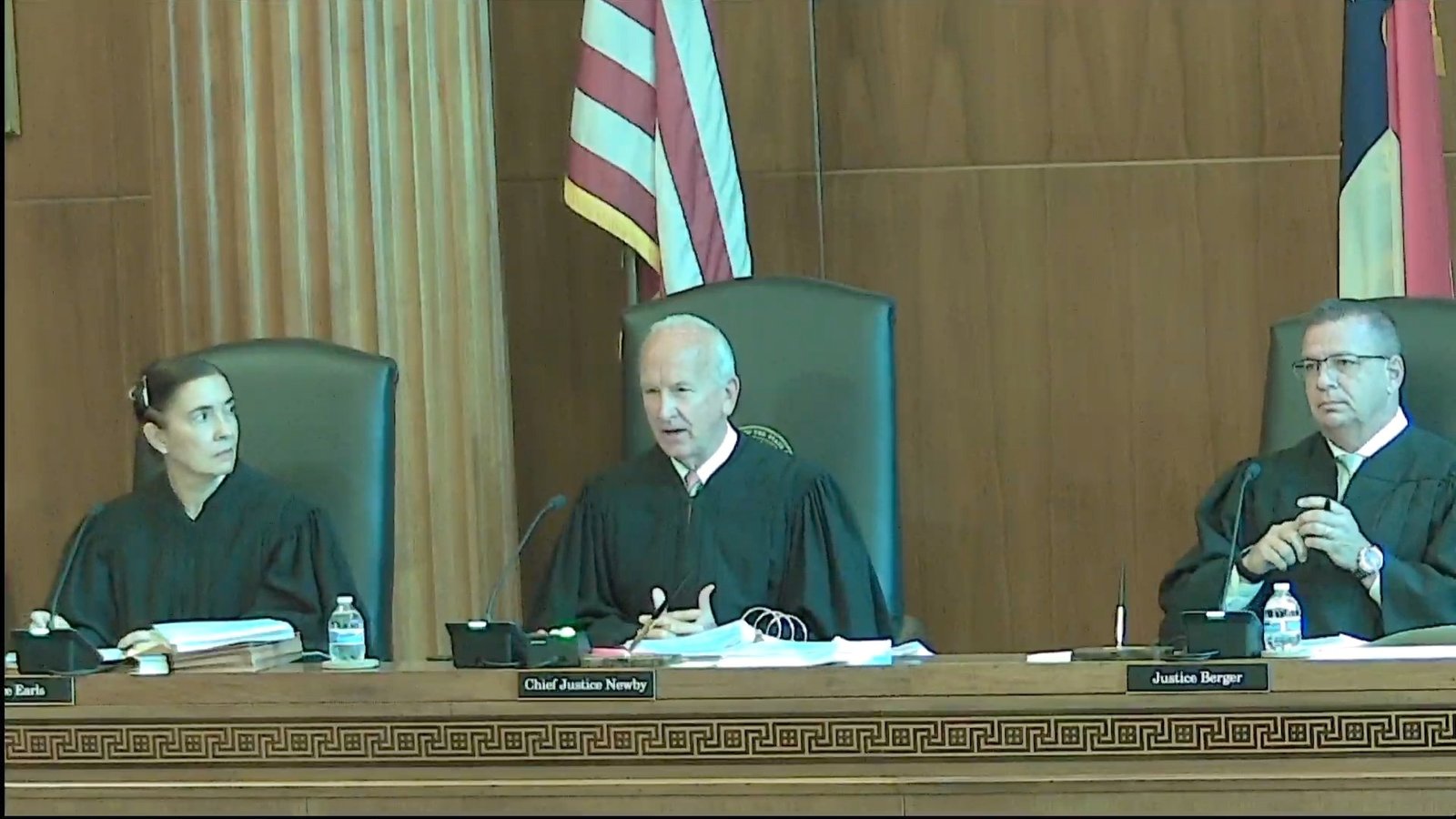
The North Carolina Supreme Court will decide in the months ahead whether law enforcement officers who smell cannabis have probable cause to search vehicles without warrants in this state. In a series of cases Tuesday, defendants urged the high court to answer no.
Critics cite the General Assembly’s 2018 decision to legalize smokable hemp. Now, the critics argue, police across North Carolina have no way to distinguish between legal hemp and illegal marijuana.
“People of North Carolina through their elected legislative representatives have made a paradigm-shifting choice,” argued Benjamin Kull, the lawyer for defendants in two of the three “odor” cases before the state Supreme Court. “They have created a legal form of cannabis in North Carolina.”
State law allows people to buy and use hemp, Kull added. “The question for this court is whether you are going to impose a tax on that lawful behavior,” he argued. “Not a tax that people will be forced to pay with money, but a tax that people will be forced to pay with their constitutional rights.”
Conditions have changed for law enforcement officers, Kull argued. “When the odor was always the odor of contraband, that odor was like Popeye’s spinach,” he said. “It immediately gave them a superpower — superpowers that they did not otherwise have.”
Kull specifically targeted the state Appeals Court’s State v. Greenwood precedent from 1980. It allowed law enforcement officers to conduct warrantless vehicle searches based solely on cannabis odor.
State Special Deputy Attorney General Zachary Dunn urged the high court in the 2020 Mecklenburg County case of Codie Bruce Schiene to preserve the odor rule. Justices also heard arguments in the 2021 Guilford County case of Tyron Lamont Dobson and the 2020 Forsyth County case of Terrel Dawayne Rowdy.
“This case and the two that follow present one overarching question, which is whether the odor of marijuana — standing alone — provides probable cause for the search of a vehicle after the passage of the Industrial Hemp Act,” Dunn argued. “If the answer to that question is yes, this case, Dobson, and Rowdy all come out the same way. Probable cause existed, and the searches were proper.”
US Supreme Court precedent requires law enforcement officers to weigh the “totality of the circumstances” before proceeding with a warrantless vehicle search. The Greenwood case allowed North Carolina authorities to cite only the odor, Dunn explained.
“The way it’s articulated is the odor of marijuana is the only circumstance in the totality of circumstances that mattered,” Dunn explained. “If you smell the odor of marijuana, then that is enough for probable cause.”
Every Supreme Court justice questioned Kull and Dunn.
“There are lots of products that — in and of themselves — may be legal, may be illegal, depending on the circumstance, and yet they still can lead to probable cause,” Chief Justice Paul Newby said while questioning Kull.
“Are you suggesting, counselor, that an officer walking out of this courtroom down Wilmington Street who smells an odor of marijuana or hemp — that there is no probability that there is illegal activity taking place?” Justice Phil Berger Jr. asked Kull.
“It seems to me that a lot of what you’re saying goes to whether there’s sufficient evidence to convict and not probable cause,” Justice Trey Allen said to Kull. “Even though there is some legal cannabis, that odor still could be indicative of illegal cannabis. … Why is that not enough for probable cause?”
Other lines of questioning offered less skepticism of the defendants’ arguments.
“The standard of review here is totality of the circumstances in every single scenario, which I think is an instruction from the Supreme Court of the United States,” Justice Richard Dietz said. “Does that give you what you want? Is that all you’re asking for … is just for us to say it’s always totality of the circumstances?”
Justice Allison Riggs raised concerns about the impact of the Appeals Court’s odor rule on a law-abiding hemp smoker.
“Doesn’t us adopting a per-se rule then deter him from behavior that the legislature has said, ‘We want this to be lawful’?” Riggs asked Dunn. “It feels like we are then intervening in a policy decision that the legislature has made in creating a real deterrent for someone engaging in that lawful behavior.”
“How does anyone engaging in the … activity that the legislature has made legal — purchasing and smoking hemp — how can they protect themselves from being arrested?” Justice Anita Earls added. “When people are arrested, that has significant consequences for losing your job and all sorts of other things.”
Dunn challenged the idea that a receipt for legal hemp could help defeat the link between the odor and probable cause.
“If this court were to announce that that no longer provides probable cause, then anyone who is transporting or owns these illegal substances — marijuana — would carry around a bag of legal hemp to dispel the probable cause,” he said.
Dobson’s case offered an extra wrinkle. Authorities searched the vehicle in which he was a passenger after smelling both cannabis and cologne. Officers considered the cologne a cover scent for the drug.
Kull’s briefing in the case suggested that the Appeals Court had created a new “double-odor” rule to justify a warrantless vehicle search.
“When you look at the de novo analysis in their decision, the only two factors that they mentioned are the two odors,” Kull said during Tuesday’s arguments. “Obviously, there are other relevant factors. If you’re going to say that on a Saturday night a group of friends that just left a nightclub gets pulled over and they smell of cologne — that the smell of cologne is an incriminating factor — then you have to balance that out with the fact that these folks just left a nightclub on a Saturday night. This is a key point about what totality of the circumstances means.”
In the Rowdy case, defense attorney Steve Fuller argued that the Appeals Court’s odor rule no longer stands up.
“All we are asking for today, your honors, is a return to the default test of totality of circumstances that we learned at the beginning of law school,” Fuller said. “We submit that the totality of circumstances test is appropriate because the rationale for odor alone has been destroyed that arose from State v. Greenwood.”
A North Carolina lawsuit plaintiff is fighting an out-of-state company’s attempt to avoid legal liability in this state’s courts.
A lawsuit from North Carolina state government retirees could cost the State Health Plan more than $3 billion if plaintiffs are successful, the plan’s lawyers warned Tuesday.
A Rhode Island-based company has asked the North Carolina Supreme Court to review a ruling that “fundamentally transforms” state business law.
The US Chamber of Commerce and NC Chamber are asking the state Supreme Court to overturn a lower court ruling that could open the door for more lawsuits against businesses in North Carolina.
Copyright 2026 John Locke Foundation. All Rights Reserved.