
ACLU Attorney ‘Confident’ Supreme Court Will Strike Down Gun Ban For Marijuana Users After Oral Arguments Next Week
Florida Lawmakers Vote To Slash Medical Marijuana Fees For Military Veterans
Virginia House Lawmakers Amend Senate-Passed Marijuana Sales Bill, Setting Stage For Bicameral Negotiations
South Dakota Lawmakers Vote To Eliminate Medical Marijuana Oversight Committee
Oregon House Passes Bill To Allow Medical Marijuana Access For Patients In Hospice Care
Scientists Reveal What Types Of Food The Marijuana ‘Munchies’ Make You Crave The Most
AI Models Like ChatGPT Can Generate ‘Convincingly Realistic’ Psychedelic Experiences When Virtually Dosed, Study Shows
Cannabis-Infused Drinks Offer Consumers A ‘Harm Reduction’ Alternative To Alcohol, Study Shows
Marijuana Use Isn’t A ‘Red Flag’ In The Dating Scene, Three In Four Americans Say In New Survey
10 Million US Adults Microdosed Psychedelics Last Year, New Report Shows
DEA Promotes Anti-Marijuana PSA Contest Inviting Students To Warn Peers About THC Dangers On 4/20
Largest Entertainment Arena In US Partners With Cannabis Businesses To Sell THC Drinks At Concerts And Live Events
Woody Harrelson Got Kicked Out Of Two Bars For Smoking Marijuana With Matthew McConaughey’s Mom
State Marijuana Regulators Share Tips On How To Stay Safe And Legal Around The Holidays
One In Three Americans ‘Pre-Game’ With Marijuana Before Family Holiday Gatherings, Survey Finds
Montana Retailers Have Sold More Than $1 Billion Worth Of Recreational Marijuana Since Legalization Took Effect
Pre-Rolls Are A Key Driver Of The Cannabis Retail Market’s Success (Op-Ed)
Massachusetts Hits $10 Billion Marijuana Sales Milestone, With Top Official Saying Consumption Lounges Will Bolster Industry In 2026
Ohio Dispensaries Sold More Than $1 Billion Worth Of Legal Marijuana In 2025
Marijuana Consumers Are More Likely To Shop At Target Following Decision To Sell Cannabis-Infused Drinks, Poll Shows
Congress will consider hemp THC product ban delay next week (Newsletter: February 25, 2026)
Dr. Oz warns about cannabis as alcohol alternative (Newsletter: February 24, 2026)
DOJ defends cannabis user gun ban, even if rescheduling happens (Newsletter: February 23, 2026)
Cannabis legalization on the ballot in Texas (Newsletter: February 20, 2026)
FDA misses cannabis deadline mandated by Congress (Newsletter: February 19, 2026)
Published
on
By
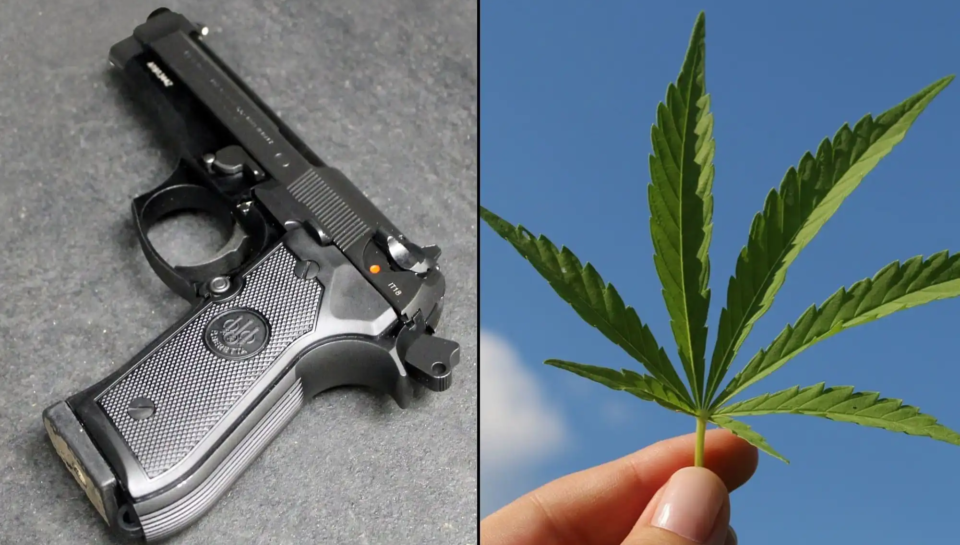
With the U.S. Supreme Court set to hear a case next week on the constitutionality of a federal gun ban for marijuana users, attorneys with the American Civil Liberties Union (ACLU) are feeling “hopeful” that justices will take their side over the Trump administration’s Justice Department and ultimately declare the current policy unlawful.
Oral arguments in the case, U.S. vs. Hemani, are scheduled for Monday. And after years of litigation on the issue in courts across the country, advocates are eager to see the cannabis and firearms issue resolved in their favor with justices agreeing that the statute known as Section 922(g)(3) violates the Second Amendment of the U.S. Constitution.
Brandon Buskey, director of ACLU’s Criminal Law Reform Project, is part of the legal team representing Ali Danial Hemani, who challenged his federal conviction under 922(g)(3) for unlawful possession of a gun as a person who regularly used cannabis.
Buskey discussed the case in an interview with Marijuana Moment on Tuesday, detailing how the organization plans to navigate the thorny legal issues that have divided lower courts, what questions it anticipates from the justices and how it is preparing to respond to DOJ’s likely claims.
In case after case and filing after filing, DOJ has been steadfast in its position that the federal gun ban is appropriately enforced, insisting that even under the rigorous standards for gun laws that must be applied under recent Supreme Court precedent, restricting firearm rights for cannabis consumers is a public safety imperative.
But on the other side of the debate, groups as politically diverse as ACLU and the National Rifle Association (NRA) have maintained that Section 922(g)(3) represents unconstitutional government overreach that ignores basic realities: That is, with cannabis now legal in some form in the vast majority of states—and even the federal government’s long-held prohibitionist policies gradually softening—it’s time to recognize that cannabis users aren’t part of some inherently dangerous caste whose Second Amendment rights must be categorically denied.
“We don’t think that there’s any valid basis in history or tradition to justify that prosecution,” Buskey said.
The following interview has been lightly edited for clarity.
Brandon Buskey: Our position is very basic and straightforward. It really consists of two parts. The first is that the statute in question prohibits gun possession by people based simply on marijuana use—but is unconstitutionally vague. It does not provide the kind of clarity that the Supreme Court requires of criminal statutes, especially statutes that expose an individual to up to 15 years of imprisonment. And because it doesn’t have that clarity, it lends itself very easily to arbitrary and discriminatory enforcement, and that’s our first point court in terms of why this law can’t stand.
Second, even if we could agree on a definition of unlawful user that would apply to our client, Mr. Hemani, the law does not comport with the Supreme Court’s test for gun rights regulation. On the Second Amendment, the court has made clear that modern gun rights regulations have to fit the history and tradition of firearms regulation, so the government has to be able to point to an analogous type of firearm restriction from around the time of the [country’s] founding in order to prohibit individuals in the present from owning a firearm.
Now our position is that that leaves ample room for the government to implement reasonable prohibitions on gun possession that are directly attuned to public safety risks. But this law does not do that. Instead, this law instead imposes a categorical presumption of dangerousness for a whole category of responsible gun owners based simply on their use of a common intoxicant like marijuana. And we don’t think that there’s any valid basis in history or tradition to justify that prosecution.
BB: We are hopeful that our position will prevail in front of the court. and that’s in part, on the Second Amendment question, because the court has emphasized that the Second Amendment is a fundamental right—and so our position is that, because it is a fundamental right, the government can’t take it away based on these arbitrary definitions of what an unlawful user might be or with prohibitions that don’t have any analogous precedent from the founding era.
I suspect the court will have questions teasing out how broad the rule might apply. Does it apply to other types of drugs? Things like that. However, our emphasis will be that our argument is very narrow, and it really is limited to how this law is applied to an individual like Mr. Hemani, for whom the government has only established two basic facts: One, that he is a regular user of marijuana and, two, that he had possession of a weapon that was safely secured at the time it was located.
And, because of that, we are confident that the court will will see that our argument is narrow and doesn’t implicate other broader questions—perhaps more difficult questions—that aren’t before the court in this argument.
BB: We anticipate that the government will have a very difficult time meeting its burden of establishing a historical analog, because it is clear that the government has decided to double down on this analogy—that someone who uses a common intoxicant like marijuana, or potentially someone, in the government’s view, [who uses] an intoxicant like alcohol, can be disarmed and imprisoned for 15 years.
In the government’s view, those individuals—based on their regular use—are the equivalent of what was known at the founding as habitual drunkards, individuals who were subject to civil commitment and criminal prosecution because they simply could not could not resist the compulsion to abuse alcohol.
That’s going to be a very difficult analogy for for the government to sustain here. And I think it’s one that the general public would be very surprised to hear that the government views users of a substance that is legal to some extent in nearly every state, as habitual drunkards [and] as people who are inherently dangerous simply by use of a common intoxicant like marijuana.
BB: I think it’s definitely relevant to the questions before the court, certainly, because the law makes it a crime for any unlawful user of a controlled substance to possess a gun. The rescheduling order directed by President Trump doesn’t technically shift the question in this case, because it would still be illegal for unlawful user of a Schedule III drug [to own or possess a] firearm.
However, it does, in our view, undermine the government’s position that individuals who use marijuana on some regular basis, although it’s not totally defined, are categorically and presumptively dangerous.
The president in that order made clear that there are valid purposes, or valid medical uses of marijuana, and it should be studied more in order to make it available to individuals who might need it for pain relief and other other purposes. And so it really strains credulity for the government to say that, notwithstanding that recognition, it should still be authorized to prosecute, for example, the veteran who is using medical marijuana legally under the laws of his or her state, but also owns a firearm. That individual, despite the president’s proclamation, would not be protected from prosecution under the statute.
BB: The best way to understand this, perhaps, is the government—under numerous administrations—almost always defends the constitutionality of criminal statutes, even when there are potentially major problems with those statues and even when it’s clear that they are not in step with the consensus of the popular will.
So I think that underscores a point that we’re making throughout our brief, which is that it’s really up to Congress to write a clearer law—but I think it’s also up to the Supreme Court to make clear that the government does not have the authority to enforce this law and cannot claim such broad authority under the Second Amendment. And I think, because the executive almost always wants to maintain the power to prosecute in these cases, then the other branches of our government have to come forward and limit that authority.
BB: I would only add that we want to make it very, very clear our position is that gun violence is a real problem. It deserves real solutions. That marijuana use is not purely innocuous. However, the prosecution of our client in this case does not serve public safety and is not in line with the kinds of valid prohibitions on gun possession or gun use that are open to states under the Second Amendment, and that’s why we’re arguing this law simply cannot stand.
Kyle Jaeger is Marijuana Moment’s Sacramento-based managing editor. He’s covered drug policy for more than a decade—specializing in state and federal marijuana and psychedelics issues at publications that also include High Times, VICE and attn. In 2022, Jaeger was named Benzinga’s Cannabis Policy Reporter of the Year.
Add Marijuana Moment as a preferred source on Google.
All the cannabis news you need, all in one place. Copyright © 2017-2026 Marijuana Moment LLC ® and Tom Angell