
Get your morning recap of today’s local news and read the full stories here: tucne.ws/morning
PHOENIX — Arizonans who enjoy marijuana recreationally don’t have to worry that it could get taken away — at least not this year.
Sean Noble told Capitol Media Services he is scrapping his plan to ask Arizona voters in November to reconsider whether they still think it’s OK for every adult to be allowed to purchase and use marijuana.
Noble, founder and president of the conservative-oriented American Encore, said he started the initiative petition drive not in opposition to marijuana — and particularly not to impair the ability of people with a doctor’s recommendation to use it to treat certain medical conditions. That was legalized by voters in 2010.
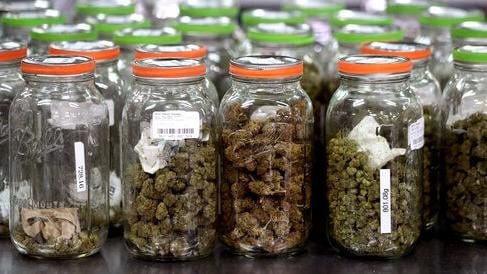
Jars at a Tucson marijuana dispensary.
He said he had fears about abuses related to the 2020 law, the one that allows any adult to buy, grow, and use the drug for recreational purposes.
But those have not been borne out, he now says.
“I’ve adjusted my viewpoints on the threat to kids,” said Noble.
That’s not the only thing that caused Noble to abandon the initiative drive.
He acknowledged that the political winds are not exactly blowing in the direction of greater regulation of marijuana.
His decision comes as the Trump administration has reversed the policy set in 1970 under President Richard Nixon, which classified marijuana as a Schedule 1 drug. That means one with a high potential for abuse and no currently accepted medical treatments in the United States.
Now it is a Schedule 3 drug. These are generally considered substances with a moderate to low risk of physical or psychological dependence.
Potentially more significant, the new designation recognizes there are currently accepted medical uses — which simply acknowledges what most states already have concluded in approving marijuana for medical use.
While the action of the Trump administration affects only the ability of doctors to prescribe the drug, and not recreational use, it signals a sea change in how marijuana is seen.
And there’s something else. Proposition 207, the 2020 Arizona initiative legalizing marijuana for recreational use, was approved by a 3-2 margin. And Noble said he hasn’t seen a major change in public attitudes in the past six years that would make it worth the time — and money — to push ahead.
He had figured it would take $5 million just to gather the 255,949 valid signatures by July 2 to get the issue on the ballot. The campaign itself, Noble said, could run as little as $10 million or as much as $20 million.
Central to all of this has been Arizona’s two-step move to make marijuana more available.
The first change came in 2010 when voters decided to let doctors “recommend” marijuana to patients with any one of a number of specified medical “debilitating medical conditions” such as cancer, glaucoma, AIDS, hepatitis C and Crohn’s disease.
It also allows a doctor to write a recommendation for conditions that produce severe and chronic pain, severe nausea, seizures and muscle spasms. Those who qualify are entitled to possess up to 2.5 ounces of marijuana, with permission for those who live at least 25 miles from a dispensary to cultivate their own.
Six years later, proponents of recreational marijuana were ready to push for the next step.
Noble worked against that ballot measure. And he said that, with foes financing the opposition, it was defeated 51% to 49%.
But by 2020, he said, there was no opposition, leading to the 3-2 approval.
That law permits adults, defined as 21 and older, to have up to an ounce and up to six marijuana plants. Users also pay a tax which doesn’t apply in cases of medical marijuana.
Noble, in submitting an application in December for an initiative to repeal the 2020 law, said voters should take a second look. Key, he told Capitol Media Services at the time, was his fear that the drug was being marketed, at least indirectly, to children despite promises to the contrary by supporters.
“I went into it with a pretty profound belief that it was happening,” he said this week, but acknowledged this was not based on any personal knowledge. “I was kind of relying on things that I had seen or read from other people.”
Only by doing further research, Noble said, did he come to the conclusion his assumptions were wrong.
“They have not done some of the things that I thought they were doing,” he said of those selling the drug.
“I don’t think that they’re specifically marketing gummies and candies and that kind of thing the way that I was led to believe that they were doing,” Noble continued. “Maybe they’re doing that in other states. But it’s not happening here in Arizona.”
And, to the extent it is, that will soon disappear.
A new law approved last year makes it illegal to advertise or sell marijuana using any names that resemble or imitate food or drink brands marketed to children. Also forbidden in the law that takes effect July 1 is the use of images or likenesses of toys, cartoons, animated or fictional characters, a list that specifically includes Santa Claus.
Advertising will be banned on buses, trains and shuttles, with billboards off limits within 1,000 feet of any child care center, church, substance abuse recovery facility, public park or playground, or any public or private school that teaches children through the 12th grade.
Also off limits will be using social media or a website unless 73.6% of its audience is expected to be at least 21.
That percentage is not random. Prescott Republican Rep. Selina Bliss, who wrote the measure, said it is based on Census Bureau data indicating that is the percentage of U.S. population that is at least 21. She said that’s also the standard set by the Distilled Spirits Council of the United States for determining whether advertising is targeted at adults or children.
That same figure shows up elsewhere in the new law: It will bar marijuana retailers from sponsoring any sporting event unless at least 72.6% of the audience is expected to be 21 or older.
Noble’s American Encore has a history in Arizona of working largely on Republican priorities, going back to a 2014 effort to kill the Affordable Care Act. His organization also sued Secretary of State Adrian Fontes over provisions in the state’s Elections Procedures Manual.
Howard Fischer is a veteran journalist who has been reporting since 1970 and covering state politics and the Legislature since 1982. Follow him on X, Bluesky and Threads at @azcapmedia or email azcapmedia@gmail.com.
Respond: Write a letter to the editor | Write a guest opinion
Subscribe to stay connected to Tucson. A subscription helps you access more of the local stories that keep you connected to the community.
Stay up-to-date on the latest in local and national government and political topics with our newsletter.
Get your morning recap of today’s local news and read the full stories here: tucne.ws/morning
PHOENIX — Scottsdale businessman Hugh Lytle can run for governor even though he technically violated a state law by not listing his home addre…
The party-line vote by the Senate followed identical action by the House last week.
Michael Wisehart, head of the Arizona Department of Economic Security, says several factors have contributed to the estimated 400,000 Arizonan…
Arizona patients have been able to get abortion pills in the mail and use telehealth for about three months — access that could be revoked aga…
Artificial intelligence is ramping up fast. Some 57% of Americans have already used it for personal purposes, and over half of U.S. businesses…
Jars at a Tucson marijuana dispensary.
Get up-to-the-minute news sent straight to your device.