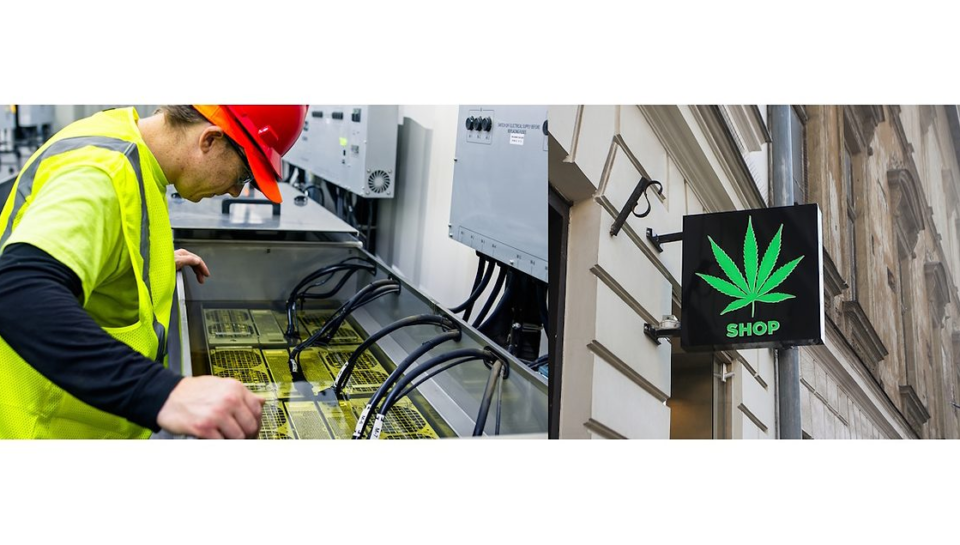
A PASSING TREND? It might be tempting to write off data center cooling (left) with the same overnight HVAC demand the cannabis industry provided, but the former affects so much more than job opportunities.
Data centers are creating new opportunities for the HVAC industry, but I can’t help thinking we’ve seen this surge of demand before.
Not so long ago, the marijuana industry took off. As more state and local governments legalized it, demand for specialized HVAC systems increased. The same appears to be true for data centers, which must keep up with demand for artificial intelligence and cloud computing.
Does it mean that contractors should bend over backwards to capture a piece of the pie? Or can it be brushed off as another trend that will fade into niche territory?
You don’t need to partake to see the similarities. Both created demand for specialized HVAC nearly overnight, with cannabis facilities requiring precise temperatures and humidity controls, while data centers need high-density cooling and precision environments.
Both industries are rewarding early adopters who took the time to learn about the system requirements and trained up their techs, earning them contracts their competitors can’t touch.
There is also the bonus of innovation. These surges have spurred manufacturers to create equipment that caters to specific needs, meaning contractors no longer need to purchase products and jerry-rig them to work.
There’s also the “not in my backyard” attitude communities have toward the necessary infrastructure, though for differing reasons. That’s on top of all the permitting and regulatory requirements for both industries.
Looking for quick answers on air conditioning, heating and refrigeration topics? Try Ask ACHR NEWS, our new smart AI search tool. Ask ACHR NEWS
In that vein, contractors need to navigate working in industries that people rally against — cannabis is illegal at the federal level, and data centers are known for negatively impacting the environment and utility rates.
The similarities, though, only go so far. It would be a mistake for contractors to brush off data centers as a passing trend or niche market. Unlike marijuana, which can be a boom-and-bust market, AI and data centers aren’t going anywhere.
Deloitte forecasts AI data center power demand rising thirtyfold from 4 gigawatts in 2024 to 123 GW by 2035. With tech giants like Amazon, Google, and Microsoft driving the market for AI, data centers are becoming critical infrastructure directly tied to the U.S. economy.
The current administration agrees, at least according to the legislative AI framework it released last month. It recommends, among other suggestions, a unified federal standard that would preempt state laws. The White House aims to eliminate “a patchwork of conflicting state laws” that would undermine the country’s efforts in the global AI race.
Compare this to the regional and fragmented cannabis industry. According to DISA, as of April 1, there are four states where marijuana is fully illegal. Another six states only allow CBD with THC. The rest of the country has either legalized or decriminalized it, allows for medicinal marijuana, or has some combination thereof.
There is, of course, a barrier to entry for data centers. The HVAC needs of cannabis centers are specialized, but it’s relatively accessible to contractors that take the time to understand the needs of growers. Data centers require more engineering and redundancy planning, fueling market shifts toward controls and system integrations.
Not every contractor is equipped to leap into data centers, and that’s fine. However, ignoring them is not the answer, either.
Even if you don’t plan to expand into data centers, you will still feel their impact on the HVAC industry. The growing demand is already affecting the type of training needed, intensifying the demand for labor, and even influencing supply chains.
They’re also affecting utilities. Data centers require huge amounts of energy and water to operate, often resulting in price increases for utility bills where they’re located. It’s spurring lawmakers to find cost-saving measures for their constituents, even if it comes at a cost. Maryland, for example, is seeking cuts to its EmPOWER program that contractors have relied on to support home upgrades.
It may be tempting to write off data centers if you’re not involved, but contractors should pay close attention to what’s happening. It’s a shift that is influencing the entire HVAC market on a much grander scale, and not the kind that measures in ounces.
Sponsored Content is a special paid section where industry companies provide high quality, objective, non-commercial content around topics of interest to The News audience. All Sponsored Content is supplied by the advertising company and any opinions expressed in this article are those of the author and not necessarily reflect the views of The News or its parent company, BNP Media. Interested in participating in our Sponsored Content section? Contact your local rep!
View The ACHR NEWS
Centennial Anniversary Timeline
On Demand As AI workloads and high-density computing push traditional cooling methods to their limits, the data center industry is accelerating the adoption of next-generation HVAC technologies.
In this session, we’ll break down how to prepare your business to capture every opportunity during peak demand. You’ll learn how to improve response times, convert more inbound inquiries, and use tools like AI to handle calls and texts, book jobs faster, and maximize revenue—without overloading your team.
Copyright ©2026. All Rights Reserved BNP Media, Inc. and BNP Media II, LLC.
Design, CMS, Hosting & Web Development :: ePublishing