
Research into cannabis and multiple sclerosis (MS) is ongoing, but available evidence suggests that cannabis-based therapies may help ease certain symptoms of the disease, particularly muscle tightness and pain.
Cannabis is a plant that has been used for medicinal purposes for thousands of years. While the legal status of cannabis varies widely by region, there are various formulations of cannabis-based medicines that are sometimes used to help manage symptoms in MS, an autoimmune disease in which inflammation damages nerves in the brain and spinal cord.
Of note, cannabis-based products are not considered disease-modifying therapies. Instead, they may be used as part of a broader autoimmune disorder treatment plan focused on easing symptoms.
Most studies evaluating cannabis-based therapies in MS were relatively small and yielded inconsistent results, but reviews of available data suggest potential benefits for certain MS symptoms:
Some studies suggest that cannabis-based products may also have benefits for other MS symptoms, but data for these symptoms are less consistent, and more research is still needed.
Studies have not found any clear benefit of cannabis on MS-related tremors.
The cannabis plant contains more than 100 biologically active compounds called cannabinoids. The two most studied are tetrahydrocannabinol (THC) and cannabidiol (CBD).
THC is the primary psychoactive component of cannabis, meaning it is mainly responsible for the high associated with recreational cannabis use, whereas CBD is not psychoactive and does not cause a high. Marijuana is a colloquial term for cannabis products that contain high amounts of THC.
CBD and THC can have a wide range of physiological effects, and studies on the use of cannabinoids in MS have looked at both compounds. Research suggests that both THC and CBD may have benefits for MS.
Has intoxicating effects
May be stimulating or sedating
Is non-intoxicating
Generally has calming effects
Various components of the cannabis plant can interact with each other, so the effects of any given cannabis-based product are dependent on its specific composition, including which cannabinoids are present and in what concentration.
Cannabis products used for medicinal purposes may contain naturally occurring cannabinoids isolated from the plant or lab-made versions with similar biological activity.
The cannabis plant is originally native to Central Asia, but over the millennia, humans have cultivated it worldwide. Selective breeding practices have produced more than 700 different strains of cannabis, each with unique biochemical features.
These strains are generally categorized based on their cannabinoid composition and the expected effects on the body.
However, most modern cannabis strains are complex hybrids, and experts increasingly consider the indica vs. sativa distinction an oversimplification. Some now prefer to describe cannabis products based on their specific chemical composition, called a chemovar.
The benefits of indica vs. sativa in MS are not established, and there is no evidence that one strain is best for people with the disease. Patients should discuss with their doctors which cannabis product would work best for their individual circumstances.
Cannabis products can be administered in several ways, and many of these formulations have been explored for people with MS.
Various other formulations may also be available. These include liquid tinctures that can be absorbed under the tongue or swallowed, and topical formulations (e.g., creams and patches).
The safety profile of cannabis depends on the product, dose, and method of administration. Cannabis side effects in MS are usually mild to moderate in severity and may include:
Other potential risks of cannabis use in MS could include:
People who use cannabis regularly typically develop a tolerance to it, meaning that a larger amount is needed to induce the same effect. While it is considered practically impossible to overdose on these products, heavy cannabis users may develop a physical dependence and experience withdrawal symptoms when they discontinue it.
Cannabis products may also interact with other medications, increasing the risk of unwanted side effects or reducing medication efficacy. People with MS should always consult their doctor before using cannabis products.
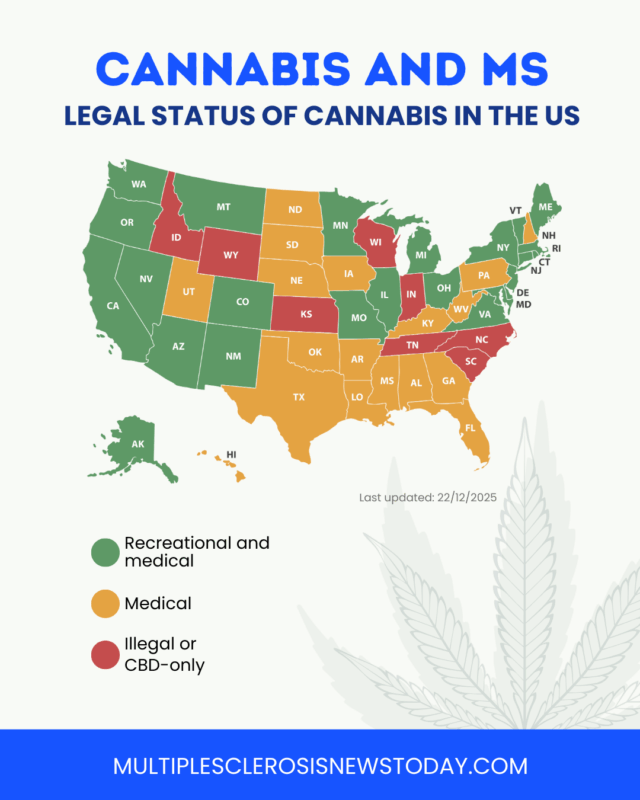
The legality of cannabis or medical marijuana for MS varies by country. In the U.S., cannabis remains illegal at the federal level, but many states have passed laws that allow the use of cannabis products for medicinal and recreational purposes within their borders.
Cannabis is legally available for MS patients in most states.
Marijuana laws for MS and other medical and recreational purposes are constantly evolving. Patients should consult with their healthcare provider to determine what is legally available to them in their area.
Three cannabis-based therapies have been approved by the U.S. Food and Drug Administration (FDA), although none specifically for MS. These include:
Nabiximols, an oral spray containing a nearly equal mixture of THC and CBD, has been approved in at least 29 countries, including Canada, Australia, and most European nations, as an MS spasticity treatment. However, this medication is not approved in the U.S.
Multiple Sclerosis News Today is strictly a news and information website about the disease. It does not provide medical advice, diagnosis, or treatment. This content is not intended to be a substitute for professional medical advice, diagnosis, or treatment. Always seek the advice of your physician or other qualified health provider with any questions you may have regarding a medical condition. Never disregard professional medical advice or delay in seeking it because of something you have read on this website.
Evidence from clinical trials suggests that cannabis products can help to ease some MS symptoms, particularly pain and spasticity. Cannabis-based therapies may also ease bladder and sleep problems in people with MS, but the effects on these symptoms are less well-studied.
While more research is still needed to better understand the safety profile of cannabis products in MS, these products are known to cause several side effects — including nausea, dizziness, and fatigue. Risks tend to be higher in people with cognitive issues, heart disease, or psychiatric conditions. People with MS should discuss with their healthcare team whether cannabis products are appropriate.
CBD, or cannabidiol, is one of the main active compounds in the cannabis plant. Though it has anti-inflammatory and anti-anxiety effects, and it can also ease pain, CBD is most beneficial for MS patients when combined with other components of the cannabis plant, including the psychoactive molecule tetrahydrocannabinol (THC). Doctors may help determine the optimal composition for each patient.
Cannabis legal status varies by country, and within the U.S., cannabis laws differ from state to state. In most states, medical cannabis can be prescribed to ease symptoms of multiple sclerosis, but there are still some states where medical cannabis products are not legal or authorized for use in MS patients.
Nabiximols is a cannabis-based oral spray that is approved to treat MS-related spasticity in Canada, Australia, and much of Europe, where it is marketed as Sativex. The therapy, however, is not approved for use in the U.S.
Get regular updates to your inbox.
3 W Garden St
Suite 700
Pensacola, FL 32502
Website: bionews.com
Email: [email protected]
Phone: 1-800-936-1363
This site is strictly a news and information website about the disease. It does not provide medical advice, diagnosis or treatment. This content is not intended to be a substitute for professional medical advice, diagnosis, or treatment. Always seek the advice of your physician or other qualified health provider with any questions you may have regarding a medical condition. Never disregard professional medical advice or delay in seeking it because of something you have read on this website.
Copyright © 2013-2026 All rights reserved.
Don’t have an account?
|
Already have an account?
Create your account by filling in the information below:
By creating an account, you are agreeing to the Privacy Policy and Terms of Service.