
By Bill OBoyle [email protected]
By Bill OBoyle [email protected]
Data centers, legalizing marijuana top issues
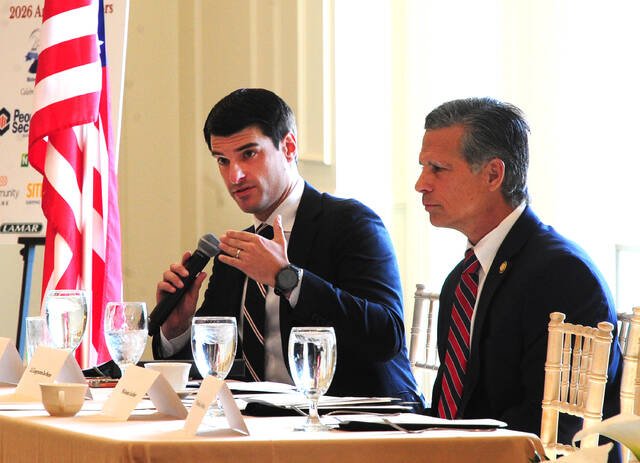
U.S. Reps. Rob Bresnahan and Dan Meuser answer questions.
Mark Moran | For Times Leader
Jimmy Walsh asks a question of the panel.
Mark Moran | For Times Leader
Wyoming County District Attorney Joe Peters attends the event.
Mark Moran | For Times Leader
State Reps. Eddie Day Pashinski, Brenda Pugh, Alec Ryncavage, and Jamie Walsh listen to residents on Friday.
Mark Moran | For Times Leader
Bill Leandri, center, attends the event.
Mark Moran | For Times Leader
Many gathered at the event on Friday.
Mark Moran | For Times Leader
DALLAS — The Back Mountain Chamber held its annual Legislative Breakfast on Friday, with state and federal legislators, and two major issues were discussed — data centers and the legalization of recreational marijuana.
The event attracted about 100 local business leaders, elected officials, and community members for an open forum on issues shaping the region.
Comprising the panel were: U.S. Rep. Dan Meuser, R-Dallas; U.S. Rep. Rob Bresnahan Jr., R-Dallas Township; State Rep. Brenda Pugh, R-Dallas Township; State Rep. Jamie Walsh, R-Ross Township; State Rep. Alec Ryncavage, R-Hanover Township; and State Rep. Eddie Day Pashinski, D-Wilkes-Barre.
Unable to attend were State Sen. Lisa Baker, R-Lehman Township, and State Rep. Jim Haddock, D-Pittston Township.
Bresnahan and Pugh had to leave midway through the hour-long event to attend a ceremony honoring a retiring fire chief.
But the conversation was informative, and the legislators had the opportunity to express their opinions on several issues, especially the two hottest topics.
Meuser was the first to address the data center issue.
“It’s a very hot topic here and in Washington,” Meuser said. “We are in a global competition with China. We are seeking what effects they will have. There is a lot of misinformation out there from our adversaries. We have to gather all the information, but if we have an extended pause on data centers, those adversaries will gain an advantage.”
Meuser said, ultimately, the people are in charge. He is a proponent of developing AI and computing data centers in Pennsylvania, stating that the state has an abundance of natural gas resources and existing energy infrastructure that positions it to handle and provide power for data centers. Meuser said the data centers will drive the economy through new jobs and the necessity to create new small businesses.
He said Pennsylvania has suitable land for data center campus development and people with a good work ethic. Meuser said the Commonwealth of Virginia has 665 data centers, while Pennsylvania has 42, and other states have far more.
“We need commitments from developers as far as water usage and power consumption,” Meuser said. “We all should have concerns, and we need an open dialogue so we know what to expect.”
Pashinski said information on water and power usage by data centers must be provided.
“There are a lot of questions that need to be answered,” Pashinski said. “We are open to progress, but we have to figure out how to do this safely.”
Walsh said data center development is the number one issue in his district, the 117th Legislative District. He said hundreds of concerned citizens attend every public meeting held on data centers.
“There are seven municipalities in my district that are faced with data center developments,” Walsh said. “I will be introducing three pieces of legislation in the next two to three weeks to address many of the concerns my constituents have. We must take the mask off of these data center projects so the people can be aware of what is happening in their towns.”
Walsh said he is calling for an 18-month moratorium on data center developments.
“We have to put some guardrails on these projects,” Walsh said. “We need to slow it down so we do it right.”
Walsh recently announced he is a co-sponsor of legislation to protect consumers from rising electricity costs driven by the growing energy demands of large-scale data centers, while strengthening the state’s energy economy.
“The proposed Pennsylvania Ratepayer Protection Act is a proactive, sensible piece of legislation to help address potential rising energy costs with the construction of new data centers,” Walsh said.
He said House Bill 2372 introduces a three-part strategy to lower costs and stabilize the energy market:
• Requires data center developers to fully fund their energy infrastructure and grid connections, ensuring no additional costs are passed on to consumers.
• Mandates large data centers to build or secure their own power sources rather than relying on the public grid, reducing competition for the limited electricity supply.
• Requires utilities to enter long-term power purchase agreements on behalf of consumers, ensuring ratepayers have equal access to stable, lower-cost energy supplies.
Together, Walsh said these requirements are expected to deliver immediate reductions in electricity prices; increase the available power supply across the PJM region; protect consumers from subsidizing large-scale energy users; and support responsible growth of the data center industry.
“By requiring data centers to meet their own energy needs and ensuring utilities secure long-term power for residents, the legislation aims to rebalance supply and demand, leading to lower prices and a more resilient energy market,” Walsh said.
House Bill 2372 is awaiting assignment to a committee.
Bills to strengthen transparency requirements
The PA House of Representatives recently passed key legislation to protect communities from the impacts of data center development.
Developers have been siting projects in the Commonwealth due to its prime, mid-Atlantic location, significant energy production, skilled workforce, and a favorable business environment, including a generous tax incentive for data center projects.
While data center developments can drive economic growth, these projects consume tremendous amounts of energy and water. In addition to rising utility bills, communities throughout the commonwealth have expressed concerns about zoning policies, detrimental environmental impacts such as air and noise pollution, and the loss of productive farmland and rural land.
• House Bill 2150 boosts transparency by establishing annual energy and water reporting requirements for data center facilities. It also requires the state Department of Environmental Protection and Public Utility Commission to jointly issue an annual report on the impacts of data center water and energy use.
• House Bill 2151 requires the bipartisan, bicameral Local Government Commission to develop an optional model ordinance, which municipalities could use to regulate data centers. He said these resources can be critical for municipalities that lack the time or financial ability to craft an ordinance from scratch.
Gov. Shapiro’s office responds
On data centers, Gov. Josh Shapiro’s spokesperson Rosie Lapowsky said, “Gov. Shapiro has heard directly from Pennsylvanians who are concerned about data center development, and he is committed to ensuring AI and data center growth strengthens communities, protects consumers, and puts Pennsylvanians first while taking advantage of the Commonwealth’s strengths for economic growth.
“To balance innovation with accountability, deliver speed and certainty in permitting, and address these concerns, the Shapiro Administration introduced the Governor’s Responsible Infrastructure Development (GRID) standards. These standards make clear that if companies want the Commonwealth’s full support — including access to tax credits and faster permitting — they must meet strict expectations around transparency, environmental protection, and community impact.
“This is about setting a higher bar for projects, not lowering it, and ensuring development happens responsibly and in a way that benefits Pennsylvanians.”
Legalization of recreational marijuana
Pashinski and Pugh were at opposite ends of the issue of legalizing recreational marijuana. Pashinski said it would add needed revenue to the state, while Pugh disagreed, saying legalizing it would create the need for treatment of addicts.
“You’re never going to stop people from smoking, drinking, and gambling,” Pashinski said. “Legalizing marijuana will add hundreds of millions of dollars to the state treasury.”
Pugh said she will always be “a strong ‘no’ vote on the issue.” She has said that she fears that drug dealers would lower their prices, and that would mean tax revenue would not be generated.
Pugh, who said she lost a nephew to drugs, said, ”I’m not interested in creating another addiction.”
Ryncavage said Shapiro’s proposed $53 billion budget falls $4 billion short of revenue, necessitating taking funds from the Rainy Day Fund and relying on a new tax on legal marijuana.
“We can’t use one-time money to fund recurring expenses,” Ryncavage said. “And we don’t know how much revenue legalizing recreational marijuana will actually produce.”
Pugh said state expenditures should never outpace income.
“The Governor’s solution to make up for the difference is using $4.58 billion from the state Rainy Day Fund. That is not the answer.”
The state budget must be passed by June 30.
Shapiro’s office responds
On the legalization of recreational marijuana, Lapowsky said, “Gov. Shapiro has made clear that we need to catch up — practically every one of our neighbors has legalized marijuana and is benefiting from hundreds of millions of dollars in economic activity and revenue.
“The Shapiro Administration stands ready to work with the General Assembly to legalize marijuana and make our Commonwealth more competitive and more just.”
Shapiro’s 2026-27 proposed budget calls for the legalization of adult-use cannabis effective July 1, 2026, with regulated sales in Pennsylvania beginning Jan. 1, 2027, generating more than $200 million annually in tax revenue once fully implemented.
Other issues
Due to time constraints, the legislators did not get to delve into many other issues. Social issues and the “rancor” and discord in Washington between and within political parties were two that were lightly discussed. Legislators agreed that the back-and-forth, accusatory political atmosphere needs to be dialed back.
All the legislators in attendance at the forum are running for reelection this year.
Reach Bill O’Boyle at 570-991-6118 or on Twitter @TLBillOBoyle.