
Legalizing Marijuana In Pennsylvania Would Generate Almost Half A Billion Dollars In Revenue By 2028 Under Governor’s Plan, State Analysis Finds
Indiana Bill To Ban Hemp THC Products Dies As Key Deadline Passes
Trump’s Surgeon General Pick Says She Doesn’t Recommend People Use Psychedelics Like She Has—But Will Follow ‘Exciting’ Research
Virginia House Passes Bill To Allow Medical Marijuana Use In Hospitals
This Black History Month, Simply Rescheduling Marijuana Isn’t Enough While Cannabis Prisoners Remain Behind Bars
Scientists Reveal What Types Of Food The Marijuana ‘Munchies’ Make You Crave The Most
AI Models Like ChatGPT Can Generate ‘Convincingly Realistic’ Psychedelic Experiences When Virtually Dosed, Study Shows
Cannabis-Infused Drinks Offer Consumers A ‘Harm Reduction’ Alternative To Alcohol, Study Shows
Marijuana Use Isn’t A ‘Red Flag’ In The Dating Scene, Three In Four Americans Say In New Survey
10 Million US Adults Microdosed Psychedelics Last Year, New Report Shows
DEA Promotes Anti-Marijuana PSA Contest Inviting Students To Warn Peers About THC Dangers On 4/20
Largest Entertainment Arena In US Partners With Cannabis Businesses To Sell THC Drinks At Concerts And Live Events
Woody Harrelson Got Kicked Out Of Two Bars For Smoking Marijuana With Matthew McConaughey’s Mom
State Marijuana Regulators Share Tips On How To Stay Safe And Legal Around The Holidays
One In Three Americans ‘Pre-Game’ With Marijuana Before Family Holiday Gatherings, Survey Finds
Montana Retailers Have Sold More Than $1 Billion Worth Of Recreational Marijuana Since Legalization Took Effect
Pre-Rolls Are A Key Driver Of The Cannabis Retail Market’s Success (Op-Ed)
Massachusetts Hits $10 Billion Marijuana Sales Milestone, With Top Official Saying Consumption Lounges Will Bolster Industry In 2026
Ohio Dispensaries Sold More Than $1 Billion Worth Of Legal Marijuana In 2025
Marijuana Consumers Are More Likely To Shop At Target Following Decision To Sell Cannabis-Infused Drinks, Poll Shows
ACLU previews cannabis & guns arguments for Supreme Court (Newsletter: February 26, 2026)
Congress will consider hemp THC product ban delay next week (Newsletter: February 25, 2026)
Dr. Oz warns about cannabis as alcohol alternative (Newsletter: February 24, 2026)
DOJ defends cannabis user gun ban, even if rescheduling happens (Newsletter: February 23, 2026)
Cannabis legalization on the ballot in Texas (Newsletter: February 20, 2026)
Published
on
By
Legalizing marijuana in Pennsylvania under the governor’s latest budget plan could bring in nearly half a billion dollars in annual revenue by 2028, according to a new analysis from the state’s Independent Fiscal Office (IFO) that estimates a significantly larger cash windfall compared to projections from Gov. Josh Shapiro’s (D) own office.
With a proposed 20 percent wholesale cannabis excise tax, 6 percent state sales tax for retail and licensing fees, IFO said Shapiro’s legalization plan that he unveiled earlier this month would generate $140 million in tax revenue in the first year of implementation from 2027-2028 and increase to $432 million by 2030-2031.
That’s a much higher revenue estimate than what the governor’s office put forward in the latest executive budget. According to that analysis, legalization would generate about $36.9 million in tax dollars in its first year from a 20 percent wholesale tax on marijuana—rising gradually to $223.8 million by 2030-2031.
Of course, the projections assume the legislature advances adult-use legalization in line with the governor’s budget request and sales begin on January 1, 2027. It remains to be seen whether lawmakers will follow through on the reform this year, but it wouldn’t be the first time marijuana legalization stalled out in the state if they don’t act this session.
Under Shapiro’s plan, revenue from cannabis sales would go toward small business loans, restorative justice programs, the state Department of Agriculture, state police and the Department of Revenue—with any remaining tax and fee dollars going to the general fund.
“The tax revenue estimate is based on the annual average dollar amount of recreational marijuana sales per adult (age 21 to 65) from comparable states and applied to Pennsylvania’s population,” IFO said in its analysis. “Because marijuana remains illegal under federal law, all marijuana sold in Pennsylvania must be grown in state (no imports).”
IFO legal recreational marijuana estimate $589 million lower than Executive Budget in FY 26-27 (lower fees) but ~$80 million higher in future years (higher tax revenues). See: https://t.co/wwprjfqk6E pic.twitter.com/VpcrwWnkWv
— Independent Fiscal Office (@ind_fisc_office) February 19, 2026
“For FY 2028-29, the analysis estimates $450 million of new taxes and fees from the proposal,” it says. “Because the new tax replaces deficit-financed spending (i.e., not new state spending that would have a positive offsetting economic impact), it results in a negative impact on other tax revenues such as income and sales tax.”
There would be seven rounds of licensing opportunities beginning on July 1 under Shapiro’s plan. Existing medical cannabis dispensaries would be eligible to apply for a conversion license in the first round if they pay a $25 million initial fee. The annual renewal fee would be $500,000, and licensees could vertically integrate to grow, process and sell marijuana products.
Due to the high cost of that conversion license, IFO said it only expects four medical cannabis businesses would expand their operations.
First-time farmer/grower licenses would come with a $1,000 initial fee, and applications would open on October 1. Starting January 1, 2027, grower, processor, dispensary and microbusiness applications would open, with a $25,000 initial fee.
“The initial license fee ($25 million) imposed on existing medical marijuana dispensaries that seek to sell recreational marijuana is much higher than other states. For example, the maximum license fee in other states include: Connecticut ($3 million), Maryland ($2 million), Ohio ($180,000) and New Jersey ($50,000). With an initial fee of $25 million, the estimate assumes that only four existing medical marijuana dispensaries would expand to the Pennsylvania recreational marijuana market and each dispensary would open five retail locations (assumed maximum allowed).”
The IFO report also notes that taxes and fees from legal cannabis sales would offset revenue from the state sales tax by $8.7 million, personal income tax by $2.5 million and all other taxes—including tobacco, alcohol and gaming) by $2.8 million.
Analysts also noted that certain studies have found that cannabis use “is much more prevalent for lower-income groups,” and so the marijuana taxes would be “regressive.” That said, “there is insufficient data to allocate the new tax to specific income groups.”
Meanwhile, this month, a coalition of drug policy and civil liberties organizations urged Shapiro to play a leadership role in convening legislative leaders to get the job done on cannabis legalization this session.
In a letter led by the Marijuana Policy Project (MPP) and sent to the governor, the coalition noted that legalization has consistently made it into Shapiro’s budget requests, “reflecting both sound fiscal policy and the clear will of the people of the Commonwealth.”
Pennsylvania House Democratic lawmakers have separately called on the GOP-controlled Senate to come to the table and pass a bill to legalize marijuana.
At a press conference earlier this month, three Democratic members of the House who have championed adult-use legalization stressed the need to move on reform, laying blame for inaction on the Senate where even supporters of the policy change have so far been unable to deliver on the issue.
Reps. Rick Krajewski (D) and Dan Frankel (D), who sponsored a bill to legalize with state-run shops that advanced through the House last year, said they understand that the novel regulatory approach they envisioned may be “controversial” to some members, but that’s all the more reason for the Senate to bring their own ideas to the conversation to finally enact the reform.
House Speaker Joanna McClinton (D) said in December that legalizing marijuana is one way to create a “very important” revenue source for the state—and that it’s an achievable reform if only legislators could find “the will to do it.”
Bipartisan Pennsylvania lawmakers who’ve been working to enact adult-use legalization over recent sessions without success so far have also recently said that President Donald Trump’s federal marijuana rescheduling order could grease the wheels in 2026.
For what it’s worth, another top GOP senator—Sen. Scott Martin (R), chair of the chamber’s Appropriations Committee—said in December that he was skeptical about the prospects of enacting legalization in the 2026 session, in part because of the federal classification of cannabis that’s now expected to change. Of course, marijuana would still be federally illegal under Schedule III, so it’s unclear if a simple loosening of the law would move the needle enough from his perspective.
—
Marijuana Moment is tracking hundreds of cannabis, psychedelics and drug policy bills in state legislatures and Congress this year. Patreon supporters pledging at least $25/month get access to our interactive maps, charts and hearing calendar so they don’t miss any developments.
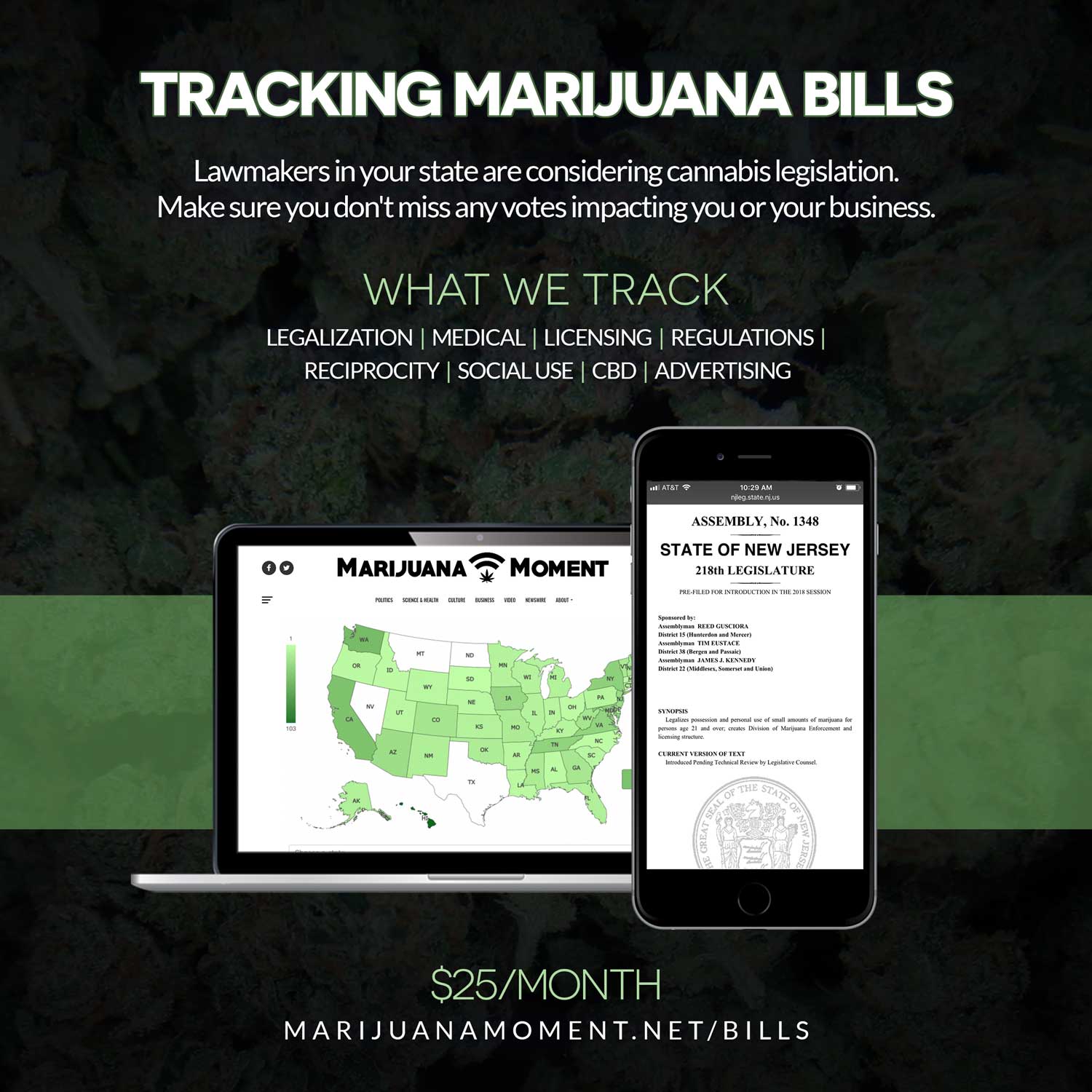
Learn more about our marijuana bill tracker and become a supporter on Patreon to get access.
—
A top aide to Pennsylvania’s governor said in September that lawmakers should stop introducing new competing legalization bills and instead focus on building consensus on the issue—while emphasizing that any measure that advances needs to contain equity provisions if the governor is going to sign it into law.
Sen. Dan Laughlin (R), for his part, said in August that the House “needs to pass the language in my bill and send it to my committee” after which point he “can negotiate with the Senate and the governor.”
The senator separately said recently that supporters are “picking up votes” to enact the reform this session.
Meanwhile, bipartisan Pennsylvania senators in October introduced a bill that would allow terminally ill patients to use of medical marijuana in hospitals.
Separately, the leading Republican candidate in the race to become the next governor of Pennsylvania dodged a question about her stance on legalizing marijuana—saying she doesn’t have a “policy position” on the issue and arguing that the sitting governor’s proposal for reform “way, way overstated” potential revenue.
The candidate, Pennsylvania Treasurer Stacy Garrity (R), pointed to neighboring Ohio, which launched its own adult-use cannabis market this year, saying “they generated about $115 million in revenue.” And while the populations of both states are relatively comparable, Shapiro’s budget projected $536.5 million in cannabis revenue in the first fiscal year of implementation.
She did, however, say that if Pennsylvania moves forward on enacting the reform, she’ll “make sure that it’s banked appropriately.”
Meanwhile, a Pennsylvania Democratic senator recently said that federal marijuana rescheduling would be “very influential” in advancing legalization in his state, giving “political cover” to GOP members on the fence about reform.
Polls have shown bipartisan support for legalization among voters, but the reform has consistently stalled in the legislature, due largely to GOP opposition. But not all Republican members are against the policy change—and one recently said she felt her party should seize the “opportunity to snatch” the issue from Democrats.
Photo courtesy of Philip Steffan.
Kyle Jaeger is Marijuana Moment’s Sacramento-based managing editor. He’s covered drug policy for more than a decade—specializing in state and federal marijuana and psychedelics issues at publications that also include High Times, VICE and attn. In 2022, Jaeger was named Benzinga’s Cannabis Policy Reporter of the Year.
Add Marijuana Moment as a preferred source on Google.
All the cannabis news you need, all in one place. Copyright © 2017-2026 Marijuana Moment LLC ® and Tom Angell