
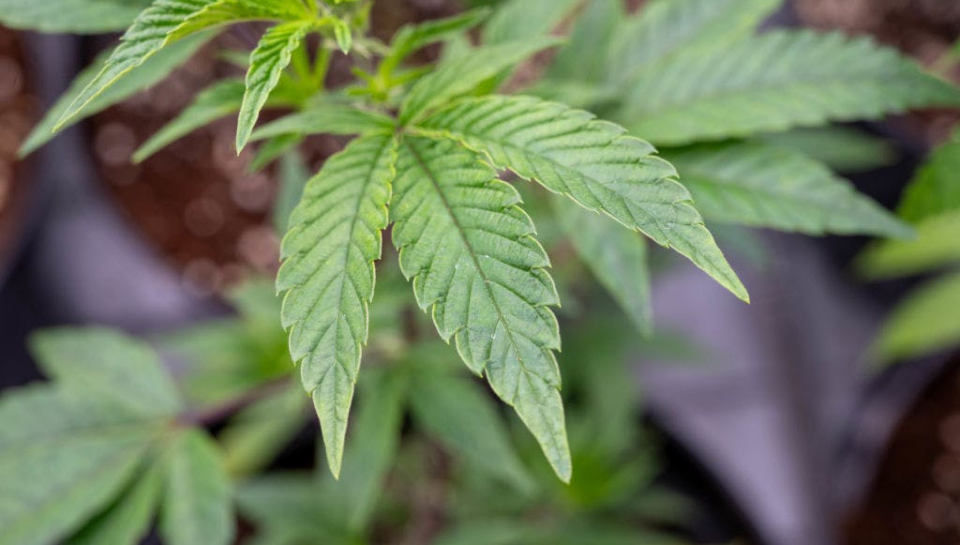
Trulieve officially began trading on the New York Stock Exchange on Thursday, becoming the first American plant-touching cannabis company to do so.
Major exchanges have historically not allowed companies that grow or sell weed in the US to list. Instead, they have traded on low-liquidity over-the-counter exchanges or Canadian exchanges.
Trulieve, which went public in 2018 with a Canadian Securities Exchange listing, is now trading on the NYSE under the ticker TRLV.
Following recent regulatory changes, Trulieve successfully applied to list on the NYSE after it spun off its recreational cannabis business. Other companies have indicated that they are gearing up to do the same.
Trulieve, which went public in 2018 with a Canadian Securities Exchange listing, is now trading on the NYSE under the ticker TRLV.
Following recent regulatory changes, Trulieve successfully applied to list on the NYSE after it spun off its recreational cannabis business. Other companies have indicated that they are gearing up to do the same.
Adobe reported fiscal Q2 results Thursday, beating analysts’ estimates for revenue and earnings, as its stock plumbed its lowest levels since 2019.
For Q2 2026, the creative software company posted:
Revenues of $6.62 billion (estimate: $6.45 billion).
Adjusted earnings per share of $5.96 (estimate: $5.82).
Annual recurring revenue of $27.1 billion (estimate: $26.6 billion).
Subscription revenue of $6.42 billion (estimate: $6.27 billion).
Remaining performance obligations of $22.27 billion (estimate: $21.86 billion).
The company also said its CFO, Dan Durn, would step down next week “to pursue a new professional opportunity.” And it boosted its full-year guidance for earnings and revenue.
Shares fell 5.5% in after-hours trading.
Adobe is feeling the pressure from AI, as the April release of Anthropic’s Claude Design threatens the company’s core design software business. Shares have tanked lately, with the stock down by nearly half over the past 12 months, putting it at levels not seen in years.
Last quarter, Adobe announced that CEO Shantanu Narayen, who had been at the company for 18 years, would be leaving after his successor was appointed. Today, Adobe announced that CFO Dan Durn would also be leaving the company — this month.
Adobe announced a $25 billion stock buyback in April, which gave the stock a boost. The company said it repurchased about 8.5 million shares during the quarter.
In a press release, Narayen said:
“Adobe delivered record revenue of $6.62 billion in Q2 reflecting strong AI-driven demand across our customer groups and we are raising our full-year fiscal 2026 revenue and non-GAAP EPS targets on the strength of that performance.”
President Trump posted on Truth Social that he was calling off impending air strikes against Iran and told reporters in the Oval Office that the US and Iran will sign a peace deal soon. Oil plunged on the news.
President Trump on Thursday afternoon said he is calling off upcoming planned strikes on Iran. In a Truth Social post, Trump said “discussions with the Islamic Republic of Iran have been brought to the highest level of Iranian leadership and approved.”
Stocks broadly popped, with the S&P 500 moving from roughly flat to up 1.4% on the day, and oil plunged on the news.
“Discussions and final points have been, in both concept and great detail, approved by all parties involved, including the United States, Israel, Saudi Arabia, UAE, Qatar, Turkey, Pakistan, Bahrain, Kuwait, Jordan, Egypt, and others. The Naval Blockade will remain in full force and effect until this Transaction is finalized — Time and place of the signing to be announced shortly,” the president added.
West Texas Intermediate crude futures are down 3% on Thursday afternoon, dropping sharply following the post.
Oil-sensitive stocks reacted accordingly, with airlines including Delta Air Lines, American Airlines, United Airlines, Southwest Airlines, JetBlue, Alaska Air, and Frontier all climbing significantly. Carnival, Norwegian, and Royal Caribbean similarly jumped.
Freight companies including UPS, FedEx, XPO, and Old Dominion Freight were also up on oil’s movement.
Oil-adjacent companies including Exxon, ConocoPhillips, and Occidental Petroleum dipped.
As we approach mid-June, the national average of US gas prices has been dropping for three weeks in a row, giving some relief to drivers traveling during a busy summer season. Since May 21, prices have fallen from $4.56 a gallon and are currently at $4.12 due to crude oil prices staying below $100 per barrel, according to the American Automobile Association.
US gas prices have a tendency to peak during this time of the year, and the uncertainty associated with the Strait of Hormuz has made them more volatile and unpredictable. While gas prices have remained around four-year highs, they’re still far from when they reached their highest, at $5 per gallon in June 2022.
GasBuddy’s Patrick De Haan posted on Wednesday that motorists today will be spending approximately $137 million less on gas than they did a month ago, but $385 million more than a year ago.
(Event contracts are offered through Robinhood Derivatives, LLC — probabilities referenced or sourced from KalshiEx LLC or ForecastEx LLC.)
Prediction markets show traders currently pricing in an 81% chance that US gas prices will drop below $3.80 this year.
US gas prices have a tendency to peak during this time of the year, and the uncertainty associated with the Strait of Hormuz has made them more volatile and unpredictable. While gas prices have remained around four-year highs, they’re still far from when they reached their highest, at $5 per gallon in June 2022.
GasBuddy’s Patrick De Haan posted on Wednesday that motorists today will be spending approximately $137 million less on gas than they did a month ago, but $385 million more than a year ago.
(Event contracts are offered through Robinhood Derivatives, LLC — probabilities referenced or sourced from KalshiEx LLC or ForecastEx LLC.)
Prediction markets show traders currently pricing in an 81% chance that US gas prices will drop below $3.80 this year.
Intel shares are surging following a double rating upgrade from Bank of America, which flipped its stance on the company from bearish to bullish.
Bank of America raised its rating on Intel to “buy” from “underperform,” boosting its 12-month price target to $135 a share from $96.
Shares of Intel rose 5.2% in recent trading, bringing the stock’s gains thus far in 2026 to more than 200%.
Analyst Vivek Arya noted “higher confidence in INTC’s opportunity to help address industry constraints in leading edge wafers/packaging” and its ability to capture a “much larger” agentic CPU market.
Bank of America heavily increased its estimate for the global server CPU total addressable market (TAM), predicting it will skyrocket to more than $170 billion by 2030. Analysts highlighted the rise of agentic AI as a critical tailwind that will require a massive volume of traditional x86 server chips.
Beyond standard chip architecture design, the report also shows confidence in Intel’s customized manufacturing services. BofA analysts now project that its server CPU revenue could top $40 billion by the end of the decade.
Momentum was built around Intel Foundry services as surging global AI demand continuously outpaces capacity. Just last week, Google reportedly placed an order with Intel to manufacture more than 3 million of its increasingly popular tensor processing unit chips in 2028. According to the report, Nvidia is also testing to see if Intel could manufacture its next-gen Feynman chips.