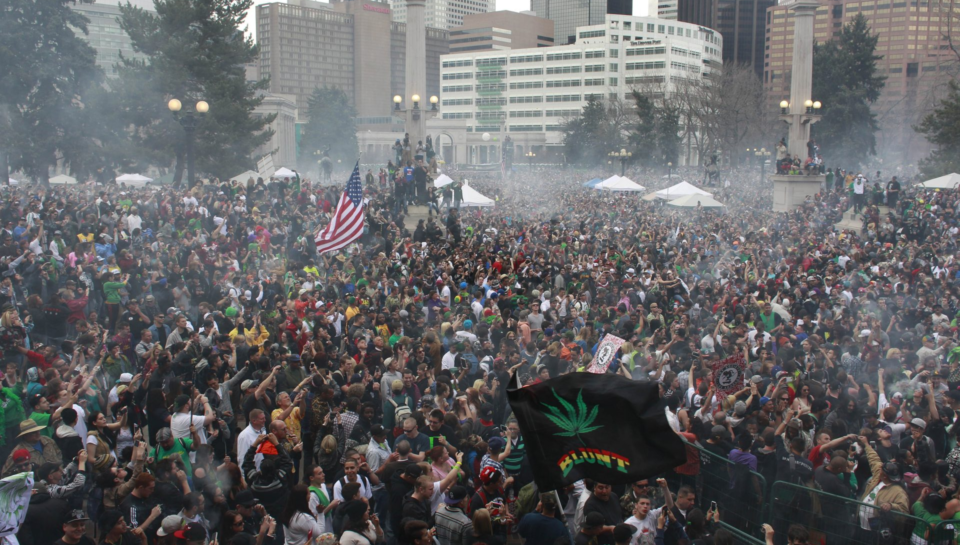
Most people don’t know what 420 stands for, let alone why it’s celebrated. Other than April 20 being an unofficial holiday to get high, the day’s origins have gotten lost in the haze.
The term 420 originated in the 1970s with a group of high schoolers in the San Francisco Bay Area. Referring to themselves as the “Waldos,” the group would meet after class at a statue on school grounds at 4:20 p.m. to smoke a joint.
According to PBS News, a brother of one of the Waldos’ friends was secretly growing a cannabis crop in the woods several miles away. He drew them a map for the group to search for the plant, but as the legend goes, they never found it.
Ava Garza, a DePaul sophomore majoring in film, thinks many people know about the 420 reference but not necessarily its meaning.
“I think people do know about it,” Garza said. “They just don’t know the history because they’ve never had the chance to delve into it.”
Don Opitz, an associate professor and director of cannabis studies at DePaul, said the April 20 story was an indicator of a wider social change.
“I think that backstory is really interesting because it fits in with the times, the early ’70s, when there was this counterculture movement in full force,” Opitz said. “There was this pushback against what was the early days of the War on Drugs, and cannabis being a focus in that war.”
The 1960s and 1970s counterculture movement fueled activism and the pacifism change that escalated the development of “hippies.” During the time of the socially accepted and unaccepted American materialism, such as “peace and love” advocates; in the U.S., many baby boomers found the movement inspiring in its sentiment towards drugs, specifically cannabis, Opitz said.
In the early ’70s, President Richard Nixon commissioned the Schafer Report. Though Nixon wanted the report to show that weed is just as harmful as hard drugs, it determined the opposite.
“The Schafer Report basically said that our studies show that there’s no harm that can come from smoking marijuana,” Opitz said. (That conclusion has since been proven incorrect for heavy users.)
Going into the 1980s, things shifted again when President Ronald Reagan and first lady Nancy Reagan pushed antidrug campaigns and the War on Drugs, which was often disproportionately aimed at Black and brown people.
It was rumored that police once used the term 420 as a code for marijuana possession, but that has been found untrue.
“People assume that, ‘Wow, that’s where 420 came from,’ but there’s nothing that backed it up,” Opitz said.
More than knowing the origins of the term 420, most people would rather just enjoy the day in their own countercultural way. Now that weed is legal, people have the ability to smoke in the safety of their own homes.
But Mira Buckman, a DePaul senior who has smoked weed, said some people who celebrate the unofficial “high holiday” might just want to party.
“When I started smoking myself, you don’t go around saying 420 and whatnot,” she said. But she does like to share the day with other people in the community.
“Growing up, it wasn’t really a day we needed to protest against drugs being illegal and whatnot. It was more of a celebration thing,” she said.
Rather than centering the holiday on political aspects, Buckman had the same perception of 420 as the Waldos: a day of mischief, and maybe munchies.
Related Stories:
The DePaulia is DePaul University’s award-winning, editorially independent student newspaper. Since 1923, student journalists have produced high-quality, on-the-ground reporting that informs our campus and city.
We rely on reader support to keep doing what we do. Donations are tax deductible through DePaul’s giving page.
Your email address will not be published.