
eNewspaper
Sign up for email newsletters
Sign up for email newsletters
eNewspaper
Trending:
GLENRIO, N.M. — It seemed, for a moment, like this town was about to die a second death.
Gabi Tuschak and her crew had already raised considerable sums of money. They bought close to 20 acres. They drafted plans and designs. They figured out how to get water and septic and utilities to a site that was going to be a crucial first step in their dreams of resurrecting this Route 66 ghost town that straddles the New Mexico-Texas border.
Then, one day in early 2023, a New Mexico county worker who came to set up their street address gave them troubling news: The building they were about to construct was actually going to be on the Texas side of the border.
Now, the precise location of an invisible boundary line shouldn’t really matter all that much. But it absolutely does when the linchpin of your vision is to open a marijuana dispensary, and selling recreational weed is still a crime on one side of that line.
“We all panicked and spent three weeks going back and forth, looking at maps and going, ‘How can this be?’” Tuschak said. “Of course, I don’t want to go to jail. I’ve got kids.”
In the end, it turned out the inspector’s handheld GPS just needed a software update, and the dispensary was — as planned — going to stand safely in the weed-decriminalized state of New Mexico.
Gabi and her partner, Erik Spain, are not the first to see opportunity in Glenrio’s location. Surrounded by desert scrub, it began as a stop on the Rock Island Railroad. In 1926, the town’s lone road was claimed by the newly formed Route 66.
Glenrio had gas stations and motels, a restaurant and a post office. Back then, the Texas side of town was in a dry county, so the State Line Bar set up shop on the New Mexico side.
Thousands of motorists passed through town daily, the Lubbock Avalanche-Journal wrote in 1965: “Enough of them stop for a few moments, to buy gasoline, to eat or only to stretch, to make the roadside businesses a profitable venture.”
As in many Route 66 ghost towns, Glenrio’s demise came at the hands of the interstate: I-40, specifically, which bypassed the town in 1975. Its population dwindled to one woman. She still lives at the eastern end of town. Her husband’s old Pontiac sits on the property, a memorial of sorts to a man who was shot dead in 1976 during an apparent robbery at the gas station where he worked, 20 miles east in Adrian, Texas.
The rest of Glenrio sat decaying for decades, its graffitied ruins becoming fodder for camera-wielding tourists.
Glenrio was added to the National Register of Historic Places in 2007. Fourteen years later, Gabi Tuschak and Erik Spain came to town.
A farmer by trade, Spain had been looking for places to grow cannabis when a friend told him about Glenrio. In its remains, he and Gabi saw the potential for something more.
Toward the end of 2021, they started buying acreage in town. Their first idea was to revive what remained of the State Line Café and Gas Station and the Texas Longhorn Motel — its sign once telling people it was either the last motel in Texas or the first, depending on the direction of travel — and maybe open a restaurant and general store before the dispensary.
That would take money, of course. Lots of it.
“And when we looked at all the numbers, it wasn’t something we’d be able to fund,” Tuschak said. “You had to kind of create all the infrastructure from scratch. We just couldn’t show that starting with the hotel would bring the return to raise capital for this project.”
A dispensary, built first, could generate the necessary money. The pair got to work finding investors. Their attorneys told them they’d need 18 months to raise the money. They did that, and opened the dispensary, in the span of 15 months.
“There wasn’t a lot of arm twisting,” Tuschak said. “There’s something magical about this little town … most of our investors are local farmers. They’re not from cannabis. They’re not from hospitality. They’re not Route 66 history buffs. They’re just locals that I think like a lot of us are just wanting to do something a little bit more interesting with their money, and something we can be proud of, something we can go visit and experience.”
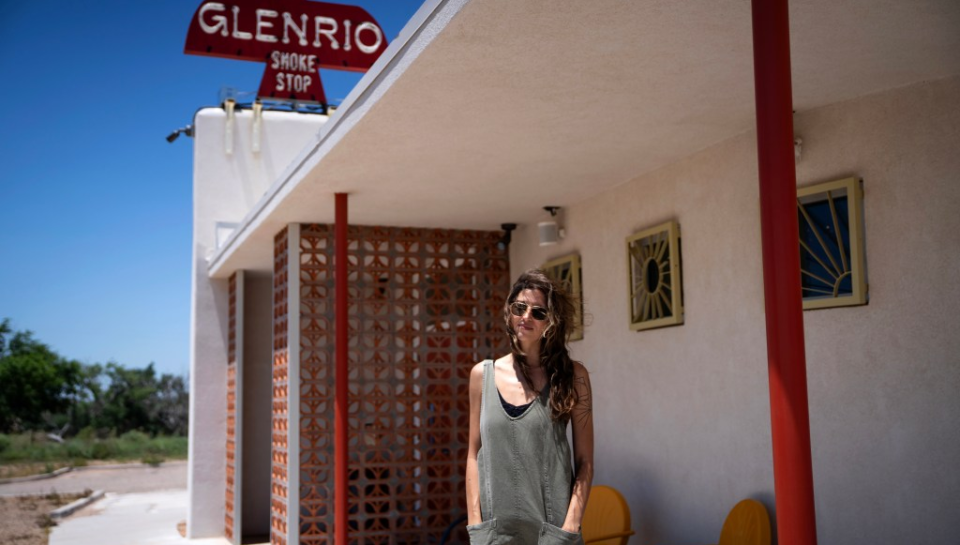
The dispensary’s retro design was meant to look as if it had been there all along. The roof line curves at the front toward a rear outdoor patio, which they call the “consumption lounge.”
The interior is part weed shop, part boutique selling clothes, jewelry, greeting cards, candles and the like. An old telephone near the entrance invites visitors to record any stories they may have about the town. There are clean bathrooms and fresh water, which delight the tourists who filed out of a bus on a Thursday last June.
There have been setbacks along the way. They were unable to save two buildings, one of them the former Stateline Bar, that were deemed structurally unsafe due to age, safety concerns and weather damage.
“I just feel incredibly fortunate to be in this project and be the steward of it,” Tuschak said. “It’s not straightforward. It’s challenging. How do you preserve something and also have to — I refer to it as almost like surgery. Sometimes you have to remove parts in order to bring it back to life. And so there’s this balance that you walk between construction and destruction. I’m very thankful, and I try my best to find that sweet spot where we can bring this back to a place where people from every walk of life feel welcome.”
Next year, Tuschak and Spain hope to start rebuilding the motel. They want 16 rooms, plus a restaurant, a gift shop, a boutique and a cafe where people can buy grab-and-go bites. In the next month or so, they plan to unveil the first piece of those efforts, a newly restored sign that once again will alert travelers to the first — or last — motel in Texas.
Copyright 2026 Chicago Tribune. All rights reserved. The use of any content on this website for the purpose of training artificial intelligence systems, algorithms, machine learning models, text and data mining, or similar use is strictly prohibited without explicit written consent.