

Congressional Committee Votes To Block Medical Marijuana From Being Covered Under Workers’ Comp For Federal Workers
White House Pushes Congress To Keep Hemp CBD Products Legal By Amending Broad Ban That’s Set To Take Effect Later This Year
Connecticut Governor Signs Bill To Expand Psychedelics Pilot Program In Preparation For Federal FDA Approval
Congressional Committee Directs Feds To Keep Testing Truck Drivers For Marijuana, Regardless Of Trump’s Rescheduling Move
Louisiana Will Let Terminally Ill Patients Use Medical Marijuana In Hospitals After Governor Allows Bill To Take Effect Without His Signature
2 In 3 Americans Who Use Marijuana Say It Helps Them Sleep Better, New Survey Shows
Hemp-Based Plastic Shows Promise As Environmentally Friendly Alternative To Traditional Packaging Materials, Study Finds
Marijuana Components Have ‘Consistent’ Anti-Tumor Effects In Glioblastoma And Other Cancers, Scientific Review Shows
Another Study Debunks Lazy Stoner Stereotype, Linking Marijuana Use To An Increase In Some Kinds Of Exercise
VA Launches New Study On MDMA To Treat Veterans With PTSD And Alcohol Use Disorder
WNBA Removes Marijuana From Banned Substances List And Sets Rules For Player Endorsements Of Hemp CBD Products
Americans Say Marijuana Is Less Cool Than Math And Country Music—But Is Cooler Than Guns Or Cryptocurrency, Survey Shows
Politicians And Major Brands Celebrate Cannabis Culture On 4/20
Woody Harrelson And Bill Maher Complain That Marijuana Taxes Are Too High While Smoking Joints At The Dispensary They Own Together
WNBA Offers To End Marijuana Testing For Women’s Basketball Players As Part Of Reported Deal With Union
Federal Labor Decision Inspires More Missouri Marijuana Workers To Seek Unionization
Missouri Marijuana Workers Win Union Vote After Federal Officials Reject Company’s Argument On Blocking Ballots
Target Is Launching Hemp THC Drink Sales In Three Of The U.S.’s Most Populous States
Target Expands Involvement In Hemp THC Drinks Market With 72 New Licenses In Minnesota
Marijuana Sales Are Rising And Alcohol Is On The Decline As Consumer Preferences Evolve, Government Data In Canada Shows
WNBA takes cannabis off banned list & sets player endorsement rules (Newsletter: June 5, 2026)
Wisconsin governor candidates pledge cannabis action if elected (Newsletter: June 4, 2026)
Amendments to save hemp THC from ban are blocked in Congress (Newsletter: June 3, 2026)
Trump sued over cannabis rescheduling (Newsletter: June 2, 2026)
GOP lawmakers push to save hemp from impending federal ban (Newsletter: June 1, 2026)
Published
on
By
The Senate has approved large-scale spending legislation that includes provisions to allow U.S. Department of Veterans Affairs (VA) doctors to recommend medical marijuana to military veterans living in legal states.
The appropriations package that senators passed on Friday was also amended to omit a controversial proposed ban consumable hemp products with any quantifiable amount of THC.
After being cleared by the Senate Appropriations Committee last month, the full chamber advanced the package covering Military Construction, Veterans Affairs (MilConVA) and Agriculture, Rural Development, Food and Drug Administration (AgFDA) in a 87-9 vote.
In committee, members adopted an amendment to the MilConVA measure from Sen. Jeff Merkley (D-OR) that contains the cannabis and veterans language. For AgFDA, the bill initially featured hemp language that stakeholders argued would devastate the industry, but an agreed-upon amendment removed those provisions following tense deliberations.
The Merkley amendment attached to the underlying defense appropriations measure is meant to mirror standalone legislation titled the Veterans Equal Access Act. The text of the proposal adopted by the Senate committee is not identical to what the House passed as part of its own MilConVA appropriations measure in June.
On the House side, Reps. Brian Mast (R-FL) and Dave Joyce (R-OH)—who are both co-chairs of the Congressional Cannabis Caucus—sponsored the adopted companion amendment, which would increase veterans’ access to state medical marijuana programs and eliminate a current VA directive barring the department’s doctors from issuing cannabis recommendations.
Mast in February filed the standalone Veterans Equal Access Act—marking one of the latest attempt to enact the measure that’s enjoyed bipartisan support over recent sessions.
In past years, both the House and Senate have included provisions in their respective MilConVA measures that would permit VA doctors to make the medical cannabis recommendations, but they have never been enacted into law.
Because both chambers again adopted differing language this year, the matter will once more be a topic of conversation in conference committee or informal bicameral negotiations and, as such, could end up being left out of the final package sent to the president this time, as has been the case in the past.
Here’s the text of the House version:
“None of the funds appropriated or otherwise made available to the Department of Veterans Affairs in this Act may be used to enforce Veterans Health Directive 1315 as it relates to—
(1) the policy stating that ‘VHA providers are prohibited from completing forms or registering Veterans for participation in a State-approved marijuana program’;
(2) the directive for the ‘Deputy Under Secretary for Health for Operations and Management’ to ensure that ‘medical facility Directors are aware that it is VHA policy for providers to assess Veteran use of marijuana but providers are prohibited from recommending, making referrals to or completing paperwork for Veteran participation in State marijuana programs’; and
(3) the directive for the ‘VA Medical Facility Director’ to ensure that ‘VA facility staff are aware of the following’ ‘[t]he prohibition recommending, making referrals to or completing forms and registering Veterans for participation in State-approved marijuana programs’.”
The Senate language reads:
“None of the funds appropriated or otherwise made available to the Department of Veterans Affairs in this Act may be used in a manner that would—
(1) interfere with the ability of a veteran to participate in a medicinal marijuana program approved by a State;
(2) deny any services from the Department to a veteran who is participating in such a program; or
(3) limit or interfere with the ability of a health care provider of the Department to make appropriate recommendations, fill out forms, or take steps to comply with such a program.”
Also attached to the MilConVA bill that the Senate approved is a report that contains cannabis and psychedelics provisions, including a call to allow VA doctors to recommend medical cannabis if the federal government reschedules it.
If rescheduling does happen, “VA should consider issuing guidance allowing VHA doctors and other personnel to discuss, recommend, and facilitate access to medical marijuana in States with state-legal medical marijuana programs to the extent allowable under Federal law,” the report says.
Another section discusses the potential for cannabis to be used as an alternative treatment option for veterans, urging VA to study “the relationship between treatment programs involving medical marijuana that are approved by States, the access of veterans to such programs, and a reduction in opioid use and abuse among veterans.”
Additionally, a section of the report for MilConVA addresses psychedelics-assisted therapy, noting that members understand “VA and other relevant Federal agencies are undertaking research to evaluate the efficacy of psychedelic-assisted therapies in treating PTSD, major depressive disorder, and other conditions.”
The committee is mandating that VA produce a report to Congress that lays out the status of research into the topic within 180 days of the bill’s enactment, and it’s further directing the agency to “initiate a longitudinal study of veterans participating in such therapies and track outcomes over a period of five years.”
The report further discusses GI Bill benefits as they related to cannabis, noting that “VA policy determinations have restricted the ability of veterans to access their earned benefits, including GI Bill Benefits.”
Under the AgFDA appropriations measure that the Senate also passed as part of a package on Friday, there are no longer provisions hemp industry stakeholders said would effectively eradicate the market by banning consumable hemp products with any “quantifiable” amount of THC.
Sen. Mitch McConnell (R-KY), who ushered in the federal legalization of hemp under the 2018 Farm Bill, championed the THC criminalization language. But while he got it included in the base bill for Ag/FDA, Sen. Rand Paul (R-KY) threatened to procedurally hold up the process if it stayed in, forcing McConnell’s hand. Paul’s amendment to strike the language passed as part of an en bloc package on the floor on Friday.
That came after a verbal lashing from McConnell, who took to the floor earlier in the day to criticize those who opposed the ban, including Paul.
“In order to move the package forward, I allowed my language to be stripped from the bill,” McConnell said. “But my effort to root out bad actors, protect our children, support farmers and reaffirm our original legislative intent will continue.”
The hemp language in the Senate spending bill was nearly identical to what the House Appropriations Committee passed in June, with noted cannabis prohibitionist Rep. Andy Harris (R-MD) leading the charge.
Meanwhile, Paul recently filed a standalone bill that would go in the opposite direction of the hemp ban, proposing to triple the concentration of THC that the crop could legally contain, while addressing multiple other concerns the industry has expressed about federal regulations.
The senator introduced the legislation, titled the Hemp Economic Mobilization Plan (HEMP) Act, in June. It mirrors versions he’s sponsored over the last several sessions.
—
Marijuana Moment is tracking hundreds of cannabis, psychedelics and drug policy bills in state legislatures and Congress this year. Patreon supporters pledging at least $25/month get access to our interactive maps, charts and hearing calendar so they don’t miss any developments.
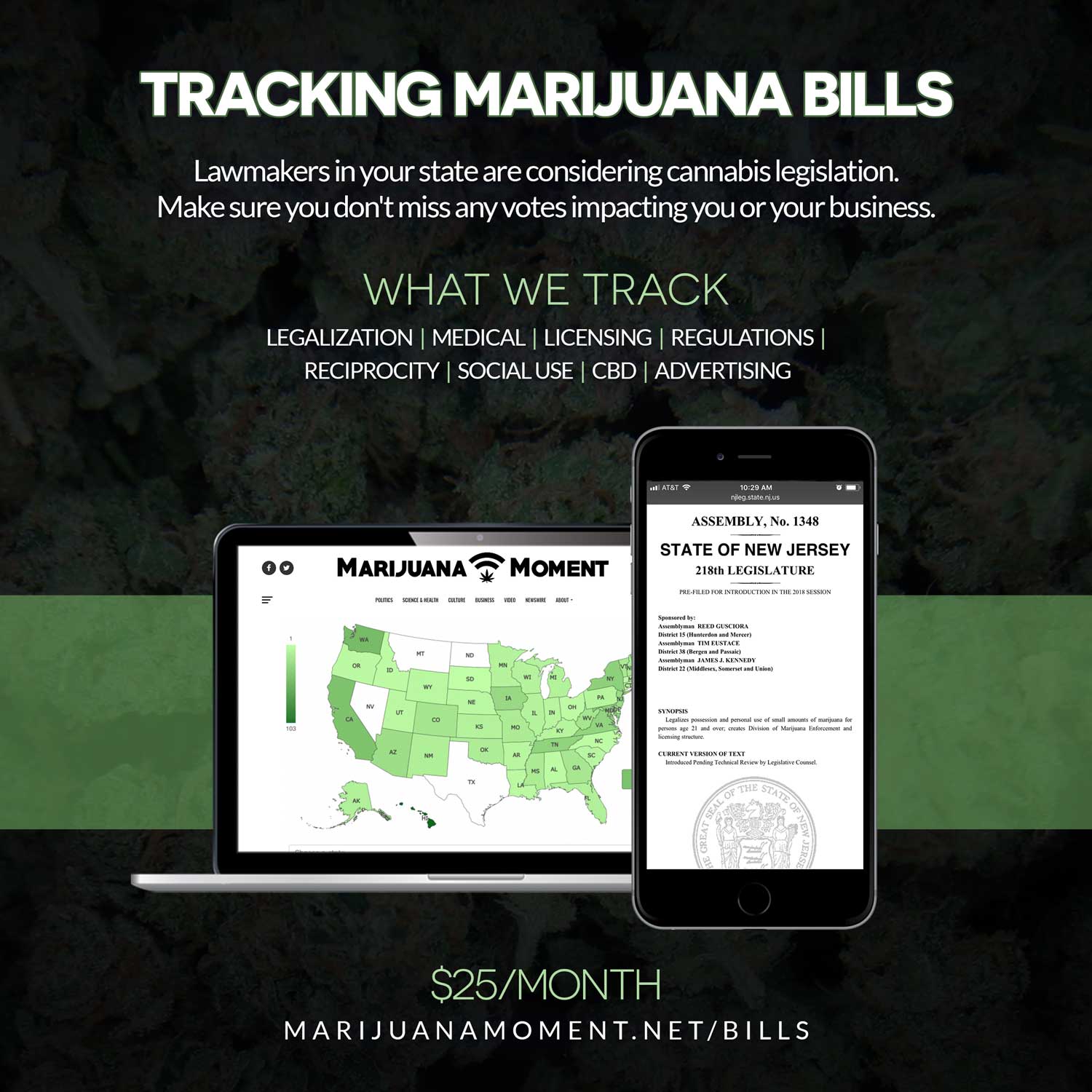
Learn more about our marijuana bill tracker and become a supporter on Patreon to get access.
—
Meanwhile, a GOP-controlled House committee last month approved an amendment attached to a must-pass defense bill that would require a “progress report” on an ongoing psychedelic therapy pilot program for active duty military service members and veterans.
However, while Congress has been notably amenable to psychedelics research proposals in recent sessions, the House Rules Committee separately blocked a bipartisan amendment to a spending bill led by Rep. Morgan Luttrell (R-TX) that would have given DOD another $10 million to support clinical trials into the therapeutic potential of substances such as ibogaine and psilocybin.
Kyle Jaeger is Marijuana Moment’s Sacramento-based managing editor. He’s covered drug policy for more than a decade—specializing in state and federal marijuana and psychedelics issues at publications that also include High Times, VICE and attn. In 2022, Jaeger was named Benzinga’s Cannabis Policy Reporter of the Year.
Add Marijuana Moment as a preferred source on Google.
All the cannabis news you need, all in one place. Copyright © 2017-2026 Marijuana Moment LLC ® and Tom Angell