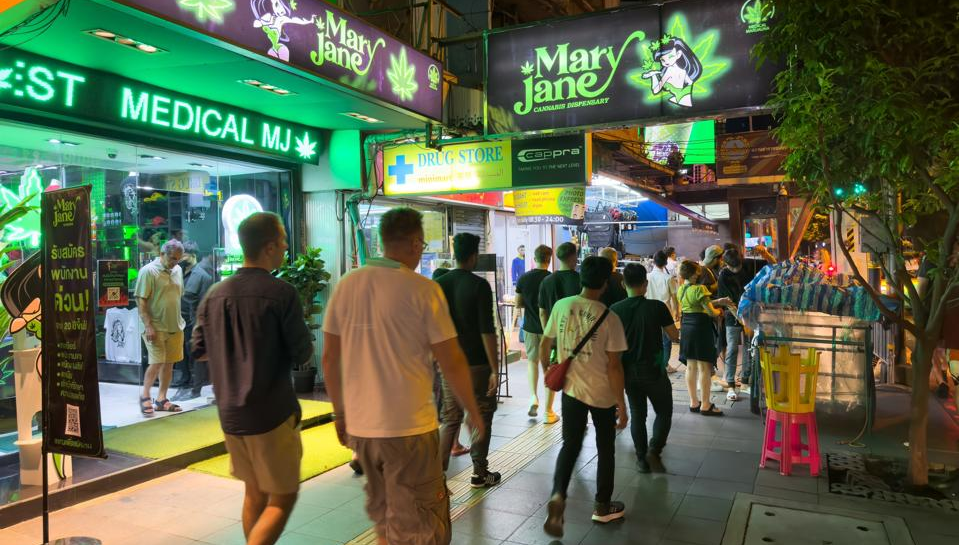
People walk past the Mary Jane Cannabis Dispensary, a legal marijuana shop on Sukhumvit Road, Bangkok, Thailand. Thailand completely legalized the production, sales and consumption of marijuana products in June 2022. (Photo by: Andy Soloman/UCG/Universal Images Group via Getty Images)
Thailand is tightening cannabis rules and restricting legal sales to medical use, effectively ending recreational cannabis sales.
Retailers who wish to continue to sell medical cannabis products will have to obtain a license and convert into approved health-focused centers, such as clinics, pharmacies, or traditional pharmacies, and staff licensed healthcare providers.
The shift marks a new phase in the country’s evolving stance on cannabis, following its 2022 decision to decriminalize recreational cannabis by removing cannabis flowers from the narcotics list for personal use, the first to do so in Southeast Asia. The move was championed by then Health Minister Anutin Charnvirakul, who became the country’s prime minister in September.
Since 2022, tens of thousands of cannabis dispensaries selling recreational products have started to pop up across the country. However, regulations lagged behind the rapid market expansion, and the government opposition vowed to crack down on the gray market.
Subsequent governments vowed to reinstate tighter controls on cannabis, allowing the use of the substance for medical purposes only based on a prescription model.
The crackdown started in 2025. By late December, Thailand recorded 18,433 cannabis outlets nationwide, according to the data from the Public Health Ministry, reported by The Straits Times. But with this regulatory change and expired licenses that affected 8,636 outlets, only 1,339 renewals were approved — about 15.5%. The remaining 7,297 retailers shut down their business. As a result, active dispensaries now number 11,136.
To reverse cannabis decriminalization, authorities will give businesses three years to align with updated medical cannabis regulations. Facilities must staff medical personnel, and only medical cannabis products will be allowed to be sold.
During this phase, officials will introduce visible authorization markers at approved locations that will indicate licensing status and validity in order to help distinguish legal medical providers from unlicensed operators, according to local news media outlets.
While decriminalization of cannabis was viewed as a progressive step, its reversal, however, is not set to undermine Thailand’s view on medical cannabis, which it sees as a potential driver of economic growth, particularly in healthcare and medical research.
Authorities are backing investment in processing facilities that meet international food and industrial safety standards, signaling a move away from raw exports. Quality control is becoming central to market access, with standards now serving as entry requirements rather than afterthoughts.
Oversight of cannabis regulation is also being expanded, according to officials, such as Phongsathorn Phokphoemdee, who heads the Department of Thai Traditional and Alternative Medicine. He reportedly said authority will now be shared across a wider system linking public health agencies, administrative bodies, and law enforcement. The updated framework consolidates oversight under coordinated structures rather than fragmented responsibilities.
Internationally, cannabis-derived products are already widely used in skincare and medicine, generating significant export value. In Thailand, however, the priority remains meeting domestic healthcare demand first. Only surplus production that meets regulatory standards may eventually be considered for export, according to Public Health Minister Pattana Phromphat, as reported by Nation Thailand.
Some private firms have already invested in the country’s cannabis sector for food, pharmaceutical, and industrial use over the past few years, such as Salus Bioceutical Thailand, MPX International and its subsidiary Salus International Management, Eternal Energy, and 88Cannatek.
This article was originally published on Forbes.com
Prosecutors are seeking to obtain Woods' prescription drug records in wake of rollover accident.
Is Georgia underperforming in the NIL era? The eligibility rule that would eliminate redshirts gets an update. Louisiana Tech settles their 20-game schedule for 2026.
Is Kylian Mbappé actually the issue at Real Madrid? We break down his trophy drought since joining, while his former club continues to thrive without him, and debate whether Harry Kane has quietly become the Ballon d’Or frontrunner. Then Sophia Wilson joins us to talk about leaving soccer at the door, motherhood, and what really drives her as a competitor. Finally, Kaylyn Kyle stops by to unpack Javier Mascherano’s shock exit from Inter Miami CF, Nashville SC’s statement win, and what it all means for the future of MLS and the USMNT.
The rise of "competency porn" reflects a growing appetite for quiet, capable people who get the job done.
PepsiCo CEO Ramon Laguarta plans to give shoppers more than just a taste of lower prices.
From OKC's Jalen Williams to Boston's Neemias Queta, here's a look at who could tilt games in the playoffs, for better or worse.
Diaz has posted an 18-9 record as the Blue Devils' head coach since taking over ahead of the 2024 season.
Of the nearly 1,000 public comments submitted prior to the vote, "100% … were against the project."
Hims & Hers stock jumped as RFK Jr. signaled that the FDA may ease restrictions on peptides.
Federal Reserve Governor Stephen Miran suggested on Thursday that he's become slightly more hawkish because inflation looks a bit stickier and he now sees less reason for accommodative monetary policy than he once did.