Cannabis is legal in California for adults 21 and older, both for recreational and medicinal use. Adults can legally possess up to 28.5 grams of flower and 8 grams of concentrate, and buy from licensed retailers. Smoking is prohibited in public places, while driving, and in areas where tobacco is banned, including within 1,000 feet of schools.
Key Details on California Cannabis Laws:Age and Purchase: Users must be 21+ for recreational use, or 18+ with a medical recommendation. Purchases must be made from a licensed retailer.Where to Consume: Legal consumption is limited to private homes or licensed on-site lounges. Landlords can ban smoking on their property (including hotels). Cultivation: Individuals can grow up to six living plants per private residence, indoors or in a locked fenced and gated space. Driving: It is illegal to have an open container of cannabis while driving or riding in a vehicle.Restrictions:Smoking is prohibited in public places, including parks, beaches, and sidewalks.It is illegal to cross state lines with cannabis, even to another state where it is legal.Local governments can set their own regulations, including banning retail sales in their jurisdiction.
Cannabis in California is illegal under United States federal law, yet legally sanctioned for medical use since 1996 and for recreational use since late 2016 under California law. The state of California has been at the forefront of efforts to liberalize cannabis laws in the United States, beginning in 1972 with the nation's first ballot initiative attempting to legalize cannabis (Proposition 19). Although it was unsuccessful, California would later become the first state to legalize medical cannabis through the Compassionate Use Act of 1996 (Proposition 215), which passed with 56% voter approval. In November 2016, California voters approved the Adult Use of Marijuana Act (Proposition 64) with 57% of the vote, which legalized the recreational use of cannabis.
As a result of recreational legalization, local governments (city and county) may not prohibit adults from growing, using, or transporting marijuana for personal use. Commercial activities can be regulated or prohibited by local governments although deliveries cannot be prohibited. Following recreational legalization, existing growers and suppliers of medical cannabis were required to register, comply with regulations, and apply for permits. Over half of the nonprofit dispensaries legally providing medical marijuana closed. Local agencies have been slow to approve retail stores selling cannabis for recreational purposes with most cities and counties banning retail with a wait and see approach. Many existing growers have been slow to apply for permits as it has been estimated that 60 percent or more of all cannabis consumed in the United States comes from northern California. The export of marijuana to other states remains illegal since the U.S. Drug Enforcement Administration considers it a Schedule I drug.
Reducing illegal activity is considered essential for the success of legal operations who pay the considerable taxes assessed by state and local authorities. Many people do not have nearby retail stores selling cannabis and continue to buy from unlicensed sellers. Illegal growing continues in remote rural areas. Raids and confiscation by law enforcement of illegal retail and grow operations have continued and in some cases stepped up after legalization.
California's main regulatory agencies were initially the Bureau of Cannabis Control (BCC), Department of Food and Agriculture, and Department of Public Health. Their responsibilities were merged under the Department of Cannabis Control in 2021
Possession
Local governments may not prohibit adults from growing, using or transporting marijuana for personal use. An appeals court ruled that inmates who possess small amounts of marijuana in prison are not guilty of a felony crime. Attorney General Xavier Becerra's office had argued that possessing small amounts of marijuana is legally banned in prison which can result in significantly increasing a prisoner's sentence.
Cultivation
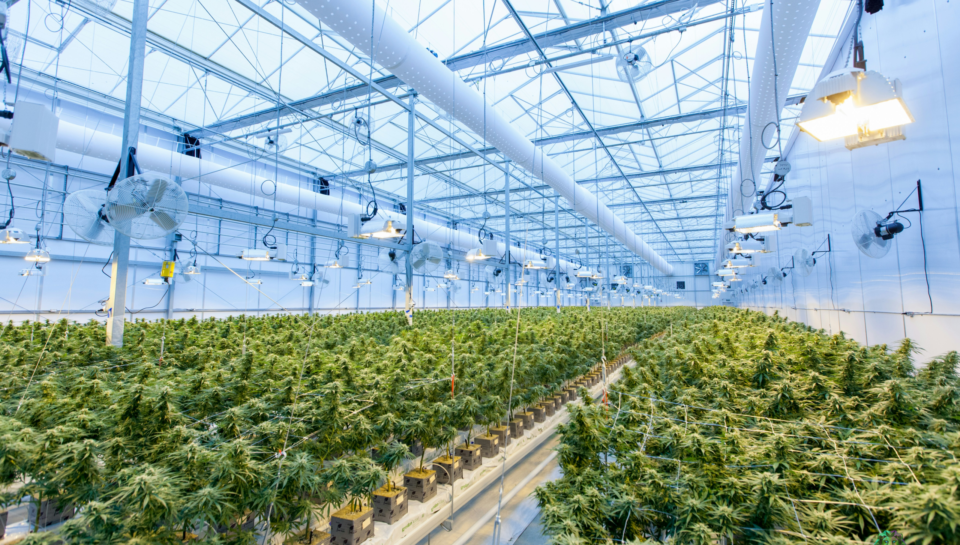
Cannabis is estimated to be the largest cash crop in California with a value of more than $11 billion. The state provided most of the cannabis consumed in the United States prior to legalization which was intended to provide a transition to legal, licensed growing. The California Environmental Quality Act (CEQA) requires a detailed analysis of the environmental impact of growers operations. Statewide, 208 growers had obtained regular, annual licenses by July 2019. At this point of some 18 months into legalization, 1,532 growers were still operating on provisional permits as they went through the CEQA process that requires extensive paperwork. Smaller farms were given five years to become established under legalization before larger growers were allowed to enter the market. Under the regulations set to expire in 2023, growers can have only one medium licence but there is no limit on the number of small licenses an individual grower can have. This loophole has allowed larger growers to operate.
Humboldt, Mendocino, and Trinity counties have long been known as Northern California's Emerald Triangle as it is estimated that 60 percent or more of all cannabis consumed in the United States is grown there. Registering and applying for permits has not been an easy decision for many long time growers in these three counties.
In Santa Barbara County, cannabis growing has taken over greenhouses that formerly grew flowers. In the first four months of legalization, the county had almost 800 permits issued for cultivators, the most of any county in the state.
Calaveras County registered more than seven hundred cultivators after county voters approved a tax in 2016.
Trespass grows
Unlicensed growing continues in remote rural areas and has expanded according to law enforcement reports. Raids and confiscation of illegal grow operations by law enforcement has continued and in some cases stepped up after legalization. Authorities are constantly dealing with illegal cultivation in remote protected areas such as state parks and national forests. Illegal grows are partially responsible for record levels of water thefts during the drought that began in 2020
So that is the legal state of affairs in California now, it sounds organized, rational, very liberal, organized and well thought out. Reality is very different.
‘Almost every county has banned cannabis growing within their county, as well as almost every city has refused to issue permits for cannabis dispensaries to operate in their cities. I know a grower through a friend of mine who has a 100 acre property in a very remote rural area of Northern California who operates an illegal grow. Actually he filed for a permit to grow, per the legislation stated above, then proceeded to plant thousands of Marijuana plants in his hundred acre farm. He also encroaches on all his neighbor’s land bordering on his. If no one complains or reports his illegal grow to the authorities he harvests the crop, sells to his customers in California and also smuggled some out of state to his other customers for more profit. For years he never got caught and made millions of dollars. Then his farm got raided, and the sheriff filed a report stated he had to destroy his crop and issued him a $40,000 fine for violating the county ordinance by growing more than 6 plants outside in an unlocked area. He waited until his crop was ready, harvested it, sold it all for over $2,000,000, then paid the $40,000 fine. The county got their money, the sheriff was happy to report their enforcement was successful and that the illegal grow was destroyed. Big win for everyone.
In my county, you are allowed to grow 6 plants, but again, people are greedy, and grow more than allowed, and they are lazy, and don’t lock up the area, or get a permit. so the sherif raids all the small personal illegal grows and confiscates the fully grown Marijuana and also fines the growers. In a fairly large town in the county there is the only legal Marijuana dispensary, both medical and recreational, owned and run by the sherriffs department. They don’t have a large farm where they grow Marijuana, which would be illegal, but they do have all the conviscated plants which they sieze from illegal growers and sell it in their dispensary. And the county gets all the fines levied on the illegal growers and the tax revenues from the dispensary sales. Everyone wins, except the small illegal growers. It’s all about the money. Sounds very corrupt to me. But that’s California politics for you.
born and raised in Southern Rhodesia, a British colony in Southern CentralAfrica.I lived in South Africa during the 1970’s, on the south coast,Natal .Emigrated to the U.S.A. In 1980, specifically The San Francisco Bay Area, California.
How does it work?
There are no comments for this story
Be the first to respond and start the conversation.
More stories from
Guy lynn and writers in History and other communities.
"white heart" seed beads—historically known as Cornaline d'Aleppo or Hudson’s Bay beads—feature an opaque white glass core encased in a translucent layer of colored glass, most commonly vibrant red. First produced in Venice and Murano in the late 17th century, they were originally made by drawing heated glass canes over a mandrel.
By
6 days ago in
History
Some great thinkers considered Atlantis a fictional island Plato had made up to teach philosophy, whilst others consider that he based it on a real place lost to history. There are even mentions of it in some CIA files. So, what is the truth about the mystical city that disappeared?
By Sam H Arnold7 days ago in History
I can no longer comment on your works. Vocal.media say I have been breaking the rules, but they not tell me what. I asked for an explantion. NOTHING. Sound like Medium.
By SAMURAI SAM: DOC NIRVANA > BYE BYE BYE💗💗 2 days ago in History
Breakfast in bed, because this is the only day you get that. Flowers and kids attacking you in bed at the crack of dawn. Kisses and hugs, that strangle the air out of your body. I hope all you moms out there got that this morning. The work you do is special and the most necessary career ever. No other career shapes the world and humanity like yours does. None.
By Alexandra Granta day ago in Humans
© 2026
Creatd, Inc. All Rights Reserved.