
News and Ideas Worth Sharing
Great Barrington — With the annual municipal election still more than a week away, residents at Saturday’s Town Meeting found themselves voting on multiple budget items whose funding hinges on the outcome of a Proposition 2½ override question on the May 12 ballot.
Proposition 2½ is a state statute that limits tax levy increases, and depending on the outcome of the ballot question on May 12, Great Barrington could become the first municipality in Berkshire County to implement the override.
During the nearly four-hour Town Meeting on Saturday, residents passed several funding articles contingent on the override’s approval:
During discussion of Article 13, State Rep. Leigh Davis (D – 3rd Berkshire District) moved to reduce the 16-1 line item from $43,000 to $23,000, citing a $20,000 grant she had secured.
Town Meeting attendees approved both Rep. Davis’ motion and Article 13.
Also during the meeting, residents approved the FY27 town assessment for Berkshire Hills Regional School District for $23,873,781, an increase of $1,664,233 from this fiscal year.
Throughout the meeting, however, an undercurrent of contention may have explained why the nearly four-hour session got through only 19 out of the 30 warrant articles.
The most contentious items involved funding to Southern Berkshire Ambulance Service (SBAS), funding 50 percent of two SBAS ambulances for $490,000, and approving $5,026,008 to fund various court judgements related to legal settlements concerning host community agreement impact fees with four marijuana dispensaries.
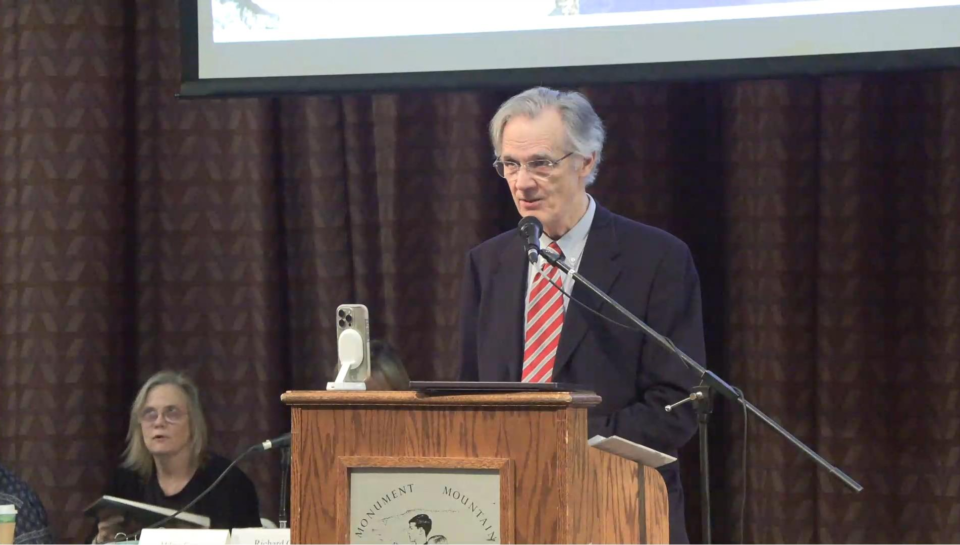
From the very beginning of the meeting, the auditorium at Monument Mountain Regional High School seemed rife with tension.
Article 1 asked residents to authorize payments from free cash to cover prior-year invoices totaling $52,542, including various Fire Department and Department of Public Works invoices.
Only 13 minutes into the meeting, resident Trevor Forbes spoke from the floor about his objections to the article. “You come to the town to get our authority to spend money,” Forbes told the Selectboard, Finance Committee, and other town officials seated in front of the auditorium. “We understand that. But you also have an obligation to give us the information that actually enables us to decide whether this money is being spent wisely or not. In looking at some of these articles, some of these amounts [in the articles] are considerably in excess of inflation and probably considerably in excess of people’s salaries going up over the next two years. I think that it’s an obligation on the town to tell us how these [budgetary] numbers came about.”
In response, Town Manager Liz Hartsgrove explained the intent of Article 1 but did not address other 29 articles on the warrant. “These are items [in Article One] that were from the previous fiscal year,” she said. “As your warrant explains, these are items that were unanticipated. While we had an absence in the Department of Public Works at the time, these were discovered after [we could close] out the fiscal year.”
The article eventually passed via a hand count vote of 202-2.
When Article 3 came up, which asked residents to approve the transfer of $1 million in free cash to fund “potential payment obligations for outstanding capital projects identified through an ongoing examination [an audit] of procurement procedures for those capital projects, including any associated costs necessary to resolve such obligations,” Forbes once again voiced concerns.
“We don’t know what this is for,” Forbes said. “This is a million dollars. It basically says, ‘Please appropriate and transfer the sum from free cash to establish a special reserve fund for potential outstanding capital obligations.’ What does all this mean? This could be used for things that matter. Where is the procurement proper policy? This gives the impression that we’re being hoodwinked into things we have no information on. No transparency, and above all, which should be a concern to everybody in this room and also the people on the stage, no accountability. We have to scrutinize everything on this budget. So I think this should be a no vote.”
Resident Michelle Loubert, who is also a member of the Finance Committee, asked residents to vote down the article. “I don’t think it’s right to go to the taxpayers and ask for a million dollars to cover the mistakes of our town government, and that’s what this is about,” she said. “The procurement audit is not done. The worst that’s going to happen if we have a no vote is we’ll have to come back to another meeting, and right now, I personally would not be comfortable voting. Yes, it’s bad enough. We’re increasing the taxes of our taxpayers for needs such as roads, bridges, safety, but to ask the taxpayers for a million dollars to forgive the errors of the town government, I cannot support.”
In response to residents’ critiques of Article 3, Town Manager Hartsgrove said, “It was discovered after I was here for less than a week that there was impropriety or questionable [practices] that required an audit.” (Hartsgrove was officially hired by the town in October.)
Hartsgrove did not elaborate on the nature of the questionable practices. “There is transparency being involved here,” she said. “As far as what we can tell you right now, the current amount that has been identified is $869,395. There will be a presentation before the town Selectboard on May 18 by the auditors regarding phase one, project one.”
Resident Peter Most made a motion to table the article. Most chairs the Zoning Board of Appeals and is a member of the Affordable Housing Trust. [Disclaimer: Most is a contributing columnist for The Berkshire Edge.] “As of right now, we have too little information to justify setting aside a million dollars,” he said. “By the town’s admission, the extent of these obligations is still undetermined.”
Most said that approving Article 3 would put funding for other articles listed in the warrant, including capital improvements and other items, at risk. He added that the town should first complete the audit before any decisions about appropriating funds can be made.
Eventually, by a majority hand count vote, residents approved Most’s motion to table a vote on Article 3.
After residents at Town Meeting approved Article 6, the proposed FY27 town budget, a motion was made to move up discussion of Article 27, which asked residents to approve appropriating $5,026,008 from free cash to fund the FY26 Court Judgements line item account deficit related to legal settlements concerning host community agreement impact fees with four marijuana dispensaries, including: $4,161,257 for Theory Wellness, $360,303 for Community Growth Partners Great Barrington Operations LLC (d/b/a Rebelle), $189,109 for Highminded LLC (d/b/a Farnsworth Fine Cannabis), and $315,338 for D2N2 (LLC d/b/a Calyx Berkshire Dispensary).
As per the Town Meeting Warrant:
The purpose of this article is to reconcile the town’s accounts so that the payments are formally recorded as coming from free cash. Approval of this article will formally shift the funds from the free cash account to the Court Judgements account, bringing the town into compliance with legal settlement requirements and ensuring accurate financial reporting. The payment amounts will not be added to the tax rate.
Once again, a line of residents came up to the microphone to critique the article, including Board of Health member Ruby Chang. “Did the Selectboard and town manager anticipate that this [lawsuit settlement] was going to happen?” she asked. “How is the new community impact study able to say that there was no impact? As we know, use of cannabinoids can cause prolonged injury to young adults over a long period, including a lifelong period of time. I’d like to know what kind of impact studies were done.”
In response, Selectboard Chair Steve Bannon said that the warrant article was placed on the agenda due to a court order. “Because the way [host community agreement impact fees were] viewed by the town was that we proactively could use this money, and many other towns also looked at it this way,” he said. “This money was not allowed to be used for free cash, and we couldn’t use this money for roads or bridges. The Cannabis Control Commission changed their view on this and said we would have to prove that there were negative effects and prove which businesses caused those negative effects. And this ended up in court, we settled to pay this back. But this money is not money that could be used for anything except for the effect of cannabis that were sold by our retail stores.”
This was not a satisfactory answer for resident Denise Forbes, who agreed with Chang. “Like Ruby said, there was no impact study done to find out what the impact was,” Forbes said. “The problem with HIPAA [Health Insurance Portability and Accountability Act] rules and laws is that you can’t go to the hospitals and ask them who came into the emergency room because they were strung out on marijuana. I can honestly tell you I know people who have been strung out because of buying [marijuana from] Theory Wellness. They purchased something that was supposed to be five grams or five millimeters, or whatever it is, of cannabis chewables, and they gave them 50 grams. It was somebody I know very closely who freaked out and had to go to the emergency room. Now these cases are not documented or no one knows how to obtain that information, so you can’t really figure out what the impact is.”
In response, Town Counsel David Doneski explained again that the purpose of the article is about reconciliation and accounting purposes.
Eventually, after a lengthy debate, the article passed by hand-count vote.
After two hours and 40 minutes, the meeting arrived on Article 14, asking residents to approve $327,777 from free cash to “support ambulance services” for the town, “with expenditure of such sum to be contingent upon execution of a contract for FY27 prior to May 1, 2026.”
The article does not specifically list SBAS as the town’s ambulance service.
Most, who is also on the board of SBAS, tried to make a motion to raise the allocated funds to $414,676 and for the article to specifically state that the funds go to SBAS.
“I’m going to rule that motion as out of scope,” Town Moderator Michael Wise, who presided over Town Meeting, told Most. “The warrant article lists the explicit limit not in excess of $327,777, and allowing a motion to exceed that amount exceeds the scope of the warrant.”
Most told Wise that, due to Wise’s ruling, SBAS would be seeking a Special Town Meeting to receive the additional funds and that members of SBAS were already collecting petition signatures from the audience to hold the meeting.
Most proceeded to make a second motion for the article to specifically state that the $327,777 in funds go directly to SBAS.
After attendees heard from SBAS Board of Directors President Jim Santos in support of the organization, Selectboard member Eric Gabriel spoke about the article and the current contract negotiations between SBAS and the town. “After several budget meetings, it became clear to us that we had significant budget line items going up,” Gabriel said. “We had our insurance and healthcare line items going up, and multiple things. For the past four years, the ambulance squad came before us with 30 to 40 percent increases.”
Gabriel said that the Selectboard asked Town Manager Hartsgrove to negotiate a contract between the town and SBAS. “I asked this budget to go forward with a seven-and-a-half percent increase [from FY26], matching it to our school system,” he said. “After four years of increases in the 30 to 40 percent categories, it just seemed like there needed to be a line drawn at a certain point here.”
Most said that the town and SBAS are negotiating for a three-year contract. “Once we have a Special Town Meeting, presumably that approves [the remaining funds], we can have the three-year contract,” he said. “But in regarding your disappointment that there has been increases over the last few years at high numbers, the issue has been the great cuts in Medicare and Medicaid [reimbursements]. We are a service that is a nonprofit that was reimbursed from the federal and state governments. We are asking the town to make up the difference [in the cuts].”
Eventually, Article 14 and Most’s motion to specifically identify SBAS as the recipient of funds passed by a hand-count vote.
The meeting went on to review Article 15: a citizen petition asking residents to approve $490,000 to SBAS “for the purpose of funding approximately fifty percent of the cost of two new ambulances currently on order.”
Most proceeded to make a motion to cut the requested funds to $240,000, explaining that the monies would “align with the three-year contract that [SBAS] is currently negotiating with the town.”
Finance Committee Vice Chair Melina Cerna asked whether the town would still be “on the hook” for the funds if the motion and article were approved but the town ultimately did not enter into a three-year contract.
In response, Santos said that if the organization and the town did not agree on a three-year contract, SBAS would be looking to sign a one-year contract with the town, with the possibility of working on a two-year extension.
When Cerna asked Santos how the contract negotiation was going, Santos said, “I would say that we’re pretty close to it. This is a process that started quite late and everybody was busy, but we’ve been going back and forth.”
“If I can interrupt a bit, I think that this is maybe the world’s worst place to negotiate a contract,” Wise interjected.
Eventually, Loubert told the audience she was uncomfortable with the article being approved without a formal contract between the town and SBAS. “I feel like by voting yes we’re tying the hands of our taxpayers,” she said. “We incur legal obligations to the ambulance squad, and we don’t have any contract.”
Most said in response that “the towns have known for a long time that the ambulances were going to be replaced and there’s an obligation to order the ambulances.” “The ambulances are on order, and they are coming,” he said. “We need the ambulances.”
“I would remind Mr. Most that, next year, if the DPW comes to us and says that they ordered an excavator and we have to approve it, we might not do that,” Bannon said. “So, you are a vendor. I love your tenacity, but I don’t think that’s the way it works. It’s a really good squad, but because you ordered something, it doesn’t mean we have to pay for it.”
Eventually, resident Karen Smith made a motion to table a vote on the article.
In response, Most said that the SBAS could not agree on a contract with the town if Article 15 was tabled.
“Again, Mr. Most is looking at the interests of the ambulance squad, which I appreciate,” Bannon said in response. “But we have to look at the interest of the town, and the ambulance squad, whatever ambulance squad we employ. The fact that you keep telling us that you ordered the ambulances is irrelevant. And the fact that you need a contract now is also irrelevant until we come to an agreement. And we haven’t had an agreement.”
Eventually, the motion to table the article was approved by a hand-count vote.
Around nearly three hours and 50 minutes into the meeting, residents yelled from the floor to adjourn the meeting after votes on 19 articles.
The meeting was adjourned after Selectboard member Garfield Reed made a formal motion.
The remaining warrant articles will be taken up at a continuation of the meeting on Monday, May 4, at 6 p.m.
But Not To Produce.
Continue reading
But Not To Produce.
The Edge is free to read. But not to produce. Consider joining the other members of your community and supporting The Berkshire Edge through paid membership.
©2026 The Berkshire Edge, LLC. All rights reserved. Read our Terms of Use | Website by Web Publisher PRO | Protected by Bot Shield