
Please Support Our Mission:
Please Support Our Mission:
InSight Crime
INVESTIGATION AND ANALYSIS OF ORGANIZED CRIME
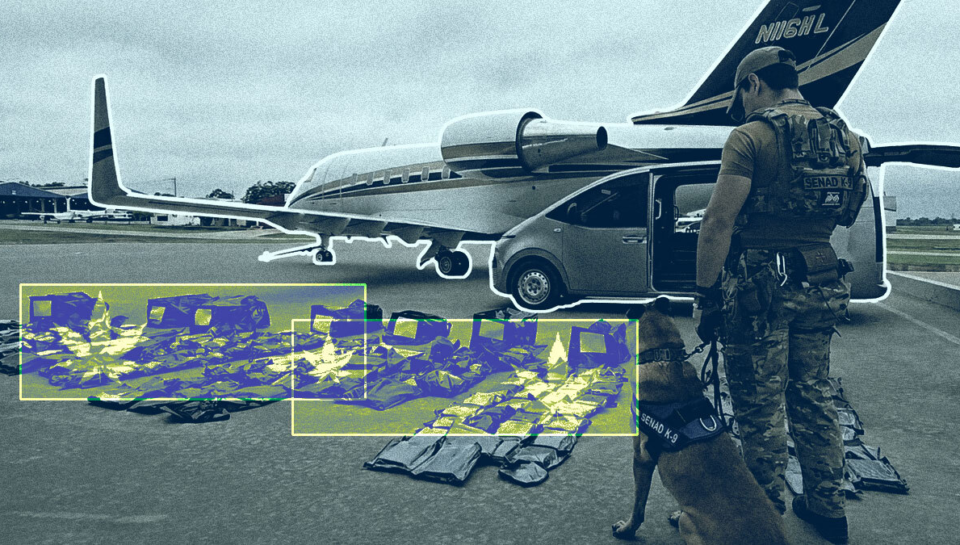
A private jet co-piloted by the winner of a MrBeast YouTube challenge was seized by Paraguayan authorities after more than 250 kilograms of premium marijuana were found on board, underscoring a little-noticed reversal in hemispheric trafficking patterns: Higher-value marijuana is now moving into South America from the North.
Paraguayan authorities found 261.6 kilograms of marijuana with a high-THC content valued at $3.6 million being unloaded from the private jet at Asuncion’s Silvio Pettirosi International Airport on May 29. Among those detained was 20-year-old influencer and co-pilot Jabari Stephen Brown. Known to his followers online as “Captain Treezy,” Brown rose to social media fame after winning a viral challenge hosted by MrBeast in late 2025, which awarded him a $2 million private jet.
According to the Paraguayan government, the aircraft departed from Miami and made a stop in Panama before arriving in Paraguay. Government investigators believe the marijuana was headed to Brazil, where demand for premium versions of the imported drug is increasingly eclipsing the low-cost compressed cannabis, known as prensado, that Paraguay has long supplied to regional markets. Paraguayan anti-drug prosecutor Ingrid Cubilla said the marijuana’s estimated value was driven by demand in the neighboring country, where each kilogram could fetch nearly $14,000 on the illicit market.
SEE ALSO: GameChangers 2025: The 10-Year Evolution of Latin America’s Booming Marijuana Market
Following news of the seizure, many social media users incorrectly conflated the aircraft involved as the same jet Brown had won from MrBeast. But Brown’s prize was a Hawker 400XP, while the aircraft seized in Paraguay was a Bombardier Challenger 604.
Authorities identified the second pilot and registered owner of the jet as Estonian citizen Keith Siilats, a co-founder of the now-defunct US micromobility startup Bolt Mobility. An arrest warrant has been issued for Siilats, said Cubilla, for international drug trafficking and unauthorized possession of narcotics.
Three other American passengers aboard the jet remain in Paraguayan custody.
Brown was briefly detained following the seizure, but investigators later determined there was no evidence he knew about the drugs on board. He was released on May 31, according to a representative of Paraguay’s drug enforcement agency.
The expansion of legal cannabis markets in the United States over the past decade has dramatically increased domestic cultivation capacity, reshaping the geography of the trade.
As legal production outpaced demand in many states, wholesale cannabis prices collapsed. The US Cannabis Spot Index stood at $1,056 per pound in May 2026, after years of steep price compression driven by chronic oversupply. Between 2021 and 2023, wholesale prices fell sharply as cultivators continued to expand output despite slowing market growth. Some of that excess production, particularly from California and Florida—home to the country’s largest medical cannabis market—has increasingly been diverted into illicit markets in South America, Central America, Mexico, and the Caribbean.
Paraguay, for instance, has historically been South America’s leading marijuana exporter, but its trade has centered on low-potency, compressed cannabis bricks that sell for about $150 per kilogram wholesale. High-potency marijuana imported from the United States can command prices approaching 100 times that amount. And Paraguayan authorities have reported a string of seizures involving high-THC cannabis arriving from the US, including a notable interception in December 2025.
SEE ALSO: Corruption Looms Over Record Marijuana Seizure in Paraguay
The latest case fits an increasingly familiar trafficking pattern: aircraft departing from logistics hubs in Florida land either at Asunción’s Silvio Pettirossi International Airport or at clandestine airstrips in border departments such as Amambay and Canindeyú. From there, the cannabis is moved overland through porous crossings near Ciudad del Este and Pedro Juan Caballero before entering consumer markets in southern Brazil.
“Historically this was not a frequent method; however, in recent years a number of cases have been observed involving the entry of high-potency marijuana varieties from the United States,” a Paraguay SENAD officer said in a statement. “What is notable in this case is the use of a large executive aircraft—an unusual method among seizures recorded in the country.”
The shift may also be creating new opportunities for the Brazilian First Capital Command (PCC) and Red Command (CV), both recently designated as Foreign Terrorist Organizations by the US. Both groups have historically controlled large segments of the trade in Paraguayan-produced marijuana and could be moving up the supply chain to broker imported US products.
Besides Paraguay, seizures of American-grown cannabis have been recorded in Bolivia, Mexico, the Dominican Republic, and other areas of the Caribbean. Panamanian authorities are also conducting their own investigation into the aircraft’s stopover.
Though the reversal of the South-North drug flow to sell American cannabis is increasing, the trade remains in early stages as exports have involved relatively modest quantities, often transported through methods adapted from cocaine trafficking networks, including concealment on commercial flights and the use of compressed or disguised products.
Graphic: Illustration created from images provided by Paraguay’s National Anti-Drug Secretariat (Secretaría Nacional Antidrogas – Senad) depicting the seizure of a private jet carrying more than 250 kilograms of cannabis, Asunción, May 29, 2026.
Subscribe to our newsletter to receive a weekly digest of the latest organized crime news and stay up-to-date on major events, trends, and criminal dynamics from across the region.
Donate today to empower research and analysis about organized crime in Latin America and the Caribbean, from the ground up.
We go into the field to interview, report, and investigate. We then verify, write, and edit, providing the tools to generate real impact.
Our work is costly and high risk. Please support our mission investigating organized crime.
Sponsored by
Member of
Join our network of thought leaders, decision makers, and change drivers taking on organized crime in Latin America by subscribing to our free weekly newsletter.
Únase a nuestra red de líderes de opinión, tomadores de decisiones y agentes de cambio que enfrentan el crimen organizado en América Latina suscribiéndose a nuestro boletín semanal gratuito.
Get investigations and analytical deep dives from the region’s most trusted source on organized crime delivered straight to your inbox every week.
Reciba investigaciones y análisis en profundidad, directamente en su correo, de la fuente más confiable de la región sobre crimen organizado.
Sign in by entering the code we sent to , or clicking the magic link in the email.
Refund Policy. This site is protected by reCAPTCHA and the Google Privacy Policy and Terms of Service apply.
At InSight Crime, we use cookies to understand how readers engage with our content, and to improve what we publish. We never use this data to sell your information. You can accept or decline at any time. If you say no, some features may be limited.