White House Raises Alarm About ‘High-Potency’ Marijuana And Its Marketing In New National Drug Strategy
Alcohol Industry Group Calls Out Congress For Failing To Address Hemp THC Product Ban In Farm Bill
New York Officials Are Now Accepting Applications For Marijuana Farmers’ Markets And Pop-Up Events
Bipartisan Senators React To Trump’s Marijuana Move, With A GOP Lawmaker Saying Her Friends Use It Medically
Pennsylvania GOP Governor Candidate Promises To Veto Marijuana Legalization If Lawmakers Passed It
Medical Marijuana Can Be A ‘Profoundly Helpful Tool’ For Seniors Dealing With Pain And Other Maladies (Op-Ed)
There’s ‘Strong Public Demand’ For Bigger Marijuana Reform Than Trump’s Rescheduling Move, Federally Funded Study Shows
Chinese Researchers Reveal Ancient Use Of Cannabis As ‘Indispensable’ Crop That Was ‘Deeply Integrated’ Into Daily Life
Teen Marijuana Use Is Lower Now Than Before Legalization, Government Study From Minnesota Officials Shows
Medical Marijuana Helps People Stop Using Opioids, Sleeping Aids And Other Prescription Drugs, Study Shows
Politicians And Major Brands Celebrate Cannabis Culture On 4/20
Woody Harrelson And Bill Maher Complain That Marijuana Taxes Are Too High While Smoking Joints At The Dispensary They Own Together
WNBA Offers To End Marijuana Testing For Women’s Basketball Players As Part Of Reported Deal With Union
DEA Promotes Anti-Marijuana PSA Contest Inviting Students To Warn Peers About THC Dangers On 4/20
Largest Entertainment Arena In US Partners With Cannabis Businesses To Sell THC Drinks At Concerts And Live Events
Target Expands Involvement In Hemp THC Drinks Market With 72 New Licenses In Minnesota
Marijuana Sales Are Rising And Alcohol Is On The Decline As Consumer Preferences Evolve, Government Data In Canada Shows
Feds Deny Snoop Dogg Request To Trademark ‘Smoke Weed Everyday’ Because Marijuana Is Illegal And Song Lyric Is Too Popular
Marijuana Kiosks For Seniors Are Coming To Independent Living Communities Across Arizona
Montana Retailers Have Sold More Than $1 Billion Worth Of Recreational Marijuana Since Legalization Took Effect
DEA clarifies synthetic cannabis component is illegal (Newsletter: May 4, 2026)
DOJ rethinks cannabis & gun prosecutions (Newsletter: May 1, 2026)
GOP lawmakers still trying to block cannabis rescheduling despite Trump (Newsletter: April 30, 2026)
Hemp amendments stall in Congress, for now (Newsletter: April 29, 2026)
Cannabis businesses can apply for federal protections with DEA this week (Newsletter: April 28, 2026)
Published
on
By
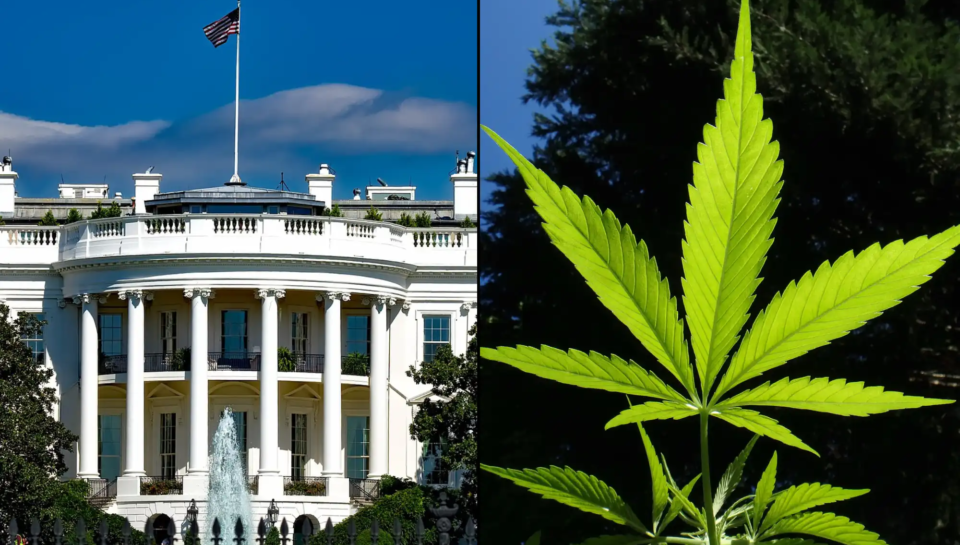
The White House released a new National Drug Control Strategy on Monday that raises alarm about “high-potency” marijuana and expresses concerns that international cartels and crime groups “exploit” state cannabis legalization laws. It also discusses the forthcoming federal recriminalization of hemp THC products that is scheduled for later this year under a law signed by President Donald Trump.
While the publication of the new 195-page document from the White House Office of National Drug Control Policy (ONDCP) comes just weeks after the Trump administration announced it is moving forward with a plan to reschedule marijuana under federal law, it makes no mention of that reform.
Instead, its sections on cannabis focus largely on concerns about its health effects and marketing as more states enact legalization.
“The commercial marketing of addictive substances poses a major threat to youth health. Legal does not mean safe, and industries selling nicotine, alcohol, marijuana, and psychedelics have adopted strategies similar to Big Tobacco’s historical targeting of young audiences,” the ONDCP strategy says.
“The commercialization of marijuana plays a role in the normalization of use, increases access to it, and decreases perception of risk of harm among youth,” it says. “Marijuana products are today of unprecedented high potency, are often highly processed, aggressively advertised, and often packaged to appeal to minors.”
The White House document also says that “convergent evidence from multiple sources suggests that cannabis exposure increases the risk of psychosis, and the prevention of marijuana use could serve to reduce the prevalence of psychosis, in addition to reducing cannabis use disorder and other consequences.”
It additionally talks about “young adults, bright with potential, whose futures were stolen by drug-induced psychosis and suicide linked to high-potency marijuana.”
“The varying legal status of marijuana across the United States notwithstanding, it remains a fact that there are Americans who are suffering from addiction and side effects of marijuana and its associated products such as psychoactive derivatives of hemp or other high-THC products, and they deserve help. People with marijuana addiction may not recognize that withdrawal may cause insomnia and anxiety, rather than the drug being an effective means to treat such symptoms. Cannabis-induced psychosis, if diagnosed and addressed early, may mitigate the potential impact on progression towards schizophrenia or other severe mental illness. Cannabis hyperemesis syndrome, also known as scromiting, due to the associated screaming and vomiting, is a common condition association with long-term marijuana use and addiction and warrants an evidence-based approach. Much like stimulants and other drugs, there are currently no FDA-approved medications for marijuana addiction or withdrawal. However, help is available for those who want it, and treatment and cessation tools for marijuana addiction must be made more widely available.”
“While all drugs carry some level of risk, marijuana has the highest conversion rate from psychosis to schizophrenia and bipolar disorder,” Trump’s ONDCP claims. “Drug use is also associated with suicide, and the number one drug found in toxicology reports of people who died from suicide under the age of 25 in Colorado and San Diego was marijuana, more than alcohol or any other drug.”
“It is important to make consumers aware of the health risks associated with marijuana use, which include harms to heart health, cognition, and cancer. In one California study, from 2005 to 2019, cannabis-associated diagnosis in emergency department visits went up 1,800% for seniors over age 65. Marijuana use can be associated with exposure to heavy metals and pesticides that can accumulate in the plant through a process known as bioaccumulation. Further, research indicates that marijuana can contain fungal pathogens that cause serious and often fatal infections in persons with immunocompromising conditions, such as cancer, transplant, or infection with HIV.”
The document notes that “the rate of marijuana smoking in the United States has surpassed tobacco use” and that “marijuana addiction, or cannabis use disorder, affected 20.6 million, or 7.1 percent, of Americans over the age of 12 in 2024, and is the number one stated reason for addiction treatment for those under the age of 20.”
“According to the 2024 National Survey on Drug Use and Health (NSDUH), in 2024, for the first time ever, the number of Americans experiencing a drug use disorder surpassed the number experiencing an alcohol use disorder. This shift has been driven principally by increasing rates of marijuana use and addiction. We must ensure that we have the tools for Americans who want help with marijuana addiction and withdrawals.”
Even though Trump endorsed a marijuana legalization initiative that appeared on Florida’s ballot in 2024, the administration document raises alarm about transnational criminal organizations and domestic gangs that “transport, store, and sell illicit drugs in American communities, including the interstate distribution of illicit marijuana from states with legal markets.”
Of particular concern are Chinese-linked groups that “exploit state-level marijuana laws to establish large-scale illicit cultivation and interstate distribution networks,” ONDCP said.
“The marijuana trade in the United States is no longer a scattered, low-level problem; it has been coopted and industrialized by sophisticated, transnational criminal organizations, particularly those with ties to China. These groups systematically exploit states where marijuana has been legalized under state law, leveraging these markets and lax regulations to establish massive, unlicensed cultivation operations. A stark illustration of this is Oklahoma, where law enforcement estimates that Chinese criminal groups run more than 80% of the state’s thousands of marijuana and hemp farms. The scale is staggering: in 2023, the state’s marijuana production exceeded its entire licensed medical demand by at least 32 times, with an estimated 85.5 million plants unaccounted for. This massive overproduction is not for local consumption; it is clear evidence of a coordinated criminal enterprise dedicated to trafficking marijuana across state lines to supply the nation’s black market. These operations are not just agricultural; they are hubs of poly-crime involving human trafficking of exploited laborers, sophisticated money laundering, and the use of dangerous, unregistered pesticides that threaten public health and the environment.”
President Trump continues to DELIVER for the American people. @ONDCP and @DrugCzar47 just released the National Drug Control Strategy.
This is not just a document, it follows through on the President’s promise to America. PROMISES MADE, PROMISES KEPT by @POTUS.…
— ONDCP (@ONDCP) May 4, 2026
The White House drug strategy also discusses hemp products at length.
Hemp derivatives with less than 0.3 percent delta-9 THC on a dry-weight basis were federally legalized under the 2018 Farm Bill that Trump signed during his first term in office. But late last year, the president signed new legislation containing provisions that will redefine hemp to make it so only products with 0.4 milligrams of total THC per container will remain legal after November 12.
“The Administration has been granted new legal authority to address certain psychoactive hemp-derived cannabidiol substances thanks to the ‘hemp loophole closure’ passed as part of the Agriculture, Rural Development, Food and Drug Administration, and Related Agencies Act funding bill for fiscal year (FY) 2026,” the ONDCP document says, “Shutting down these domestic sources of harmful substances is crucial to degrading the overall availability of illicit drugs within our communities.”
“Psychoactive derivatives of hemp are a growing concern. Although the hemp plant naturally contains small amounts of cannabinoids such as delta-8 THC, delta-10 THC, THC-O-acetate, THCP, and other THC analogues, they are often produced in laboratories; and since the passage of the 2018 Farm Bill, products containing them have proliferated. Any final hemp-derived cannabinoid product containing these chemicals will be considered a Schedule I controlled substance under the Hemp Restriction regulations that are scheduled to take effect in November 2026. These products are often sold in smoke shops and gas stations, are not regulated, and can contain dangerous chemicals or psychoactive substances. When found in marketed products, these compounds are synthetic, not naturally occurring, have not been evaluated for safety in animals or humans, and have been linked to cases of psychosis and suicide attempts. In many cases, cannabinoids are considered to be Schedule I drugs under the international conventions, and some states have already banned these potentially dangerous products.”
It says that law enforcement will “intensify efforts to prosecute the illicit production and distribution of dangerous substances originating within the United States”—including “targeting retail operations, such as vape and smoke shops, that unlawfully market harmful products, particularly to minors.”
While Trump recently called on Congress to take action to alter the hemp cannabinoid ban language he signed into law in order to allow continued sales of full-spectrum CBD products, it’s not clear how far he wants to scale back the scope of the scheduled federal restrictions and what kinds of revised THC rules and limitations he would prefer to sign into law.
Meanwhile, ONDCP says the administration will “work to improve drug testing in clinical settings,” noting that “currently utilized hospital tests do not detect nitazenes, psilocybin, or psychoactive hemp products such as delta-8 THC, and may not detect all fentanyl analogs.”
ONDCP Director Sara Carter Bailey has previously voiced support for medical cannabis, while stating that she doesn’t have a “problem” with legalization, even if she might not personally agree with the policy.
“I don’t have any problem if it’s legalized and it’s monitored,” she said in 2024. “I mean, I may have my own issues of how I feel about that, but I do believe that cannabis for medicinal purposes and medical reasons is a fantastic way of handling—especially for people with cancer and other illnesses, you know—of handling the illness and the side effects of the medication and those illnesses. So I’m not saying we’ve gotta make it illegal.”
Tom Angell is the editor of Marijuana Moment. A 25-year veteran in the cannabis and drug law reform movement, he covers the policy, politics, science and culture of marijuana, psychedelics and other substances. He previously reported for Forbes, Marijuana.com and MassRoots, and was given the Hunter S. Thompson Media Award by NORML and has been named Journalist of the Year by Americans for Safe Access. As an activist, Tom founded the nonprofit Marijuana Majority and handled media relations, campaigns and lobbying for Law Enforcement Against Prohibition and Students for Sensible Drug Policy.
Add Marijuana Moment as a preferred source on Google.
All the cannabis news you need, all in one place. Copyright © 2017-2026 Marijuana Moment LLC ® and Tom Angell